
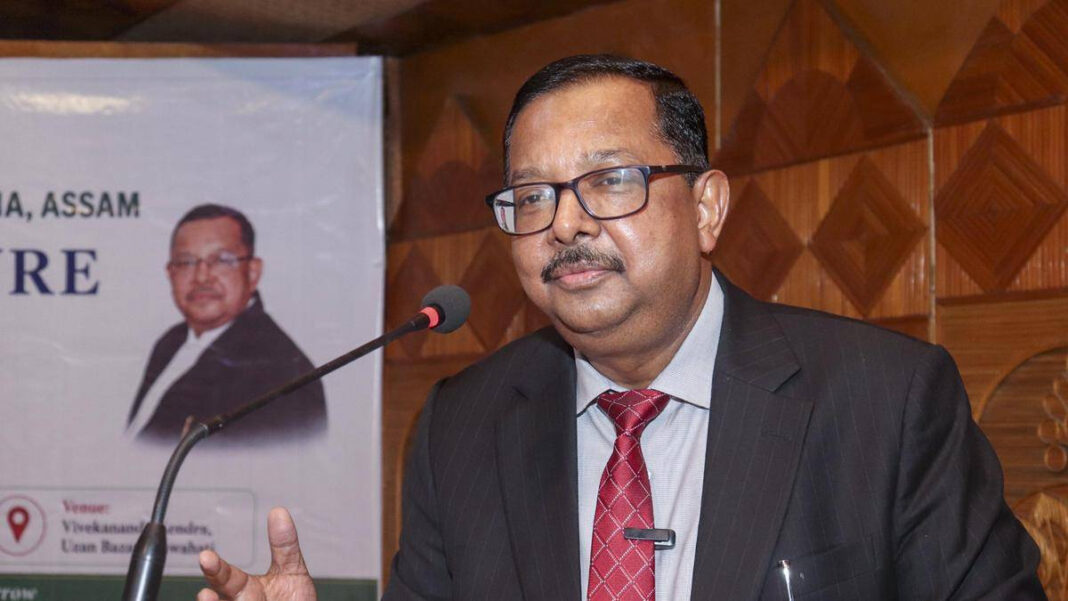

Process disenfranchising millions, turning them into second-class citizens is arbitrary, says Justice Bhuyan
Supreme Court judge Justice Ujjal Bhuyan on Sunday warned that any process that disenfranchises millions of citizens and renders them second-class in their own country by depriving them of the right to vote is intrinsically arbitrary and unconstitutional. Speaking at NALSAR University of Law in Hyderabad on October 4, 2026, he said such actions offend universal adult suffrage and the right to equality under the Constitution.
‘No whataboutery can justify mass exclusion’
Addressing students and faculty, Justice Bhuyan said there is no constitutional basis for creating two classes of citizens—those with voting rights and those without. “Any process which leads to wholesale disenfranchisement of Indian citizens making them citizens without voting rights would be violative of Articles 326 (adult suffrage) and 14 (right to equality) of the Constitution,” he said. “If any process results in disenfranchising millions and millions of Indian citizens making them second class citizens in their own country in the sense of being citizens without voting rights, such a process is intrinsically arbitrary. No amount of whataboutery can justify it. It strikes at the very heart of the Constitution.”
Emphasising the centrality of the vote to Indian democracy, Justice Bhuyan added: “No one could tinker with universal adult suffrage. No authority can do it; no court can condone it. No one is above the Constitution. Indian citizens’ right to vote is intertwined with India’s long years of struggle for freedom.”
Agitations over voter deletions
Justice Bhuyan’s remarks come amid continuing student and youth protests demanding the resignation of Chief Election Commissioner Gyanesh Kumar. The agitation has intensified following the Election Commission’s Special Intensive Revision (SIR), which has so far led to the deletion of approximately 13.3 crore voters from the electoral rolls, according to figures cited in the public discourse around the process.
Right to vote as a constitutional guarantee
Arguing that the franchise is foundational to citizenship, Justice Bhuyan said the right to be a voter is not merely a statutory entitlement but a constitutional right, falling within the framework of the Constitution’s Basic Structure. “Citizenship and franchise are intertwined, and one cannot be divorced from the other. The right of franchise is the very essence of citizenship. It is the only way an ordinary citizen of India can participate in the governance of the country,” he said.
He further underscored procedural safeguards around the electoral rolls: “Except in the case of a dead voter, the name of a voter once enlisted in the electoral roll cannot be deleted without notice and hearing.”
Historical lessons and constitutional vision
Justice Bhuyan traced the evolution of suffrage in India, recalling how the Government of India Act, 1935 imposed “partial franchise” on Indian subjects under the British Crown. Under that regime, voting rights in the Part A States were based on restrictive qualifications such as residence, taxation, property, literacy, community and, for women, marital status—factors that together enfranchised only about 14% of the population.
The Constituent Assembly rejected these restrictions as arbitrary and retrograde, he noted, embracing universal adult suffrage in recognition of the wisdom and pragmatism of ordinary Indians. “One may be a billionaire, and one may be a rickshaw puller; yet both will have their votes, and the value of their votes would be equal. Likewise a socially high placed temple priest on the one hand and a person belonging to the lowest strata of the society compelled to work as a manual scavenger have an equal vote with equal value. This is the transformational vision of the Indian Constitution,” he said.
Other judicial voices raise alarms
Justice Bhuyan’s intervention follows recent remarks by former Supreme Court judge Rohinton F. Nariman, who highlighted what he called an “astounding figure” of 90 lakh disenfranchised voters in West Bengal alone. He questioned why the Supreme Court had not stayed the Special Intensive Revision process in light of the scale of deletions and criticised the exclusion of voters and delays in deciding their appeals as “a completely illegal knocking out of the common man, the citizen of India, in order that a government obtains what it wants.”
Implications for electoral integrity
Justice Bhuyan’s comments add significant constitutional weight to growing concerns about mass deletions from the electoral rolls and the procedures by which they are being carried out. By framing the right to vote as a constitutional guarantee embedded in the Basic Structure, his remarks raise the stakes for ensuring due process, transparency and accountability in any revision of electoral rolls, with the warning that wholesale disenfranchisement would be fatal to the constitutional scheme.
As protests continue and legal scrutiny intensifies, the debate over the conduct and consequences of the Special Intensive Revision is likely to sharpen, focusing on the balance between maintaining accurate rolls and upholding the non-negotiable principle of universal adult suffrage.