
Interest in Gandhian Studies dwindles in many State universities in Karnataka
Academic activity at several centres dedicated to Gandhian thought across Karnataka’s State-run universities has slowed dramatically, with courses suspended or scaled back amid dwindling student interest, funding constraints and staffing shortfalls. While a handful of institutions report steady enrolments, the overall picture points to a steep decline in uptake for programmes focused on Mahatma Gandhi’s philosophy and its contemporary relevance.
At Bangalore University, courses halted and activity stalled
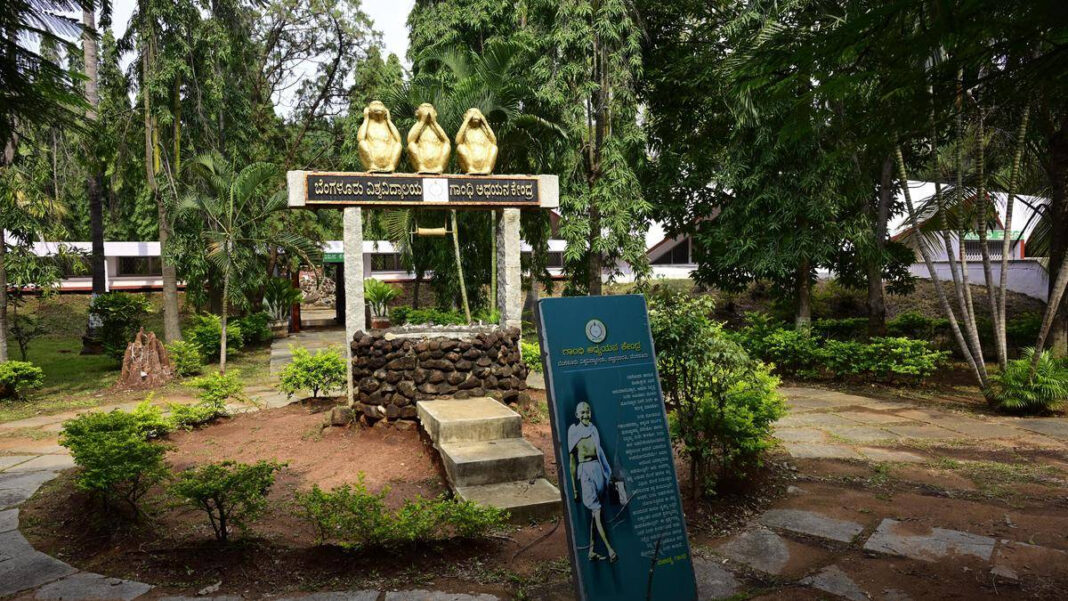
The Centre for Gandhian Studies on Bangalore University’s Jnanabharathi campus has effectively come to a halt, with the university discontinuing its diploma and certificate courses about five years ago after enrolments fell sharply. The centre, which once offered a one-year diploma and a six-month certificate in Gandhian Thought, has struggled to attract students in recent years.
Founded with high hopes—the foundation stone was laid by former President of India Dr. Sarvepalli Radhakrishnan on December 8, 1965—the centre has faced not only low enrolment but also allegations that some students were using admission primarily to secure hostel accommodation and other university benefits rather than for academic pursuit.
“Conducting classes became difficult, leading to the discontinuation of the courses during the tenure of the Centre’s previous director,” said B.N. Shreekeerthi, the current director. He cited lack of funds as another major factor affecting the centre’s activities. “While we portray Gandhiji as a historical figure, we fail to put his principles and ideology into actual practice in the present context. This has been a major setback in attracting the youth to Gandhian thought,” he added.
Despite the setbacks, efforts are afoot to revive academic offerings. Shreekeerthi said steps are being taken to launch a diploma course in Gandhian Philosophy and Contemporary Leadership at Dr. Manmohan Singh Bengaluru City University. “Our Centre is also planning to introduce diploma courses,” he said.
Faculty and enrolment challenges at Karnatak University
A similar downturn is visible at Karnatak University, where the Department of Gandhian Studies—established in 1976 and once noted for producing distinguished alumni—no longer has a permanent faculty member. The Dean of Social Sciences currently heads the department in the absence of a full-time chair.
The department continues to offer a postgraduate (PG) diploma and an Open Elective Course (OEC), with classes handled by adjunct professor Shivanand Shettar, who retired as chairman a few years ago, and long-serving guest faculty member Siddu Bashetti. However, capacity and demand have both fallen: the department’s intake has been reduced from 60 to 20, and admissions to the PG diploma have dropped to five this year from 10 last year. By contrast, the OEC has drawn 47 students from various departments.
“It is not just Gandhian Studies. Most departments offering PG diploma courses have witnessed low admissions over the last three years,” said Bashetti, who has taught in the department as guest faculty for 21 years. He pointed to an increase in fees as one deterrent. “Earlier, the fee was just ₹570 as concessions were offered. But now students have to pay over ₹10,000, while those from outside the university have to pay ₹15,000.”
Bashetti also attributed the fall in interest to the opening of PG centres in colleges and a growing student focus on competitive examinations, which he said has shifted academic priorities.
A contrasting picture at the University of Mysore
In contrast to the struggles at Bengaluru and Dharwad, the University of Mysore (UoM) continues to attract students to its Gandhian Studies programmes, even after the university’s jurisdiction was restricted to Mysuru district following bifurcation.
Gandhi Bhavan, which houses the Centre for Gandhian Studies at UoM, reports that a majority of its students come from rural backgrounds and often aspire to work in rural development and the NGO sector. The centre offers an MA in Peace and Conflict Resolution, a Diploma in Gandhian Studies, and a doctoral programme in Gandhian Studies.
Gandhi Bhavan Director Prof. Narendra Kumar said the MA course currently has 17 students against an intake of 25, while all 19 seats in the diploma course have been filled. The centre also supports nine research scholars on fellowships, with three additional scholars pursuing research without fellowships. “Though we are short of students for the MA course, enrolment is reasonably good as there has been a drop in student strength on the campus following the bifurcation of the university,” he said.
Prof. Kumar added that the university had previously requested the State government to consider Gandhi Bhavan students for employment opportunities in departments such as Rural Development and Panchayat Raj and Women and Child Development, indicating a push to create clearer career pathways for graduates in the field.
Fees, focus and future pathways
Across institutions, faculty members and administrators point to converging reasons for the decline in interest: higher fees compared to earlier years; the proliferation of PG centres offering alternative programmes closer to students’ homes; and a noticeable shift among students towards preparing for competitive examinations and job-oriented courses.
At the same time, centres that have aligned Gandhian thought with contemporary fields—such as peace studies, conflict resolution, rural development and NGO work—appear to be weathering the downturn better, as seen at the University of Mysore.
Outlook
While the landscape for Gandhian Studies in Karnataka is uneven, planned diploma offerings at Bengaluru City University and proposed courses at Bangalore University’s Centre for Gandhian Studies suggest efforts are under way to reinvigorate interest. University leaders argue that linking Gandhian principles to present-day governance, development and social-sector roles—and ensuring affordability—could be key to drawing a new generation of students to the discipline.
For now, however, the decline in enrolments, the absence of permanent faculty in some departments and funding constraints remain significant hurdles for many State universities seeking to keep Gandhian Studies active and relevant.