
 "
/>
"
/>

Malayalam Movie ‘Izhakalkkappuram’ Calls for a Critical Approach to Gandhian Ideals
In a thought-provoking exploration of Gandhian philosophy, Venu Nair’s film Izhakalkkappuram prompts audiences to reconsider the relevance of Mahatma Gandhi’s ideals in contemporary society. Released in theaters on October 2, coinciding with Gandhi Jayanthi, the film has been characterized as a ‘philosophical chamber drama’ that delves deep into the ideological conflicts between a father and his daughter.
Background and Overview
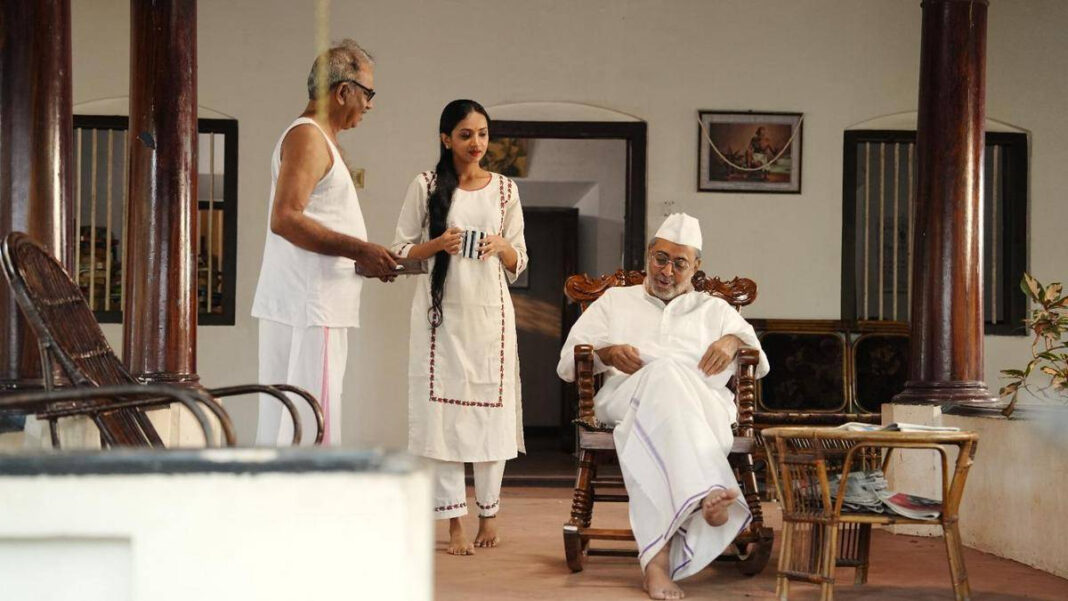
The narrative centers on Anand Sivan, played by Dinesh Paniker, a retired academic who holds strong beliefs in Gandhian principles, and his progressive daughter Karthi, portrayed by Gautami, a documentary filmmaker eager to interrogate those very ideals. The film’s premise unfolds as Karthi embarks on a project to create a documentary about Mahatma Gandhi, which ignites a series of discussions between her and her father. These conversations rapidly evolve into a contentious examination of Gandhi’s philosophy, the relevance of his teachings to modern life, and the socio-political context of their current era.
Detailed Explanation of the Film’s Themes
The juxtaposition of Anand’s traditional viewpoints and Karthi’s critical perspective serves as the film’s core conflict. As the father-daughter duo engages in discussions about their nation’s past and present, tensions rise. Anand becomes defensive when Karthi challenges his long-held beliefs, occasionally retreating into silence when confronted with perspectives that contradict his passionate convictions. Their dialogues, while deeply personal, resonate with broader societal questions regarding the adherence to historical ideologies and the need for critical assessment.
Acting as a mediator in their evolving relationship is Jagadeesh, Anand’s confidant. His presence provides a dual function; he represents the traditional perspective yet remains a voice of reason, often bridging the generation gap between the ideological views held by Anand and Karthi.
Key Developments in the Film
A notable theme of Izhakalkkappuram is the idea that ideals, including those of Gandhism, should serve humanity rather than the reverse, where human lives and freedoms are sacrificed for the sake of upholding those ideals. This critical approach to Gandhism encourages viewers not to simply accept or dismiss Gandhian tenets, fostering a dialogue that urges reflection on their application in today’s world.
Context of the Filmmaker’s Vision
Venu Nair, the film’s director, writer, and producer, brings over three decades of experience in filmmaking to this project. He has previously been recognized for his work on award-winning feature films and documentaries, including Jalasamadhi and Raja Ravi Varma: The Father of Modern India Art. In Izhakalkkappuram, he takes on multiple roles, from handling music and sound design to overseeing the film’s technical aspects, with Pushpan Divakaran serving as Director of Photography and Pradeep Chandran as editor.
Footprints of the Film’s Production
The film’s setting in an ancestral home adds to its introspective atmosphere, highlighting the personal and historical layers entwined in its narrative. With the complexities of both personal relationships and national identity intertwining, Izhakalkkappuram aims to challenge viewers to reflect on the ongoing relevance of Gandhian philosophy amid societal changes.
Reactions and Expectations
As the film is poised to stir conversations around its central themes, audience responses will likely shape the discourse around Gandhian concepts and their implications for modern realities. Nair’s intent to bridge historical teachings with present-day challenges underscores the film’s ambition to contribute to an ongoing dialogue regarding philosophy and practice.
Conclusion
With Izhakalkkappuram, Venu Nair invites a re-examination of Gandhian ideals, advocating for a nuanced understanding rather than a rigid adherence to dogma. The film not only examines the ideologies of the past but challenges contemporary society to reflect on how these ideals can be beneficially interpreted and applied in today’s world. As audiences engage with the complex relationship dynamics presented in the film, they may find themselves contemplating the larger implications of Gandhi’s legacy within their own lives.