
The 1981 byelection that triggered twists and turns in Tamil Nadu politics
Tamil Nadu is once again in the throes of bypoll politics. On October 6, voters in Madurantakam in the north and Dharapuram in the west will pick new representatives to the State Assembly. With five more constituencies vacant, another round of bypolls is likely once legal issues are settled. Meanwhile, the Madras High Court is hearing a challenge to the razor-thin result in the Tirupattur Assembly constituency, where the ruling Tamilaga Vettri Kazhagam (TVK) candidate R. Seenivasa Sethupathy was declared elected by a single vote.
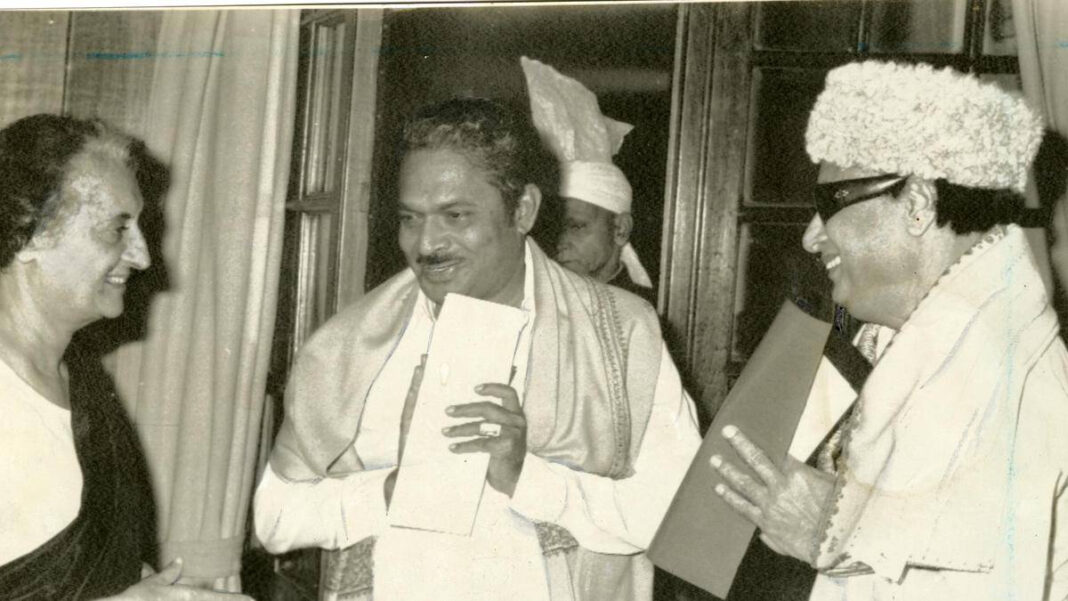
Four decades ago, Tirupattur itself became the epicentre of a by-election that reverberated far beyond its borders. The November 1981 contest there reshaped political equations in Tamil Nadu, marked a sharp turn in relations between Chief Minister M.G. Ramachandran (MGR) and Prime Minister Indira Gandhi, and foreshadowed the alliances that would define the State’s politics for years.
How a vacancy set the stage
The Tirupattur seat fell vacant after the death in December 1980 of V. Valmiki, a Congress (Indira) MLA from Karaikudi. At the time, the Congress (I), Dravida Munnetra Kazhagam (DMK), and the Muslim League had contested together, while the All India Anna Dravida Munnetra Kazhagam (AIADMK) led a sprawling 11-party coalition. That front included the Communist Party of India (CPI), the CPI (Marxist), Gandhi-Kamaraj National Congress (GKNC), Tamil Nadu Kamaraj Congress (TNKC), All India Forward Bloc (AIFB), Congress (Urs), and the Lok Dal, as well as smaller outfits such as the Tamil Nadu Muslim League, All India Muslim League, Republican Party (Gavai), and the Working People’s Council.
Defying expectations, the AIADMK swept back to power in the June 1980 Assembly elections. MGR’s party secured 129 seats on its own; its allies added 33, ensuring a comfortable second term for the Chief Minister.
Fractured ties after Thanjavur
MGR’s second innings began amid tension with Prime Minister Indira Gandhi, who felt let down by him in the run-up to the Thanjavur Lok Sabha bypoll in June 1979. Then in Opposition, Gandhi was eager to return to Parliament after her December 1978 expulsion from the Lok Sabha. In May 1979, the AIADMK announced an alliance with the Congress (I), which was preparing to field Gandhi from Thanjavur.
But MGR cooled to the idea of Gandhi contesting there. The Congress (I) eventually fielded S. Singaravadivel, who won the Thanjavur seat on June 18, 1979, defeating the DMK’s Anbil P. Dharmalingam by a massive 92,848 votes in a 12-cornered contest. Though Congress won with AIADMK support, the political relationship deteriorated. By September 1979, the Congress (I) and the DMK had announced they would fight the 1980 Lok Sabha polls together. That front scored a thumping victory in the parliamentary elections—but suffered a stunning defeat in the subsequent Assembly polls at the hands of the AIADMK-led coalition.
A blunt exchange in Chennai
During Indira Gandhi’s visit to Chennai on September 11–12, 1981, the uneasy equation surfaced publicly. Veteran civil servant P.C. Alexander, who served as the Prime Minister’s Principal Secretary from 1981 to 1984, recalled in his memoir, “My Years With Indira Gandhi,” that Gandhi invited MGR to ride with her from the airport to Raj Bhavan (now Lok Bhavan). “To put it mildly, the talk that followed was not pleasant,” Alexander wrote, adding that Gandhi expressed “great annoyance at the nasty attacks on her by MGR’s Ministerial colleagues.”
At Raj Bhavan, MGR reportedly protested to Alexander about the Prime Minister’s tone and manner. Yet, after Gandhi spent two hours reviewing State development schemes, MGR told journalists she appeared “well disposed” towards the Tamil Nadu government and had indicated the Centre would not turn down its “legitimate claims,” The Hindu reported on September 12, 1981.
The bypoll that would “cause turns and twists”
Two weeks later, the announcement came: the bypoll for Tiruppathur would be held on November 29. MGR remarked that the contest “might cause turns and twists in the political climate of Tamil Nadu.”
DMK president and former Chief Minister M. Karunanidhi responded with characteristic sarcasm. Citing MGR’s shifting stance during the 1979 Thanjavur bypoll, he said, as quoted in R. Kannan’s “MGR: A Life”: “He is capable of making changes easily. In the Thanjavur [by-]elections, he took a decision at 10 p.m. At 10.30 p.m. he changed [it]. Therefore, I don’t know what change he would bring this time.”
Signs of rapprochement—and a churn in Congress ranks
Despite what he viewed as shabby treatment, MGR kept trying to mend ties with Gandhi. On the eve of her late-October trip to Romania and Mexico—where she met U.S. President Ronald Reagan for the first time—he sent her his best wishes.
Simultaneously, senior Congress (I) leaders began signalling a rethink of the party’s alliance with the DMK. Union Finance Minister R. Venkataraman and Tamil Nadu Congress Committee (I) president M.P. Subramaniam publicly said the “current thinking” in the Congress (I) was to contest the Tiruppathur bypoll “on its own.” Asked whether this meant a break with the DMK, Venkataraman replied on October 18, 1981: “You may draw your own inference; there are no permanent alliances or permanent enmities in politics.” Earlier, Congress (I) general secretary Kalpanath Rai had called the tie-up “temporary.”
On October 31, MGR met Indira Gandhi in New Delhi. According to The Hindu, he sought her support for extending job reservations for Scheduled Castes and Scheduled Tribes to the private sector and invited her to the December centenary celebrations of nationalist poet Subramania Bharati. AIADMK sources maintained the bypoll was not discussed.
Opposition groups coalesce; Congress (I) goes it alone
As the AIADMK inched closer to Congress (I), seven parties—the CPI, CPI(M), TNKC, GKNC, AIFB, Progressive Muslim League and the Peasants and Workers Party—met in Chennai on November 4 and agreed to field a common candidate. The next day, the Janata Party named T.S.S. Thirumal Yadav as its nominee. The CPI fielded V.R. Shanmugham with backing from its allies, including the CPI(M).
The constituency had seen varied outcomes in preceding elections. In 1977, the CPI, then aligned with the Congress, captured the seat through S. Shanmugam Koothagudi, defeating both Dravidian majors. In 1980, Koothagudi finished third, trailing winner V. Valmiki (Congress I) and veteran DMK leader and former Minister S. Madhavan, who contested as an Independent.
By November 1981, however, the real fight had narrowed to two: the Congress (I)’s R. Arunagiri versus the Janata Party candidate. When Congress (I) named its nominee, the party president and Prime Minister issued a statement declaring: “We are putting up our own candidate. We welcome support from all political parties and all sections of the people in Tamil Nadu.” Seeking to widen the gap with the DMK, Congress (I) general secretary M. Satyanarayana Rao empowered the TNCC (I) president to decide whether to invite leaders and workers of other parties to campaign.
How the Dravidian majors responded
Karunanidhi announced that the DMK would support the Congress (I) candidate. However, he said the party would not campaign “on their own” and would engage in propaganda for Congress (I) only if invited.
A couple of days later, the AIADMK executive met in Madurai, welcomed Indira Gandhi’s statement and resolved to back the Congress (I) nominee. The rationale, read out by Power Minister S. Ramachandran in MGR’s presence on November 7, 1981: barring court-ordered vacancies, by-elections should restore seats to the party that had previously won them. Leaders R. Nallakannu (CPI), P. Nedumaran (TNKC) and Kumari Anandan (GKNC), who had earlier sought the AIADMK’s support for the common Opposition candidate, sharply criticised the decision. Political writer R. Kannan described the move as “tantamount to making a mockery of democracy.”
MGR threw himself into the campaign, addressing voters at 20 locations on the final day alone. Karunanidhi and senior DMK colleagues stayed away. The Hindu reported on November 28 that DMK general secretary K. Anbazhagan visited Madurai the previous week but did not go to Tiruppathur—seen as a tacit boycott—though Karunanidhi had issued a formal appeal to support the Congress (I).
The verdict—and the message
R. Arunagiri won the bypoll comfortably, polling about 42,000 votes. The Janata Party candidate finished a distant second with around 17,600 votes, while the CPI’s V.R. Shanmugham secured 11,515 votes.
R.V. Swaminathan, then Union Minister of State for Agriculture and MP from Sivaganga, praised MGR’s role but criticised the DMK’s conduct. The Hindu reported that, contrary to the DMK high command’s assurances, many party volunteers and members in Tiruppathur taluk worked for the Janata nominee.
Realignments in slow motion
The political realignment MGR anticipated was only beginning. Even as it smarted at being sidelined, the DMK supported the Congress (I) nominee, Giani Zail Singh, in the 1982 Presidential election. It would take further negotiations and shifting national winds before the two Dravidian majors sealed their respective alliances with national parties—the Congress (I) and the Janata fold—for the 1984 Lok Sabha polls.
Why it still matters
The 1981 Tiruppathur by-election was more than a midterm test; it was a hinge moment when bypoll strategy became a tool for state–centre signalling and for recalibrating alliances in Tamil Nadu. As the State heads into another cycle of by-elections, the currents and counter-currents from that contest—pragmatism over permanence in alliances, leadership signalling through campaign intensity, and the decisive weight of organisational discipline on the ground—remain as relevant as ever.