
Beyond Fort St. George: Tamil Nadu government’s quest for an Assembly–Secretariat site is more than a century old
The Tamilaga Vettri Kazhagam (TVK)-led government’s ongoing search for a new site to house Tamil Nadu’s Legislative Assembly and Secretariat is the latest chapter in a 100-plus-year effort to find a home beyond the colonial-era precincts of Fort St. George. Over the decades, multiple locations were proposed, plans were drawn up and even executed in part, and the legislature itself shifted out of the Fort more than once—only to return. The Fort’s historic pull, combined with questions of ownership and competing priorities, has kept the State’s seat of power in a state of flux since the late 19th century.
Early visions on the Marina (1896)
As early as 1896, an ambitious proposal envisaged a new building for the Legislative Council Chamber and the Secretariat of the then Madras Government. Archival records indicate the preferred site lay on the South Beach—now Kamarajar Salai—near Presidency College. The plan, estimated at ₹12 lakh, included a covered passage connecting the Council Chamber to the Board of Revenue and other public offices in Chepauk Park, east of Chepauk Palace. The Board of Revenue, then a powerful administrative body of senior officials, would continue until its abolition in 1980.
The 1930s push: Bracken’s motion and a design debate
The project gained fresh momentum on March 12, 1936, when G.T.H. Bracken—Finance Member and a former Chief Secretary of the Madras Presidency—moved a motion to construct a new building to house the legislature. Bracken anticipated a bicameral legislature following the first elections under the Government of India Act, 1935. In the pre-1935 dispensation, the head of the council of “Members” (rather than “Ministers”) was called the First Minister.
Bracken also flagged a reality that continues to shape decisions today: ownership of the Fort complex by central authorities. He noted the Government of India’s provisional permission for the Napier Battery, near Napier Bridge, to serve as the legislative site. The issue echoes a recent point made in the Assembly by Chief Minister C. Joseph Vijay, who underscored that Fort St. George falls under the Union government—specifically the Ministry of Defence and the Archaeological Survey of India.
The 1936 debate extended beyond location to the cultural character of the proposed edifice. Justice Party leaders C.R. Reddi and C. Natesa Mudaliar urged a “Dravidian and Swadeshi” design. C.R. Parthasarathy Iyengar, a member from Chittoor and a Theosophist, wanted the architecture and setting to “evoke the purest and highest national feelings.” Beyabani, another member, pressed for a provision for Muslim worship within the complex. Bracken, while non-committal on a specifically Dravidian style, said he was sympathetic to an “Indian” design—“Dravidian, Moghul, or otherwise”—and stressed that any new structure must harmonise with adjacent buildings, notably Chepauk Palace. The motion was adopted.
‘Parliament House’ on the foreshore—and a pushback
Public discourse in the late 1930s and 1940s commonly referred to the future complex as “Parliament House.” After the British administration appointed an architect to design a House on the foreshore north of Napier Bridge—where the Napier Battery stood—The Hindu published an editorial titled “Spare the Foreshore” (September 17, 1936). It recommended the Island Grounds as a better site and cautioned that “the needs of the military cannot be subordinated for all time to the needs of the civil government.” To this day, the Island Grounds remain with Defence authorities.
Rajaji’s course correction and interim shifts (1937–1939)
Ten months later, when C. Rajagopalachari (Rajaji) formed a Congress government, the Napier Battery site was dropped. A vacant tract in the Esplanade area emerged as a possible alternative, even as negotiations with the Government of India for a portion of the Island Grounds made little headway.
Meanwhile, the newly bicameral legislature began functioning from the Senate House in Chepauk. It was here that Rajaji—then also holding the Finance portfolio—presented the first budget by an Indian in the State. The Banqueting (Rajaji) Hall on the Government Estate later served as a legislative venue as well, historian V. Sriram has noted.
In 1939, Fort St. George underwent remodelling with an eye to bringing the legislature back within its walls. The outbreak of the Second World War in September 1939, and the British declaration that India was at war with Germany, prompted all Congress provincial governments, including in Madras, to resign—stalling progress on the new complex.
Post-war momentum: Government Estate in the spotlight (1946–1950)
With Congress back in power in April 1946 under Chief Minister T. Prakasam, talk of a new “Parliament House” revived. Attention turned to the Government Estate—today named after former Chief Minister Omandur P. Ramaswami Reddiar. By then, Governors of the Madras Presidency were living at the Guindy premises (now the Lok Bhavan complex) rather than the Government House on the Estate, which sprawled across about 110 acres. Archibald Nye, the last British Governor to leave India, offered to set aside the entire Estate to house the legislature.
Fort St. George was increasingly seen as unfit for purpose. A report from July 16, 1946, captured the frustration: the Assembly chamber at the Fort had been designed for about 100 members—less than half the Assembly’s strength at the time—and lacked adequate offices, restrooms, a library, and a restaurant. Members frequently stood in corridors when the House was not sitting.
While the government flirted with using the Museum Theatre at the Government Museum, Egmore, the Estate remained in contention. By June 1950, the decision had crystallised. Public Works Minister M. Bhaktavatsalam said the permanent Parliament House would be built east of the then Cooum House, along Adams Road (now Sivananda Salai), facing the Cooum river.
Opening the new legislature building (1952)
By late 1951, Finance Minister B. Gopala Reddi told the Assembly the new building would be ready by January 1952; records show ₹4.6 lakh had been spent as of September 25, 1951. On May 2, 1952, Governor Sri Prakasa formally opened the legislature building in the presence of Chief Minister Rajaji and pro tem Speaker P.T. Rajan, the last elected member of the Justice Party and grandfather of former Finance Minister P. Thiaga Rajan.
The building was designed for an Assembly strength of 375. But after the States Reorganisation, the House’s size declined, and the authorities once more shifted the legislature back to the Fort. The Estate building, constructed at a cost of ₹10 lakh, took on new lives: first as the Children’s Theatre (Balar Arangam) and later as Kalaivanar Arangam, named for the famed thespian N.S. Krishnan.
Back and forth: 1956 to the 2010s
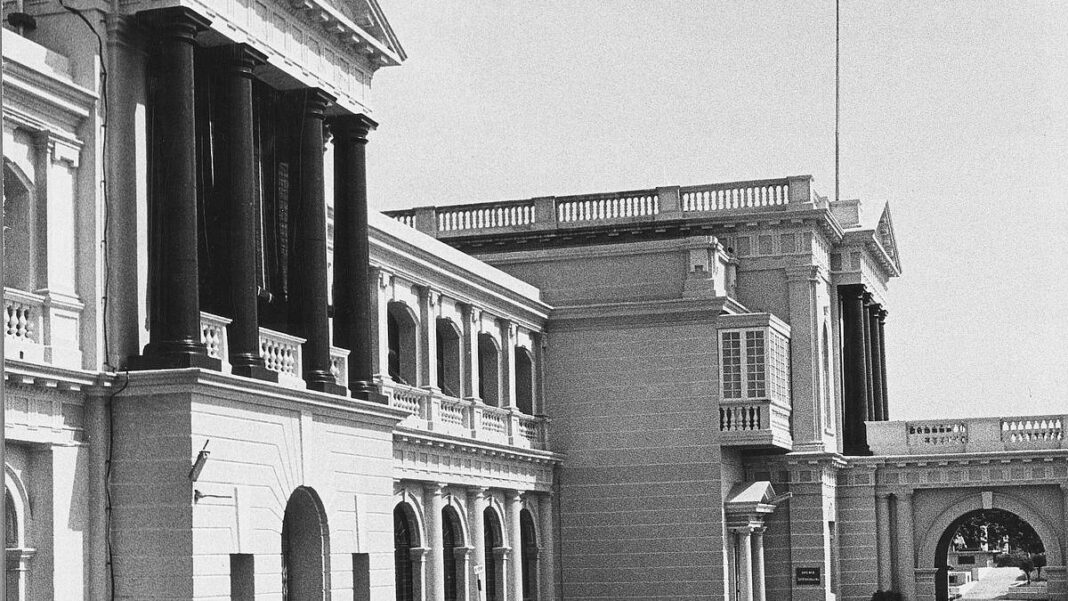
The Assembly’s last sitting at the Estate in this early phase was on December 27, 1956. More than five decades later, in March 2010, the Dravida Munnetra Kazhagam (DMK) government led by M. Karunanidhi moved the Assembly and Secretariat back to the Estate, inaugurating a new complex built at a cost of ₹450 crore to house both institutions.
The pendulum swung yet again in 2011. On May 16 that year, Jayalalithaa of the All India Anna Dravida Munnetra Kazhagam (AIADMK) took office as Chief Minister and returned the Assembly–Secretariat to Fort St. George. The DMK-era Secretariat building at the Omandurar Government Estate was subsequently rechristened and repurposed as a multi-specialty hospital.
Enduring pull of the Fort—and a familiar dilemma
Across these episodes, Fort St. George has remained both a magnet and a constraint. Its 17th-century heritage status and centrality in the State’s political narrative are offset by practicalities of space, facilities, and ownership by the Union government. The dynamic is not new: even in 1936, the colonial administration’s control over strategic tracts such as the Napier Battery and the Island Grounds shaped what was possible—and what was not. The Island Grounds remain with Defence authorities to this day.
What next
The TVK-led government has revived the long-running effort to identify a permanent Assembly–Secretariat site outside Fort St. George. With a century of proposals behind it—from the Marina to the Esplanade, from the Island Grounds to the Government Estate—the State’s experience suggests that questions of design, heritage, military land control, and administrative suitability will all factor into the decision. For now, the search continues, informed by the lessons—and false starts—of more than a hundred years.