
Kumaraswamy alleges illegal changes to BMIC plan, says deviations led to ‘NICE scam’
Union Minister H.D. Kumaraswamy on Tuesday alleged that the outline development plan approved for the Bengaluru–Mysuru Infrastructure Corridor (BMIC) in February 2004 illegally departed from the state Cabinet-cleared framework agreement of 1997, triggering what he called the “NICE scam.” Speaking at a press conference in Bengaluru, he said the changes violated Cabinet procedure and court directions and resulted in environmental damage, including the impact on 15 lakes.
Background: A 1997 framework and a 2004 plan
Kumaraswamy said the original framework agreement (FWA) for the BMIC was approved by the then JD(S) government led by the late J.H. Patel in 1997. He contended that the outline development plan (ODP) approved by the Bengaluru–Mysuru Infrastructure Corridor Project Authority (BMICPA) in February 2004 deviated from that FWA without returning to the Cabinet for ratification.
According to him, the BMICPA at the time was headed by D.K. Shivakumar, who also held the Urban Development portfolio. “The original framework agreement (FWA) was approved by the Cabinet in 1997 and the modification to it did not go back to the Cabinet as per procedure,” he said.
Alleged deviations from Cabinet-approved plan
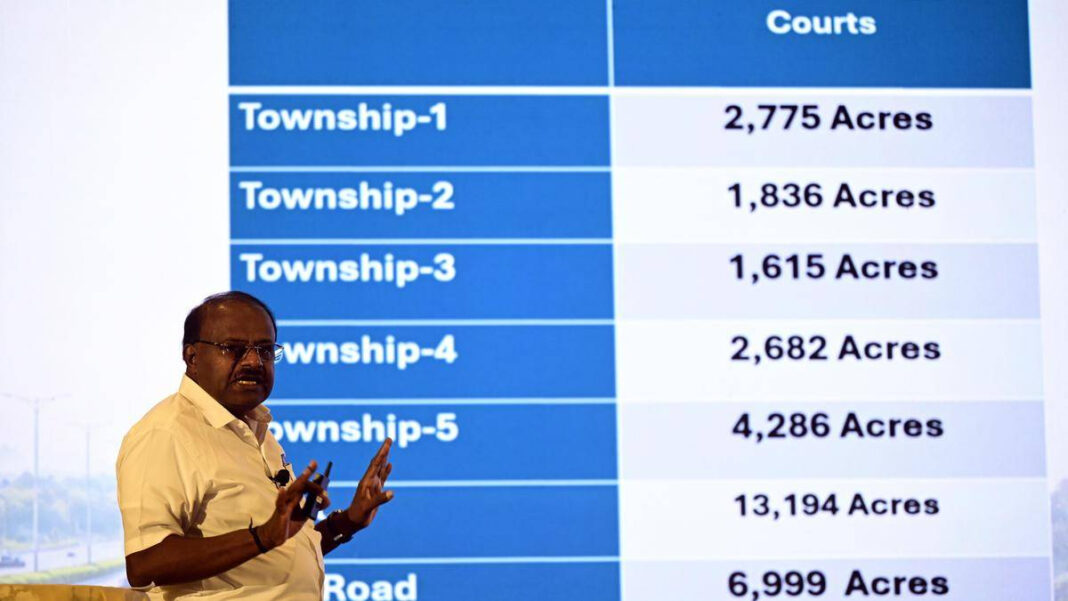
Kumaraswamy underscored that the 1997 Cabinet decision earmarked a total of 20,193 acres for the project area under BMICPA, of which 6,999 acres were specifically allotted for the road project. He alleged that the 2004 ODP, while keeping the overall area unchanged at 20,193 acres, increased the land for the road corridor to 9,488 acres—a jump of nearly 2,500 acres compared to the Cabinet-approved FWA.
He further claimed the ODP redistributed land among the townships attached to the corridor by expanding the extent for three townships closer to Bengaluru and reducing the acreage in two other townships. “Modifications were brought wherever they wanted,” he said, terming the changes contrary to the FWA, the previous Cabinet decision, and court orders.
Court directions and procedural questions
The Union Minister said that as far back as 1999, when the promoter sought modifications, the government had made it clear that any such changes would require Cabinet approval. He added that both the Karnataka High Court and the Supreme Court had directed Nandi Economic Corridor Enterprise (NICE), the project promoter, to conform strictly to the FWA.
“NICE had submitted an affidavit in the High Court that it would construct the road on 6,999 acres. Who gave permission to this [increase]? Was this taken back to the Cabinet for approval? Was there transparency? Has there been an audit of BMICPA?” he asked.
Environmental impact: 15 lakes affected, says Minister
Kumaraswamy asserted that while the original FWA did not affect any lakes, the modifications introduced in the 2004 ODP resulted in the impact on 15 lakes. He presented this as evidence of the alleged arbitrary nature of the changes and the need for scrutiny of the approvals process.
Why wasn’t it reversed earlier?
Responding to questions about why these decisions were not revisited during his 20-month tenure as Chief Minister between 2006 and 2007, Kumaraswamy said active court proceedings, including contempt matters, constrained the government’s ability to cancel the ODP at the time. “The outline development plan could not be particularly cancelled because of ongoing court cases, including contempt. They have all been cleared now,” he said.
He added that his government had taken action where it could: “My government cancelled the tripartite agreement between the government, NICE, and Nandi Economic Corridor Enterprise signed in August 2002, that allowed sale of land or mortgage. The agreement had also allowed for arbitration in London in case of dispute.”
Calls for accountability
Reiterating that the 2004 modifications were “illegal,” Kumaraswamy demanded answers on whether proper approvals were obtained, whether the process was transparent, and whether BMICPA’s decisions had been audited. He maintained that the alleged deviations not only breached the Cabinet-approved FWA but also ignored explicit directions from the Karnataka High Court and the Supreme Court.
The allegations revive long-standing questions around the BMIC project’s scope, approvals, and environmental impact. While Kumaraswamy said legal hurdles that once prevented action have now been cleared, he did not detail the next administrative steps he expects from the state or the project authorities.