
Country has lost its way, but always finds its path back: Murli Manohar Joshi
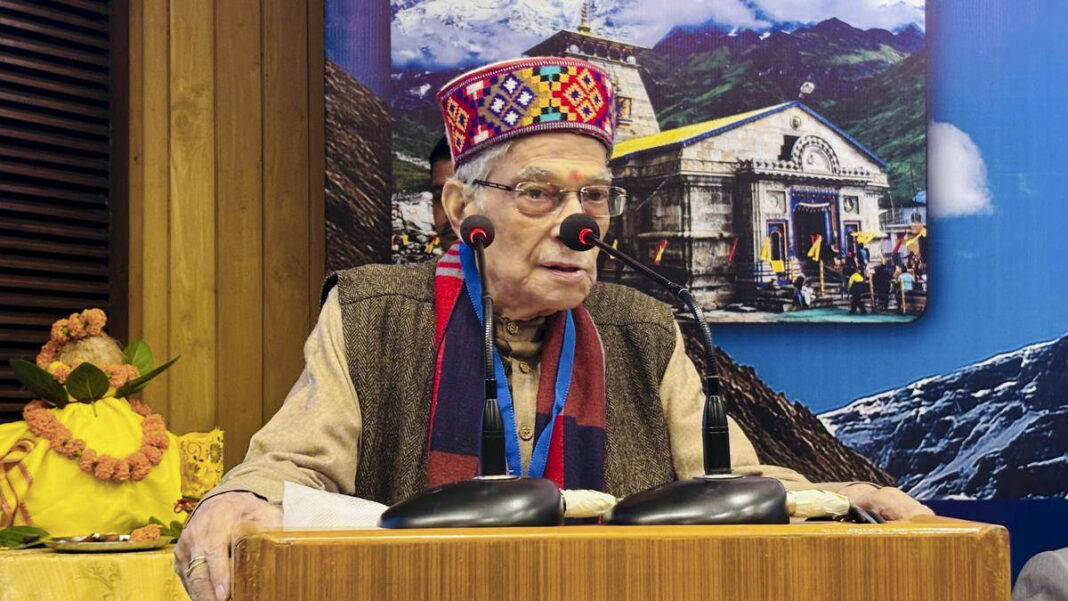
BJP veteran Murli Manohar Joshi has warned that India is “losing its track” amid controversies over electoral processes, youth unrest and allegations of corruption linked to the Ram Temple in Ayodhya, but expressed confidence that the country historically corrects course. In a wide-ranging interview with The Hindu, he called for accountability in governance, restraint in development in the fragile Himalayas, and a renewed focus on public trust as the foundation of India’s democratic life.
Accountability over Ram Temple trust and corruption
Responding to questions about allegations of embezzlement of donations to the Ram Temple in Ayodhya, Mr. Joshi declined to comment on any individual case but said the issue underscored a deeper malaise. “Corruption has become so deep-rooted in society that it has reached the core,” he said.
He noted that while the BJP had supported the Ram temple movement, the party had sought a “consensus” resolution rather than a legal one. “We believed that the Ram temple should be built, not through litigation but through consensus. The matter, however, reached the Supreme Court, and after years of hearings, the apex court decided that the Ram temple should be built in Ayodhya and Muslims should be given a piece of land. The SC also decided that a trust would build the temple. Who forms the trust? The government. So, whatever is happening in the trust is the responsibility of the government,” he said.
‘Badrinath is no ordinary place’: Sanctity, tourism and fragile ecologies
Mr. Joshi criticised the organisation of a music concert near the Badrinath shrine in Uttarakhand, arguing that efforts to promote tourism must respect the sanctity and ecological sensitivity of pilgrimage sites. “Badrinath is no ordinary place. Adi Shankaracharya chose it with great care and set its customs to connect North and South. Even today the Rawal of this temple comes from Kerala,” he said.
Arguing that sound itself can harm the local ecology, he cited longstanding traditions aimed at limiting noise and crowds. “Our ancestors knew the Himalaya is fragile. Sound harms the ecology of this place; hence, even blowing the conch is forbidden at this site and large gatherings were avoided,” he said. Recalling Kalidasa’s description of the Himalaya as devatatma (divine soul), he asked, “What have you done to its divine soul? You have built multi-level parking? Organised DJ style music concerts?” He added: “We agree that tourism makes money, but India never sold mother nature.”
‘Like a child’: Development limits in the Himalayas
Pressed on whether current pushes for roads, pilgrimage infrastructure and connectivity exceed what the mountains can absorb, Mr. Joshi replied unequivocally: “Yes. The Himalaya is the most fragile mountain in the world; it’s like a child. You cannot load a child’s school bag above the limit he can handle.”
He pointed to the cracked homes in Joshimath as a warning and cautioned against imitating European alpine models without regard to local geology. “You want Joshimath to become a Switzerland without considering the fact that Switzerland doesn’t have a fragile Himalaya,” he said.
Recalling earlier debates over river management, Mr. Joshi said that during the British period, a proposed dam at Haridwar prompted Madan Mohan Malaviya to insist on ensuring pure Ganga water reached Varanasi for last rites—an agreement he said reflected Indians’ historical resolve to protect rivers and mountains. “It was we who opposed the building of the Tehri Dam in Uttarakhand. But it was built, and look at the water now; it’s extremely impure,” he added.
On the strategic “all-weather road” through the region, he said the project had some military rationale but questioned its scale. “The all-weather road was partly a military requirement, but when I enquired at the highest level whether roads this wide were necessary. The reply was negative.” Emphasising that he was not opposed to development itself, he said, “I am not saying that there should be no development; what I am saying is that it should be sustainable and the environment must be considered.”
Drawing on religious symbolism to press for ecological coexistence, he said: “Look at Shiva. His bull, his wife, Durga’s lion, the snake around his neck, the mouse, and the peacock all live together. The Himalaya, home of Shiva, also teaches coexistence. If the Himalaya is the father, Bharat is the mother. You cannot save the mother at the cost of the father.”
On the BJP’s evolution and India’s direction
Reflecting on the BJP’s journey from the era of Atal Bihari Vajpayee and L.K. Advani to the present, Mr. Joshi acknowledged that “policies and working do change with time.” But he added a caution: “If the changes are more than required, or the fundamentals start being weakened, then it’s not acceptable.” He said, “Speaking about myself, I have not deviated from the principles I held then.”
Assessing the national mood more broadly, he said, “In the present scenario, I think the country has lost its track. But if we look at history, whenever our country deviated from its path, it also managed to realign. We make mistakes, and we always learnt the lesson, which is reflected in our growth.”
Electoral rolls, power and the primacy of trust in democracy
Amid concerns surrounding the special intensive revision (SIR) of electoral rolls, Mr. Joshi said the urge to retain power is a political constant. “It’s a harsh truth that every government wants to stay in power,” he said, noting that the Constitution envisages a census and delimitation every ten years, but that these were deferred under both Indira Gandhi and Atal Bihari Vajpayee. “Because we also wanted to stay in power,” he said of his own party’s time in office.
For democracy to function, he argued, three conditions are essential: fair elections, accountable government and a transparent bureaucracy. “One must understand that democracy is best, provided elections are fair, the government is held accountable, and the bureaucracy remains transparent,” he said. “For a good democracy, the opposition needs to be responsive and ready with an alternative plan to take the nation ahead to its desired goals.”
Stressing that “a republic runs on trust,” Mr. Joshi cited Lal Bahadur Shastri, whom he said people trusted when he asked citizens to give up a meal, and Subhas Chandra Bose, who drew support with the pledge: “give me blood and I will give you freedom.” When trust is missing, he added, “people won’t accept even good things. If voices are raised, address them; standing there with a stick won’t work.”
Youth protests, jobs and the Ashtavakra lesson
Asked about the government’s handling of the Jantar Mantar protest, Mr. Joshi turned to an allegory from the life of the sage Ashtavakra. He recalled a story in which a teacher angered by criticism from an unborn child in the womb—who had corrected him—cursed the child to be deformed in eight places, only for the boy to grow into a scholar who triumphed in debate and reconciled with his father. The tale, Mr. Joshi suggested, underscores the need for established authority to heed young voices rather than trying to silence them.
“Why is Gen Z angry? Because of the misguided aspirations that we created. You promised jobs. Where are the jobs?” he asked. If promises fell short, governments should acknowledge it, he said, and speak directly to the young: “Son, we couldn’t do what we promised. But we will work on it.” He added, “They are our children.”
He cautioned that “established authority has always crushed new voices, sometimes in good faith, sometimes in bad,” but insisted that the Indian way is one of dialogue and correction: “the young challenge without taking revenge, and elders advise, set right and correct.”
A call for responsibility anchored in trust
Across themes—allegations linked to the Ram Temple trust, the sanctity of Badrinath, the limits of development in the Himalayas, the conduct of elections and the aspirations of young Indians—Mr. Joshi’s message emphasised responsibility, restraint and restorative dialogue. While warning that India has strayed from its path, he expressed faith in the nation’s capacity for self-correction, provided that leaders prioritise sustainable development, uphold democratic accountability and rebuild public trust.