
Mammoth protest at Kittur Chennamma Circle by sugarcane farmers; growers agree to Delhi talks with Joshi after MLAs intervene
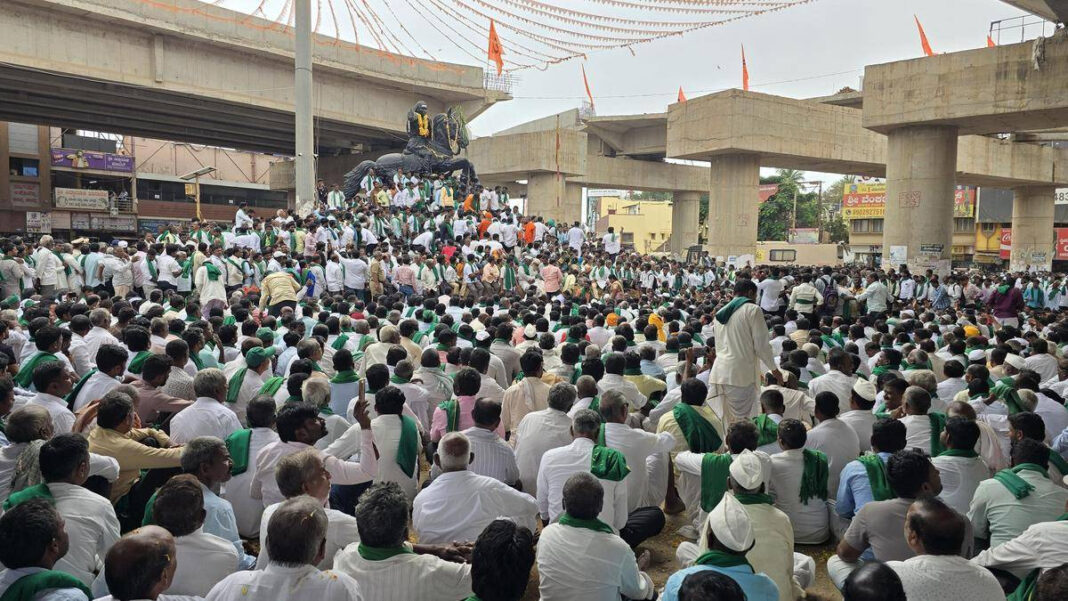
Thousands of sugarcane growers from Karnataka and the neighbouring states of Maharashtra and Telangana converged on Hubballi’s Kittur Chennamma Circle on Tuesday, mounting a massive day-long protest to demand remunerative prices for sugarcane and an urgent revision of the minimum selling price (MSP) of sugar. The standoff eased late in the evening after an appeal from Union Minister for Education, Consumer Affairs, Food and Public Distribution Pralhad Joshi and the intervention of local legislators, with farmers agreeing to withdraw the agitation and send a 30-member delegation to New Delhi for talks on October 10.
Demands and organisers
The agitation was spearheaded by the Karnataka Rajya Raitha Sangha and Hasiru Sene, drawing large contingents from sugarcane-growing belts across the region. Leaders including Karnataka Rajya Raitha Sangha and Hasiru Sene office-bearer Chunappa Pujeri and spiritual leader Shashikanth Guruji from the Inchageri Mutt in Belagavi addressed the gathering and led the mobilisation.
Farmer leaders pressed for a comprehensive package of measures. Chief among their demands was fixing the sugarcane price at ₹5,500 per tonne for the 2026–27 crushing season. They also sought an increase in the MSP of sugar from the current ₹31 per kg to ₹60 per kg, arguing that the Centre has not revised the MSP for several years. Additional demands included raising the procurement price of ethanol, permitting sugar mills to sell their entire ethanol output, clearing all pending sugarcane dues, and implementing the M.S. Swaminathan Commission’s recommendations in full.
Escalation after 3 p.m. deadline
Tensions rose through the afternoon after the farmers set a 3 p.m. deadline for a “clear statement” from Union Minister Pralhad Joshi on their demands. While the minister issued a video message appealing for talks in Delhi, protest leaders initially rejected the proposal and insisted he meet them in Dharwad. When no further communication from the minister followed by the deadline, large groups of protesters began marching towards his residence at Mayuri Estate.
Police had erected barricades along the route as a precaution. However, several protesters broke through some of the barricades and reached the minister’s residence, where a heavy police deployment prevented them from laying siege. Another sizeable group was stopped at Ramesh Bhavan. The standoff continued into the evening amid ongoing efforts by senior officials to de-escalate the situation.
Negotiations and intervention
Throughout the day, Police Commissioner Bhushan Borase, Inspector General of Police (Northern Range) Sandeep Patil, and Dharwad Deputy Commissioner Snehal R. engaged with farmer leaders in an attempt to defuse tensions and persuade them to withdraw the agitation. The breakthrough came after local MLAs Mahesh Tenginakai and M.R. Patil reached out to the protest leaders with a concrete proposal.
The legislators assured the farmers that a 30-member delegation would be facilitated to travel to New Delhi for direct talks with Union Minister Joshi on October 10, with all expenses to be covered. They emphasised that with the Model Code of Conduct in force, a meeting in Dharwad would not be feasible. On the strength of this assurance and the minister’s appeal for dialogue in the national capital, the farmer leaders agreed to call off the day’s protest.
Following the agreement, protesters moved to Nehru Stadium and later dispersed to return to their respective regions.
Traffic disruption across Hubballi
The day-long demonstration and the blockade of Kittur Chennamma Circle and adjoining arteries severely disrupted traffic across Hubballi. With several routes choked and diversions in place, motorists faced prolonged delays, and congestion persisted for hours on alternative roads as the protest continued.
Context and significance
The mobilization reflects deep-seated concerns among sugarcane growers over input costs, delayed payments, and pricing policies that they say have not kept pace with rising expenses. The call to revise the MSP of sugar and to set a higher cane price for the upcoming crushing season is aimed at securing predictable, remunerative returns. Demands related to ethanol—both on procurement prices and the ability of mills to sell their entire output—come amid ongoing policy thrusts linking the sugar sector with the national ethanol blending programme. The insistence on clearing arrears and implementing the Swaminathan Commission recommendations highlights longstanding structural issues impacting farm incomes.
What happens next
With the protest withdrawn, attention will now turn to the proposed talks in New Delhi on October 10. According to the assurances given to the farmer leaders, a 30-member delegation will meet Union Minister Pralhad Joshi to present their charter of demands, including price revisions and sectoral reforms. The outcome of these discussions will be closely watched by growers and sugar mills across the region, given the immediate implications for the upcoming crushing season and the broader policy framework governing the sugar industry.
Conclusion
Tuesday’s protest in Hubballi underscored the scale and intensity of farmer discontent across the sugarcane belt. While swift intervention by officials and legislators helped avert a prolonged standoff, the core issues—pricing, arrears, and policy clarity—now move to the national stage. The scheduled Delhi talks will be a critical test of whether the Centre and farmer representatives can find common ground on long-pending demands that have significant economic and social ramifications across multiple states.