
Congress adopting ‘politics of convenience’ on voter rolls, says BJP
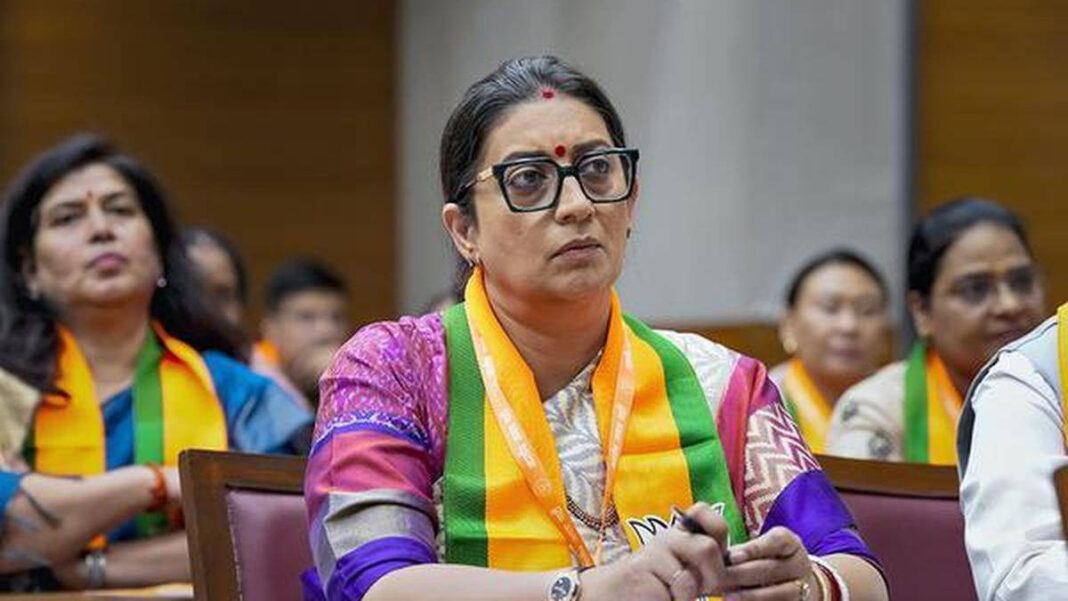
The Bharatiya Janata Party (BJP) on Tuesday accused the Congress of undermining India’s democratic institutions by attacking the Election Commission of India (ECI) over alleged irregularities in electoral rolls, with senior party leader Smriti Irani asserting that the Opposition was engaging in a “politics of convenience” instead of addressing issues such as duplicate and deceased entries.
BJP’s charge against Congress
Addressing a press conference on September 29, 2026, former Union Minister and BJP national leader Smriti Irani criticised the Congress for its public stand against the ECI and for invoking the Lahore Congress Session in its arguments. “The Congress party that was created to protect the British Empire is today attacking India’s Election Commission by referring to the Lahore Congress Session. Nothing could be more shameful than this,” Ms. Irani alleged.
Her remarks came a day after the Congress Working Committee (CWC) demanded the immediate removal of Chief Election Commissioner Gyanesh Kumar, the suspension of the ongoing special intensive revision (SIR) of electoral rolls, the restoration of over 13.30 crore names purportedly deleted from the rolls, and the resignation of Prime Minister Narendra Modi.
Ms. Irani said Prime Minister Narendra Modi had “repeatedly” urged the Congress during the 2019 election cycle to direct its criticism at him rather than at India’s constitutional bodies. “However, the Congress leadership is leaving no stone unturned in undermining India’s constitutional institutions,” she alleged.
Defense of the Election Commission and voter list verification
Asserting that the ECI has reinforced India’s democratic architecture and “been hailed by several countries,” Ms. Irani linked the Congress’s present posture to its electoral performance. “The Congress is unhappy that, within the democratic framework, the people of India do not support it today. Therefore, instead of introspection on its defeats, the Congress is attacking the Election Commission,” she said.
Questioning the CWC’s call for restoring deleted names to the rolls, she asked: “If someone’s name is duplicated or if the name of a deceased person appears on the electoral roll, why does the Congress party want those names to be restored or continue?” She also questioned why the party was not directing similar criticism at States not governed by the BJP, citing Himachal Pradesh, Punjab, Kerala and Karnataka.
Referring to the ECI’s public communication on the SIR, Ms. Irani said the verification process would be conducted by Booth Level Officers (BLOs) through home visits. “The Election Commission has made it clear in its press note that the BLOs will visit the homes of people who have been issued notices in connection with the SIR, collect documents from their homes, and verify the matter themselves,” she said.
Historical references and allegations
Expressing “shock” over the Congress leadership’s invocation of the Lahore Congress Session, Ms. Irani argued the party should also present historical facts related to its founding figure A.O. Hume, who, she said, “served as the Secretary of Revenue, Agriculture, and Commerce of the British Empire.” Alleging colonial-era intent behind the party’s origin, she said: “A.O. Hume… shared a proposal with the Viceroy that if the British Empire was to be protected, the Congress party should be formed; a political organisation should be formed.”
‘Politics of convenience’: BJP cites past Congress positions
In a separate press conference, BJP spokesperson Sidharth Yadav accused the Congress of reversing its stance on electoral roll cleansing for political reasons and to “hide its electoral failures.” He said the Opposition party had earlier demanded similar corrective measures to weed out bogus entries.
Mr. Yadav cited multiple instances across States, saying that in Andhra Pradesh in 2018 the Congress had called for “purification” of the voter list over alleged duplicate entries and that the ongoing 2026 SIR mirrored the same objective. He added that in Telangana and Rajasthan, the Congress had publicly flagged discrepancies in the rolls and sought revisions.
Highlighting Kerala as another example, Mr. Yadav said, “In Kerala, the Congress did not merely make allegations, its leader created a website and entered those names, went to the High Court and said that these names must be removed. The SIR took place…” He noted that the Congress went on to win the State Assembly elections and, at the time, “officially took a stand praising the SIR [in Kerala]. However, the party keeps changing its stand because of its politics of convenience,” he said. He also cited examples from West Bengal, Bihar, Delhi and Maharashtra to argue that the party’s position varied by political expediency.
CWC’s demands and the SIR debate
The CWC’s resolution sought the removal of CEC Gyanesh Kumar, the suspension of the SIR process, and the reinstatement of more than 13.30 crore names it said had been deleted from the electoral rolls. It also demanded the Prime Minister’s resignation. The BJP has countered that the SIR is a due process aimed at ensuring that rolls are accurate and that mechanisms are in place for voters to respond and be verified, including through home visits by BLOs, as per the ECI’s press note cited by Ms. Irani.
What’s next
While the Congress has pressed for a halt to the SIR, the BJP has indicated that the ECI’s verification exercise will proceed with on-ground checks by BLOs and opportunities for citizens to respond to notices. No immediate response from the Election Commission to the CWC’s demands was referenced in the BJP’s remarks, but the party maintained that the process is designed to address precisely the concerns the Congress has previously raised in several States.
Significance
The exchange underscores a widening political confrontation over the integrity of electoral rolls and the role of the Election Commission. As the SIR process continues, the BJP has framed Congress’s objections as an attempt to discredit institutions and avoid introspection over electoral setbacks, while pointing to the Opposition’s earlier support for similar roll-cleaning measures in multiple States.