

Lalbagh to get 2.5-acre garden inspired by Singapore’s Gardens by the Bay
Bengaluru’s iconic Lalbagh Botanical Garden is set to debut a new 2.5-acre attraction inspired by Singapore’s Gardens by the Bay, with the Karnataka State Department of Horticulture (KSDH) introducing fog and mist technology and curating a collection of shade- and mist-loving plant species to create a distinct microclimate within the park.
Project overview
Officials said the new garden is being developed on a 2.5-acre tract located directly in front of the Horticulture Department’s office within Lalbagh. The site was reshaped a few years ago into a valley-like depression to channel rainwater from surrounding areas—particularly runoff from the Lalbagh Rock—into a centralized basin.
“This 2.5-acre land is located in front of the Department of Horticulture. A few years ago, a valley-like area was built in front of the office so that rainwater from surrounding areas, especially from the Lalbagh Rock, can flow into it,” said M. Jagadeesh, Joint Director, Horticulture Department (Parks and Gardens).
With mature trees already casting substantial shade over the area, the department plans to plant exclusive and rare varieties not currently represented in Lalbagh’s collections. In all, officials expect to introduce around 50 species adapted to shade and mist, sourced from across Karnataka, Kerala, Odisha, Himachal Pradesh, and other regions.
Fog and mist technology at the core
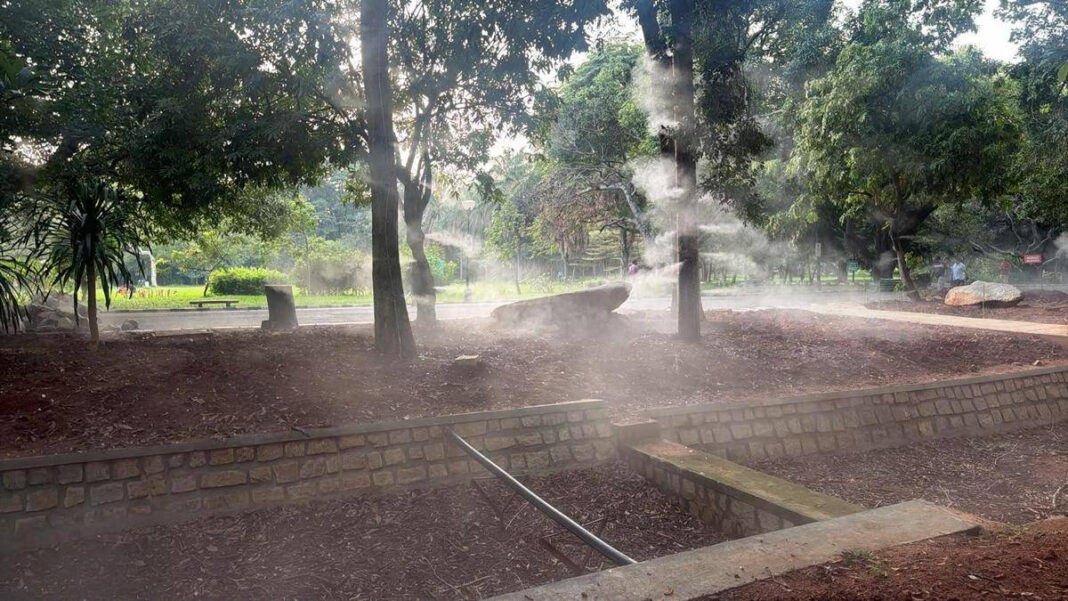
As part of the redevelopment, the department has introduced fog and mist technology for the first time. Officials noted that similar systems are already used in hill stations such as Kodagu and Ooty to cultivate climate-sensitive crops like coffee, tea, exotic fruits, spices, and floriculture.
“Since this 2.5-acre valley houses some old trees that provide a lot of shade, we thought of planting exclusive and rare varieties that are not in our garden. However, these plants need purified water that is sprayed using this fog and mist technology. Hence, the ultra-fine nozzles used in this technology were bought from Germany. We have used stainless steel pipes to supply water to these nozzles. A separate Reverse Osmosis (RO) water facility has been established in our office. Normal water or water from borewells will be purified in this RO facility to remove dissolved salts and heavy metals, and then supplied to pipes and finally to nozzles that spray it in the form of fog,” Mr. Jagadeesh explained.
The entire system is automated, with the nozzles programmed to spray intermittently—10 minutes on followed by 10 minutes off—to maintain consistent humidity without over-saturating the plants, he added. The department has also used locally available natural stone to construct a revetment stabilizing the valley’s edges.
Water security through check dams
To ensure year-round water availability, especially during summer, the department has built a network of check dams to capture and store rainwater flowing through the valley. “We have built around 15 check dams measuring 60 metres wide and 5 metres high. Whenever it rains, water gets collected in these check dams after flowing through the valley. At least 20 crore litres of water that gets collected in these check dams will help us water hundreds of plants and trees beyond this 2.5-acre area. The water will recharge rainwater-harvesting pits and the underground water table will also increase,” Mr. Jagadeesh said.
Curated plant palette and a new microclimate
The planting plan emphasizes species that thrive in shaded, humid environments and can make effective use of moisture delivered via mist. Department teams have visited multiple States to identify and procure suitable varieties that can adapt well to the microclimatic conditions being engineered at the site.
“Some of the species include Bird’s Nest Anthurium, which is found in the rainforests of Central and South America. We are procuring it from vendors within India who specialise in growing such plants. Matchstick Bromeliad from Tamil Nadu, Yucca gloriosa from Himachal Pradesh, and species of Elephant Ear plants, which are natural air purifiers, are also being introduced. These are mostly indoor plants used to enhance the decor of homes and offices, but we will be using them outdoors,” Mr. Jagadeesh said.
He added that Pearl Grass from Kerala will be introduced for the first time in Lalbagh. “All these species are known to absorb water provided in the form of mist. Over a period of time, this will lead to the creation of a microclimate within Lalbagh,” he noted.
What visitors can expect
The department aims to recreate the lush, atmospheric experience associated with Gardens by the Bay by combining shaded topography, precision misting, and a carefully selected array of species. While officials did not specify a completion timeline, the infrastructure for water purification, automated misting, and rainwater harvesting is in place, paving the way for phased planting and establishment.
Published: September 29, 2026 09:53 pm IST