
Protest against CEC Gyanesh Kumar: AISA president Neha released from Narela Industrial Area police station
All India Students’ Association (AISA) national president Neha Bora was released late on Sunday from the Narela Industrial Area police station after being detained earlier in the day during demonstrations in New Delhi demanding the removal of Chief Election Commissioner (CEC) Gyanesh Kumar. Her detention, which AISA alleged was carried out by police in an unmarked private vehicle without a woman officer present, sparked a swift outcry from opposition leaders and civil society groups as her whereabouts remained unknown for several hours.
March to Jantar Mantar halted; leaders seek information on detainees
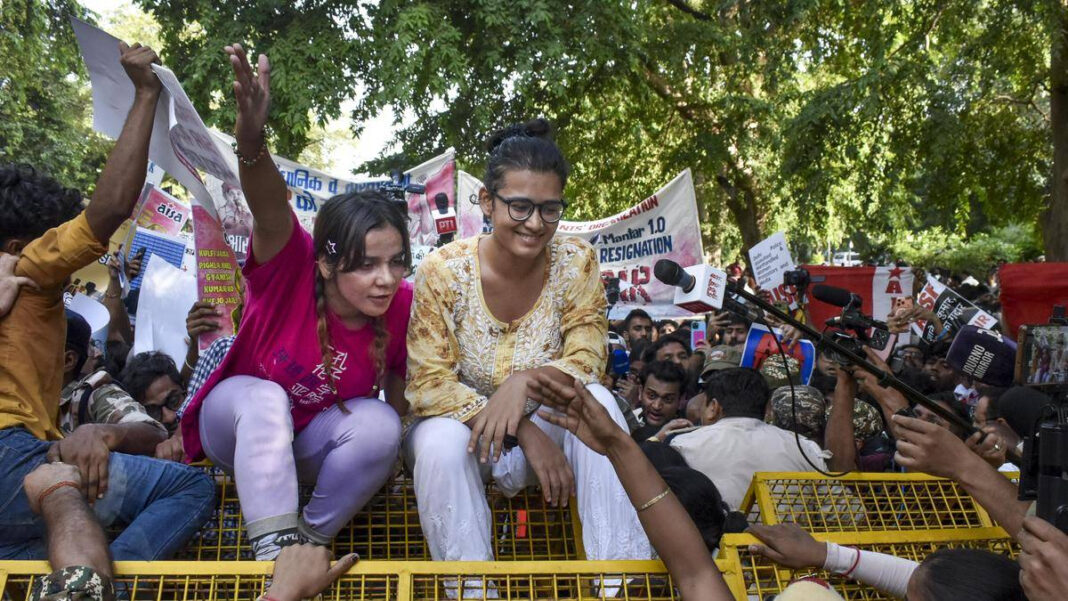
AISA and allied student activists had gathered near Andhra Bhawan Circle on Ashoka Road for a third consecutive day of protests against the Election Commission’s ongoing Special Intensive Revision (SIR) of electoral rolls, which opposition parties and activists allege has resulted in large-scale and selective voter deletions. Heavy barricading and a large police deployment prevented the crowd from marching to Jantar Mantar, the designated protest site. Visuals from the scene showed Neha Bora attempting to scale a barricade as police restrained her.
Following reports of her detention, senior leaders including AIDWA’s Asha Sharma and Maimoona Mollah, RTI activist Anjali Bharadwaj, and activist Navsharan Singh went to the Parliament Street Police Station to seek information on Ms. Bora and other women activists allegedly picked up in unmarked vehicles. Ms. Bora was subsequently traced and released from the Narela Industrial Area police station.
Reacting to her release, Trinamool Congress Rajya Sabha leader Derek O’Brien said he had been anxious after learning that Ms. Bora had been taken away.
Allegations of harassment of women journalists; Press Club condemns police
The Press Club of India condemned what it described as the Delhi Police’s treatment of journalists covering the anti-CEC protests and demanded immediate action on complaints of sexual harassment against police personnel. The statement followed allegations by three women journalists that they were harassed while reporting on Saturday’s demonstrations at Jantar Mantar, including one who said she was “molested and groped by an ACP” and spent hours at the Parliament Street police station trying to get a First Information Report registered.
Delhi Police said it has received the complaints and transferred them to the Crime Branch for a “fair and impartial enquiry.” Earlier on Sunday, representatives of a civil society group alleged police were unwilling to meet the journalist who had complained against the ACP, and legal experts cited provisions of the Bharatiya Nyaya Sanhita to argue that non-registration of an FIR for a molestation complaint could itself constitute a cognisable offence.
Opposition escalation and planned protests
The Delhi units of several INDIA bloc parties announced a joint protest outside the Delhi Election Commission office on Wednesday, October 7, to oppose the SIR and demand the CEC’s resignation. At a coordination meeting, representatives of the Congress, CPI, CPI(M), RJD, NCP and RSP said they would jointly oppose what they termed a “flawed” revision process. Delhi Congress general secretary Anil Bhardwaj said the voter list is the foundation of democracy and any process that risks removing citizens’ names or undermining their franchise would be resisted.
Separately, INDIA bloc parties in Jammu and Kashmir announced a “Save Democracy” rally in Jammu on October 7 and district-level marches from October 4 to 8 to press for Mr. Kumar’s removal.
Political reactions across the spectrum
Leading opposition figures intensified criticism of the Election Commission and the CEC:
- Congress leader Sachin Pilot accused the CEC of undermining the Election Commission’s independence, alleging the SIR was being used to selectively delete voters.
- Former Union Minister P. Chidambaram said the “wisest thing” for Mr. Kumar to do would be to resign immediately in light of the growing controversy, adding that protests would continue until he steps aside.
- RJD leader Tejashwi Yadav alleged that “fraudulent means” were being deployed to help the BJP win elections and claimed public anger had forced people onto the streets.
- National Conference president Farooq Abdullah condemned reported voter deletions, saying “no one has the right to remove an Indian citizen from the voter list,” and asserted that people were showing “courage” and that “change” was on the way. He alleged that Muslims had been “selectively targeted,” even citing prominent individuals who reportedly found their names missing.
- Activist-academician Yogendra Yadav called for scrapping the SIR, characterising it as discriminatory, and appealed for a citizen march to India Gate.
- Actor-activist Prakash Raj denounced the revision exercise, describing it as a tool of “electoral genocide,” and urged nationwide mobilisation to restore voter rights.
From within the ruling National Democratic Alliance, Union Minister Chirag Paswan defended the SIR in principle but said the Election Commission must maintain the highest transparency if citizens have doubts, stressing that an independent and impartial poll body and public faith in its functioning are essential for democracy.
BJP rebuts “vote deletion” narrative
Amid the escalating protests, the BJP issued a point-by-point rebuttal of opposition claims about the SIR. The party said the assertion that 13 crore voters had been deleted was false, stating that names were flagged in the draft rolls under categories such as dead, absent, shifted or duplicate, and that final action would follow the statutory cycle of claims, objections and appeals. It also maintained that Form 6 — used for voter enrollment — had not been changed, apart from an additional declaration attached “for voter convenience,” and that the electoral rolls remained decentralised with state election machinery retaining statutory powers.
SC to hear plea seeking CEC’s suspension and review of EC decisions
In a significant legal development, the Supreme Court is slated to hear on Monday, October 5, a batch of pleas seeking the suspension of CEC Gyanesh Kumar and challenging the manner in which decisions were taken by the poll panel, allegedly without the approval of two election commissioners. A bench of Chief Justice Surya Kant and Justices Joymalya Bagchi and V. Mohana is scheduled to hear petitions filed by Rakesh Kumar Singh and advocate Shailendra Mani Tripathi. One of the PILs asks the Court to determine whether Mr. Kumar has been individually exercising powers that legally belong to the Election Commission as a whole and to declare any such actions unauthorised if proven.
Judge’s remarks on voting rights fuel debate
Adding to the intensifying debate around electoral revisions, Supreme Court judge Justice Ujjal Bhuyan, speaking at NALSAR University, warned that any process which disenfranchises “millions of Indian citizens,” making them “second class citizens in their own country,” would be “intrinsically arbitrary” and strike at the heart of the Constitution. In separate remarks quoted by Congress leader Jairam Ramesh, Justice Bhuyan was cited as asserting that the right to vote forms part of the Constitution’s basic structure. The comments, while made in a public address and not a judicial order, were seized upon by opposition leaders to argue that the current revision process violates constitutional guarantees of universal adult franchise and equality.
Protests spread beyond Delhi
In Mumbai, Shiv Sena (Uddhav Balasaheb Thackeray) chief Uddhav Thackeray and Maharashtra Navnirman Sena leader Raj Thackeray led a protest march against the CEC from Metro Cinema to the BMC headquarters, joined by state leaders from the Congress and Sharad Pawar-led NCP (SP). Addressing a separate rally, Raj Thackeray demanded that the SIR be scrapped in Maharashtra and called for a return to paper ballots in place of EVMs, alleging large-scale voter exclusions in the state and nationwide. In Delhi, Aam Aadmi Party workers also staged protests near India Gate, with several workers detained by police.
Related case in Agra: Congress workers granted bail
Six Congress leaders arrested in Agra on September 29 for allegedly defacing the residence of the CEC with black paint were released on bail from the district jail on Sunday, a day after a local court granted bail. Police had earlier dropped an attempt-to-murder charge during the investigation.
Why the protests matter
The immediate trigger for the protests is the Special Intensive Revision of electoral rolls. Opposition parties and civil society groups allege the exercise has led to sweeping and selective deletions, disproportionately affecting vulnerable and minority communities, and undermining the principle of universal adult franchise. The Election Commission and the BJP have countered that entries have only been flagged in the draft lists and that established processes exist for citizens to file claims and objections before any final action is taken.
What comes next
All eyes turn to the Supreme Court hearing on October 5 on pleas challenging the CEC’s actions and seeking his suspension, even as opposition parties escalate street mobilisations in Delhi and across states. The Delhi Police’s handling of journalists’ complaints is also under scrutiny, with the Crime Branch now tasked with an internal probe. For now, Neha Bora’s release has eased immediate tensions around her safety, but demands for the CEC’s resignation and for a rollback of the revision exercise continue to gather momentum.
As legal, political and civil society challenges converge, the coming week is expected to be pivotal for the Election Commission’s credibility and for public confidence in the integrity of India’s voter rolls.