
At CWC meet, Rahul says Modi told him: ‘When we go, you will come’
At a meeting of the Congress Working Committee (CWC) in New Delhi on Tuesday, Leader of the Opposition in the Lok Sabha Rahul Gandhi told party colleagues that Prime Minister Narendra Modi had remarked to him in a closed-door interaction that the Congress would return to office once the Bharatiya Janata Party (BJP) demitted power. Mr. Gandhi’s remarks came during a 20–25 minute address in which he urged the party to remain confident and emphasised the principle of resistance, according to participants present at the meeting.
Inside a closed-door exchange with the PM
Recounting a Selection Committee meeting for a constitutional appointment that included the Prime Minister and the Home Minister, Mr. Gandhi said he had questioned Mr. Modi on pushing through a candidate he had opposed in his capacity as Leader of the Opposition. The Prime Minister, Mr. Gandhi told colleagues, replied that he was acting in the tradition of previous Prime Ministers, including Indira Gandhi. Mr. Gandhi said he had responded by noting that she lost the subsequent election.
“You don’t believe me, but the Prime Minister and Home Minister, in the [closed-door] meeting, told me, ‘When we go, you will come’… So you should trust me,” Mr. Gandhi said with a smile, according to those present.
Asked later about Mr. Gandhi’s account, Congress general secretary (organisation) K.C. Venugopal declined to comment on internal deliberations. “Whatever deliberation done by Rahul Gandhi ji, will be in the CWC room,” he told a press conference.
‘Vote chori’ drive to intensify; call for CEC’s resignation
Mr. Gandhi also trained his focus on the Congress’s ongoing campaign against alleged “vote chori” (vote theft), asserting that Chief Election Commissioner Gyanesh Kumar would “have to resign” and vowing a “fight to finish.” He told the meeting that, when the campaign began, only about 20% of people believed the issue was real, but that figure had now risen to more than 80% in his estimation. He urged the party to raise the issue more forcefully in the days ahead.
Congress communications chief Jairam Ramesh said Mr. Gandhi linked the latest “expose” on alleged vote tampering to a sustained Congress effort. “Rahul ji spoke about both virodh (opposition) and pratirodh (resistance). We will oppose inside Parliament and resist outside on the streets,” Mr. Ramesh said.
Mobilisation plans on the table
The closed-door CWC discussions centred on mass mobilisation to press the poll integrity agenda, with proposals for rallies and campaigns coalescing around slogans such as “Chalo Delhi, Vote Bachao” (March to Delhi, Save Your Vote). Several leaders put forward ideas on the way forward.
Senior leader Abhishek Singhvi suggested that youth and students should be at the forefront of public mobilisation, pointing to the prominent role played by young activists in protests against question paper leaks.
Priyanka Gandhi Vadra and Anand Sharma proposed that the Congress extend an open call to all sections—social movements, civil society, and political parties—to join the campaign, arguing that broad alliances would amplify pressure for reforms.
Manish Tewari advocated mobilising every Congress worker and staging a dharna in the national capital until Mr. Gyanesh Kumar steps down as Chief Election Commissioner and the special intensive revision (SIR) of electoral rolls is scrapped. He cited the example of Punjab’s farmers, whose prolonged agitation compelled the Union government to withdraw the three farm laws.
When Shashi Tharoor suggested holding a mass dharna on Gandhi Jayanti on October 2, Congress president Mallikarjun Kharge responded that Mr. Tharoor should ensure his presence at such a programme rather than merely writing about it in a newspaper.
V.D. Satheesan briefed the meeting on Mr. Gyanesh Kumar’s record as a Kerala-cadre bureaucrat and flagged what were described as questionable decisions during his tenure, according to participants.
Debate on ballot papers and Nitish Kumar
Party veteran Digvijaya Singh argued for restoring ballot papers in elections and contended that the Congress should have been able to retain Janata Dal (United) leader Nitish Kumar within the Opposition alliance. He was countered by the party leadership on this point.
Former Congress president Sonia Gandhi weighed in firmly, saying Mr. Kumar had “betrayed” the Opposition bloc and that it was better he left when he did.
Setting and tone
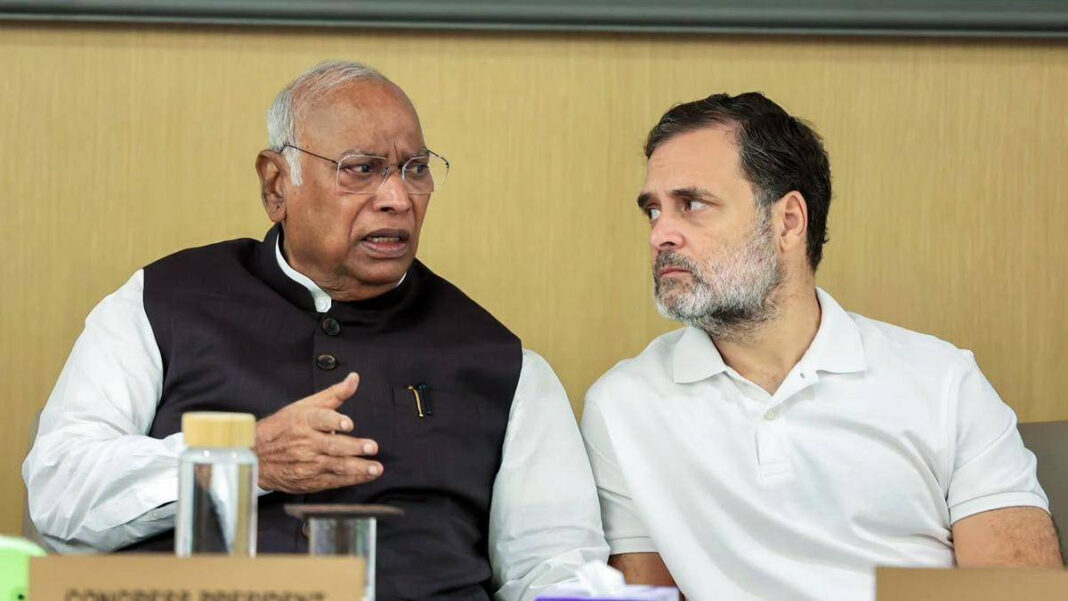
The CWC met at Indira Bhawan in the capital, with AICC president and Leader of the Opposition in the Rajya Sabha Mallikarjun Kharge presiding. Mr. Gandhi’s remarks, party leaders said, aimed at bolstering internal confidence, sharpening the party’s twin-track approach of institutional opposition and street-level resistance, and channelling organisational energies into a focused national mobilisation around electoral integrity.
What to watch next
While the Congress has not formally announced the shape of its next phase of agitation, the meeting indicated a preference for sustained, high-visibility actions in Delhi and beyond, greater youth participation, and a concerted push to demand accountability from the Election Commission. With Gandhi Jayanti approaching and several leaders advocating a capital-centric dharna, the party is expected to crystallise its plans in the coming days.
Published: September 29, 2026