
‘Breach of peace’ a ploy to enable preventive detentions, plea tells Supreme Court
The Supreme Court has agreed to hear a petition by academician and columnist Apporvanad Jha alleging that authorities are wrongfully equating calls for peaceful protest with a “breach of peace” to justify sweeping preventive detentions in the national capital. A Bench led by Chief Justice of India Surya Kant will take up the matter on November 19.
The petition and what it challenges
Mr. Jha has moved a criminal writ petition challenging the legality of prohibitory orders issued under Section 163 of the Bharatiya Nagarik Suraksha Sanhita (BNSS). He is represented by senior advocate Nitya Ramakrishnan and advocate Akriti Chaubey. Additional written submissions have been filed to support the plea.
On October 15, Ms. Ramakrishnan informed the court that the submissions are supported by documentary material placed on record. The petition argues that labelling a peaceful public demonstration as a “breach of peace” is both unwarranted and a deliberate strategy by the Central government and the Delhi Police to enable preventive detentions.
Core allegation: Right to protest wrongly conflated with ‘breach of peace’
“Breach of peace is a state of affairs when a violent act or other criminal act is imminent,” Mr. Jha submitted, contending that the routine treatment of peaceful gatherings as potential disturbances effectively extinguishes citizens’ right to assemble and demonstrate.
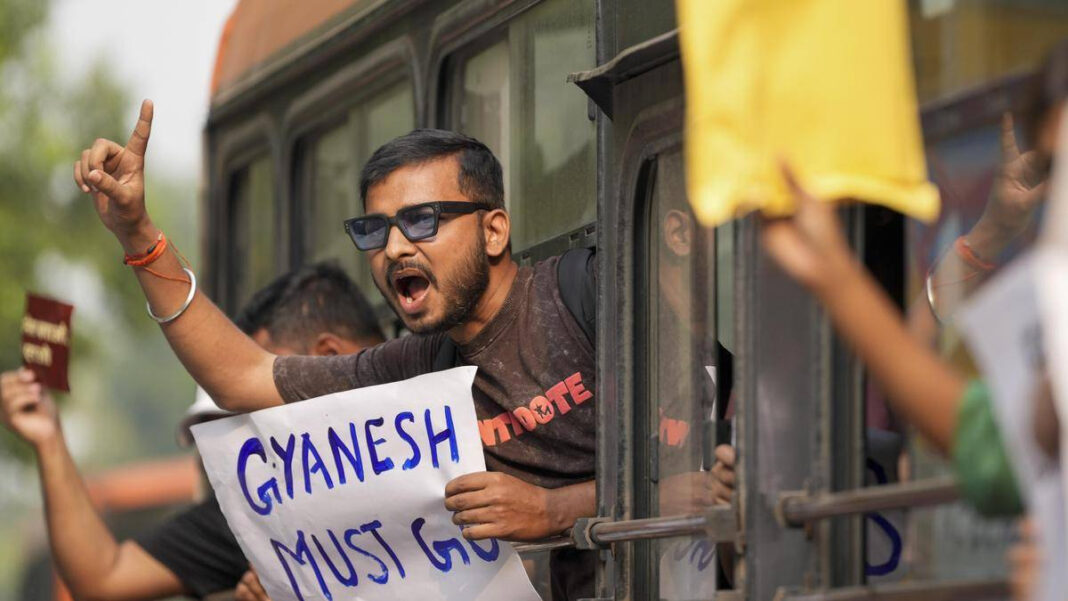
The additional submissions detail specific instances of preventive detentions, including of minors, many of which allegedly lasted close to 24 hours. These detentions, the petition states, took place during protests demanding the resignation of Chief Election Commissioner Gyanesh Kumar.
“A declaration to hold a peaceful demonstration by unarmed citizens is hardly information of commission of a cognisable offence or a harbinger of a violent breach of peace so as to warrant preventive arrests,” the plea argues.
Prohibitory orders and the Jantar Mantar question
The petition describes what it terms a modus operandi: first, police refuse permission for a demonstration, and then blanket areas of New and Central Delhi with prohibitory orders to manufacture grounds for detention based on alleged violations of police orders.
Central to the submissions is the status of Jantar Mantar as a protest site. According to the petition, the Delhi Police formally denotified Jantar Mantar as the “designated protest site” through a Standing Order on October 12—an act which, the plea says, itself acknowledges that Jantar Mantar had been the formally recognised venue for protests.
The plea further points to prohibitory orders issued under Section 163 of the BNSS on August 23, which covered the “whole of Sub Division Parliament Street” but explicitly exempted “the exempted area at Jantar Mantar Road.” Despite this exemption, the petition alleges, the police blocked entry and exit to Jantar Mantar, thereby creating an untenable situation in which people could be compelled to “technically” breach the order simply to access the designated and exempted protest area.
Accounts of detention and treatment of protesters
The submissions describe the detentions as mass, indiscriminate and “ab initio illegal.” Protesters, including students and ordinary citizens, were allegedly “herded like cattle” into buses, transported to police stations—some at considerable distance—manhandled and deprived of their mobile phones, the petition claims. Many were released only late at night or the following morning, it adds.
The filing also alleges that detainees were compelled to disclose passwords to their mobile phones. Such actions, it argues, constitute unwarranted intrusions into privacy and, in some instances, were accompanied by beatings that resulted in injuries.
Legal grounds cited against prolonged preventive custody
The petition asserts that detaining individuals for nearly 24 hours in the absence of any alleged or apprehended cognisable offence is unlawful. It cites Section 65 of the Delhi Police Act, 1978, to argue that, at most, the law allows removal from the spot or production before a Magistrate within 24 hours; it does not by itself authorise continued detention for that period.
“Even disobedience of an order of a public servant is a bailable offence. Therefore, the long hours of detention are completely uncalled for,” the submissions contend. According to the petition, the conduct of the police evinces an assumption that detainees can be held “at least for 24 hours” without any genuine apprehension of a cognisable offence—an assumption the plea argues is without legal foundation.
Reliefs sought
Mr. Jha has urged the court to summon records from police stations and detention centres related to the protests, seek explanations for the alleged misconduct, and order appropriate action against the police personnel involved. He has also sought compensation for what he describes as “gross violations of rules,” including unlawful detentions, seizure of phones and forced disclosure of passwords.
What comes next
The Bench led by CJI Surya Kant has agreed to list Mr. Jha’s writ petition for hearing on November 19, along with connected matters. The court is expected to examine the scope and application of prohibitory orders under Section 163 of the BNSS, the legal threshold for declaring a “breach of peace,” and the permissible limits of preventive detention during peaceful public demonstrations.
Why it matters
The petition places before the Supreme Court a set of questions that could shape how public order is balanced with constitutional freedoms in high-security zones of the capital, particularly in and around traditional protest sites. Its outcome may have significant implications for the policing of protests, the use of blanket prohibitory orders, and the legality of prolonged preventive detention in the absence of alleged cognisable offences.