
Actor Imran Khan moves Bombay High Court against ‘arbitrary, illegal’ leave-India notice
Actor Imran Khan on Saturday, October 17, 2026, filed a writ petition in the Bombay High Court challenging a “leave India notice” (LIN) issued to him by the Mumbai office of the Foreigners Regional Registration Office (FRRO), calling the directive arbitrary, illegal and unconstitutional. Khan’s legal team, led by advocate Zulfikar Memon, is expected to seek an urgent listing of the matter in the High Court on Monday, October 19.
FRRO issues second notice over OCI card
Even as the petition was moved, the FRRO on Saturday served a separate notice to Khan—who is a U.S. citizen and holds an Overseas Citizen of India (OCI) card—asking him to explain why his OCI status should not be cancelled. The actor has been given 15 days to respond to this show-cause notice. The earlier LIN had directed him to exit India on or before October 28, 2026.
Petition cites violation of constitutional rights
In his plea, Khan contends that the LIN violates Articles 14 and 21 of the Constitution, asserting that the decision was taken without adherence to due process. The petition alleges that the action stems from a politically motivated complaint lodged by a leader of a political party, and questions how the principles of natural justice were set aside.
Seeking disclosure of the grounds for the FRRO’s action, the petition states: “The LIN directs the petitioner to leave India by 28.10.2026 without disclosing any reasons, supporting material, or specific statutory contravention. It was issued without inquiry, a show-cause notice, or any opportunity for the petitioner to respond to the alleged violations.” The filing further describes Khan’s brief detention by the police on October 10 as “unjust.”
Detention during protest and subsequent FIR
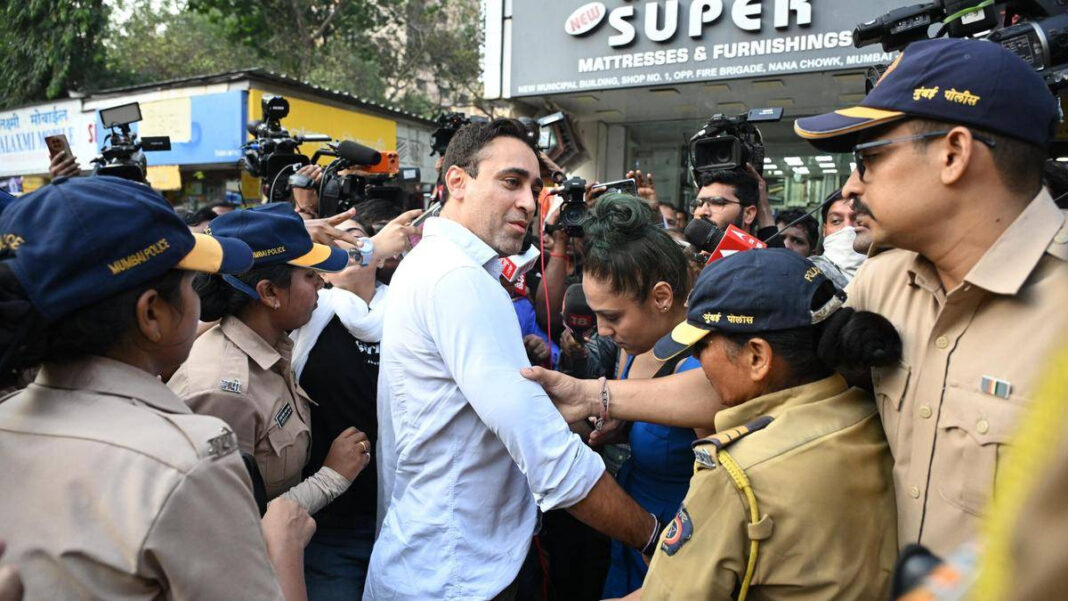
The legal challenge follows Khan’s participation on October 10 in a protest in Mumbai demanding the resignation of Chief Election Commissioner Gyanesh Kumar. According to the petition, Khan was stopped at a barricade before August Kranti Maidan and subsequently detained. He later learned through media reports that he had been named in an FIR in connection with the protest.
Khan asserts he is being “arbitrarily targeted as a public figure” and maintains that the LIN does not cite any specific breach. He argues that he committed no violation justifying such action by the authorities.
‘Non-application of mind’ and lack of due process alleged
The petition characterizes the notice as reflecting a “patent non-application of mind.” It adds: “Not only is the LIN manifestly disproportionate, if implemented, it would reduce the very principles of natural justice that the Respondents are duty bound to uphold to nothing but a dead letter.”
Khan maintains that he did not infringe any provisions of the Immigration and Foreigners Act or the Citizenship Act. “No gathering was taking place when the petitioner arrived; he neither entered any restricted or barricaded area nor disobeyed the police direction to leave; and he was apprehended only after the media surrounded him while he was returning to his nearby vehicle,” the petition states.
Personal ties to India
Emphasizing his long-standing connections in India, Khan notes in the petition that he has lived in the country since he was two years old, has deep-rooted familial, marital, educational and professional ties, and has no criminal antecedents. Khan is the nephew of renowned actor Aamir Khan and has acted in several Hindi films.
What’s next
The petition is likely to be mentioned before the Bombay High Court on Monday for urgent hearing. Separately, the FRRO’s show-cause notice regarding the potential cancellation of Khan’s OCI card requires a response within 15 days, even as the earlier directive asks him to leave India by October 28.
The case sets up a legal test of the FRRO’s actions against an OCI cardholder in the context of protest-related proceedings, with implications for due process and constitutional protections claimed by the petitioner.