
CJP ‘Tiranga’ protests: Detentions of Abhijeet Dipke and AISA’s Neha Bora spark political outcry; Central Park shut, heavy police deployment in Delhi
Detentions of Cockroach Janata Party (CJP) founder Abhijeet Dipke and All India Students’ Association (AISA) president Neha Bora on Friday during the CJP’s ‘Lehra Do Tiranga’ campaign in New Delhi drew sharp reactions from Opposition leaders and rights groups, even as authorities shut Connaught Place’s Central Park, enforced prohibitory orders and mounted a heavy police presence across central Delhi.
What happened on October 16
Central Park — the planned site for the 5 p.m. ‘Tiranga’ gathering — was ordered shut by the New Delhi Municipal Council (NDMC) for October 16–17, citing “administrative reasons.” Delhi Police said the event had no permission and warned of legal action for violations of prohibitory orders. More than 6,000 police personnel and 220 Central Armed Police Force (CAPF) companies were deployed in the area. Roads leading to Central Park were barricaded with police vehicles and a traffic advisory warned of congestion in and around Connaught Place from 3 p.m. onwards.
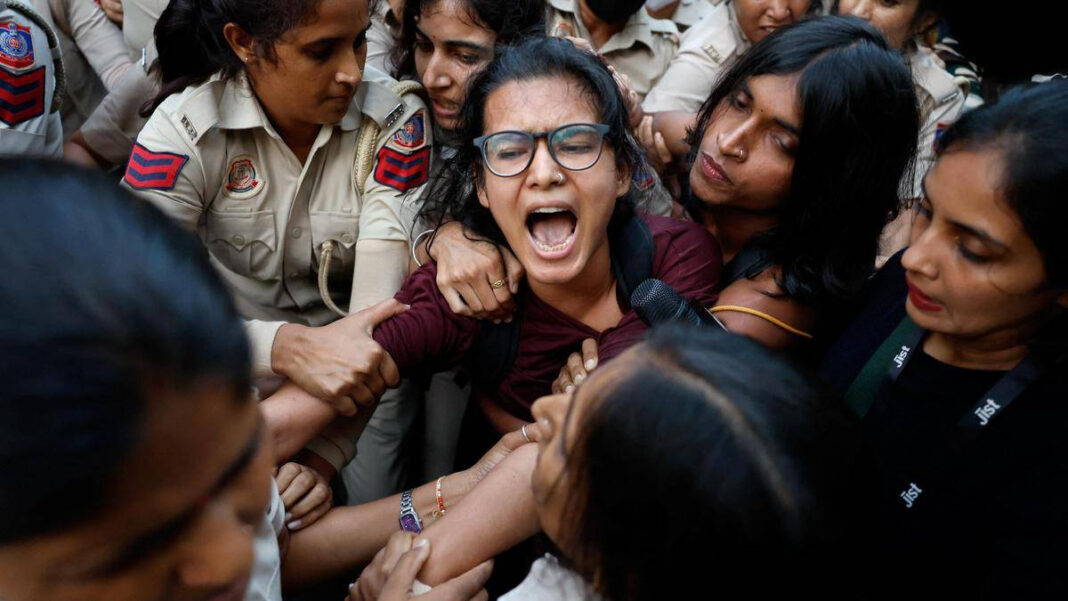
Despite the curbs, student and youth groups attempted to march with the tricolour towards Connaught Place. AISA announced an assembly at Mandi House metro station at 5:15 p.m., calling for the resignation of Chief Election Commissioner (CEC) Gyanesh Kumar, rollback of the Special Intensive Revision (SIR) of electoral rolls and repeal of the 2023 Election Commissioner Appointment Act. AISA’s Neha Bora led a march from Mandi House before being detained by police at the Mandi House circle along with other protesters.
Earlier in the day, CJP alleged that Dipke was detained outside the residence of NCP–SP spokesperson Anish Gawande as soon as he stepped out. A police official at the spot informed him of “preventive detention,” saying, “Section 163 is in force in Connaught Place. You are being detained.” The CJP later said Dipke was taken to an undisclosed location and denied access to lawyers.
Separately, AISA said Bora was initially taken alone to the Anti-Narcotics Task Force office in Manglapuri while associates were kept outside by “7–8 people in civil dress.” The group alleged two individuals in civilian clothes, who were “not detainees,” were in the van with her. As the night progressed, AISA said Bora was “rushed out” in a car with blackened windows and her whereabouts were unclear. Near midnight, AISA announced that lawyers were able to meet her at RK Puram police station, adding she had been unwell for days and was in need of medicines, which they said police were denying. The police had not provided clarity on her release by then, AISA said.
Marches, blockades and parallel rallies
Youth wings SFI–DYFI–AISF–AIYF and CPI(M) MPs John Brittas, V. Sivadasan and A.A. Rahim attempted to reach Central Park. A group led by SFI was stopped at Janpath–Tolstoy Marg, the road to Jantar Mantar. Later in the evening, Brittas and other CPI(M) MPs were reported to have reached Central Park with youth organisations. The Aam Aadmi Party (AAP) held a ‘Tiranga’ march on North Avenue near Rashtrapati Bhavan, led by Delhi AAP president Saurabh Bharadwaj, and later tried to march from its party headquarters towards Connaught Place before being stopped by security forces. The CJP urged supporters to head to Connaught Place in groups of fewer than five, take photographs with the tricolour and exit the area swiftly.
In Mumbai, CJP activists staged a solidarity ‘Lehra Do Tiranga’ protest at Azad Maidan, demanding the resignation of CEC Gyanesh Kumar. Social activist Anjali Damania sought accountability for what she called “brutality” by Delhi Police against protesters, while MNS leader Sandip Deshpande accused the Union government of trying to distract from inflation and unemployment.
Legal backdrop and court actions
On Thursday, the Delhi High Court declined to restrain the CJP’s planned October 16 protest at Central Park, while taking on record Delhi Police assurances that all steps would be taken to regulate crowds. Earlier on Friday, the Supreme Court refused an urgent hearing on a plea challenging the NDMC order closing Central Park.
In separate proceedings related to the October 10 protests over the electoral roll revisions, the Supreme Court asked the Union government to “enlighten” it about prohibitory orders issued under Section 163 of the Bharatiya Nagarik Suraksha Sanhita (BNSS), 2023, which led to mass detentions of journalists, lawyers and protesters. It directed preservation of CCTV footage. Delhi Police, in an affidavit, defended the “preventive measures” based on intelligence inputs and said detainees were kept in makeshift centres for two to six hours, provided “hot, fresh, good meals,” and that only cellular internet was suspended.
Statements and reactions
Condemnation over the detentions intensified through the day:
- DMK president M.K. Stalin called the detention of Dipke and Bora “blatantly illegal and deeply inhumane,” demanded their “immediate release,” and questioned their “whereabouts.”
- Congress MP Shashi Tharoor said “walking on a public street with a tiranga is not a crime” and sought an explanation from Delhi Police.
- CPI(M) MP John Brittas asked, “What kind of law and order allows the police to detain a citizen and keep her location a secret? Delhi police, remember you are accountable to the law — not above it.”
- CPI(ML) general secretary Dipankar Bhattacharya accused Delhi Police of violating “basic protocols regarding detention of a woman.”
- West Bengal Chief Minister Mamata Banerjee condemned Dipke’s detention, writing, “Abhijeet Dipke has been detained for holding the Indian National Flag. Let that sink in. In Independent India, our youth are being detained for peacefully asserting their democratic rights.”
Among other political responses, AAP leader Gopal Rai backed the ‘Tiranga Lahra Do’ campaign and termed the crackdown “dictatorial,” saying, “If the vote is saved, democracy will be saved. If democracy is saved, the nation will be saved.” Congress said the Election Commission had agreed to provide parties with a machine-readable digital voter list, a demand Rahul Gandhi had been pressing, adding, “The arrogance of Gyanesh Kumar… has bowed down.”
The BJP and allies countered with sharp criticism of recent Opposition actions. Defence Minister Rajnath Singh alleged Rahul Gandhi was “keeping the Constitution in his pocket” while spreading anarchy, insisting “democracy is not a license to spread chaos.” The BJP accused Opposition leaders of trying to turn the Supreme Court premises into a protest site during their October 12 march to file a petition on the SIR issue. JD(U) spokesperson Rajiv Ranjan Prasad called the march an “unprecedented attempt to pressure the judiciary,” noting that many issues raised were already sub judice; the Supreme Court has issued notices to Gandhi and other Opposition leaders on a plea against the march and sought responses from the Election Commission and CEC Gyanesh Kumar.
In a separate remark, BJP leader and former MP Brij Bhushan Sharan Singh alleged that U.S. entrepreneur Elon Musk was behind the Delhi protests as part of an “anti-India conspiracy” to advance his business interests. He provided no evidence to support the claim.
Protesters’ case: ‘Democratic rights, not anarchy’
Earlier on Friday, Dipke defended peaceful protests as “the most fundamental expressions of democracy,” saying CJP would exercise constitutional rights rather than “resort to physical force,” even after he was “personally assaulted in Jaipur.” He alleged “extraordinary restrictions” in Delhi were aimed at stopping protests that demand CEC Gyanesh Kumar’s resignation and a rollback of the SIR. At a joint press conference with Bora and leaders from SFI and AISF on Thursday, he questioned alleged large-scale deletions from voter rolls, asking, “Over 13 crore voters deleted, what is this if not a setting?”
Election roll controversy and institutional responses
The protests are anchored in allegations surrounding the SIR of electoral rolls. Investigations and state-level developments cited by Opposition groups and civil society over recent days include:
- Reports that lakhs of voters in Telangana and elsewhere, categorised as ‘Absent, Shifted, Dead and Duplicate’ (ASDD), were deleted via auto-generated Form 7s signed by Electoral Registration Officers without following due process under the Registration of Electors Rules, 1960.
- Concerns that State poll authorities implemented auto-Form 7 deletions without any written standard operating procedures from the Election Commission of India (ECI).
- In Maharashtra, the Chief Electoral Officer had yet to publish the list of 1.22 crore voters issued notices for “logical discrepancies” or being “unmapped” in earlier phases, despite ECI directions to put such lists on State websites.
As protests intensified, the ECI announced resumption of the annual Special Summary Revision (SSR) in 17 States and Union Territories, including poll-bound Uttarakhand, Uttar Pradesh and Punjab, to enrol new voters and update rolls — an exercise that had been stalled last year due to the SIR. Separately, the Supreme Court issued notice to the Centre on a plea by the Association for Democratic Reforms challenging lifelong immunity granted to the CEC and Election Commissioners for acts done in official capacity under the 2023 law.
Press freedom and safety advisories
Following reports of detentions and assaults on October 10–11, the Committee to Protect Journalists said at least 43 journalists were temporarily detained across Delhi, Ahmedabad, Pune and Mumbai while covering anti-CEC protests; some were allegedly assaulted and at least five phones were seized. This week, the Press Council of India issued fresh safety guidelines for journalists covering protests, advising them to carry valid IDs, plan escape routes, and keep first-aid kits, among other precautions.
Regional and international notes
In Bengaluru, police denied permission for a solidarity Tiranga March planned with Jagruta Karnataka, AISA Karnataka and ‘My Vote, My Right,’ citing a High Court order designating Freedom Park — not Town Hall — as the approved protest venue. Meanwhile, India’s Ambassador to the U.S., Vinay Mohan Kwatra, termed comments by U.S. Congresswoman Pramila Jayapal supporting the anti-SIR protests as “unacceptable interference” in India’s internal affairs. Jayapal had drawn parallels between the SIR and purported voter roll strategies in the United States.
Business impact in Connaught Place
The hospitality and retail sector in Central Delhi flagged losses amid the weeks-long protest cycle. National Restaurant Association of India treasurer Manpreet Singh said frequent protests had hurt Connaught Place businesses, sometimes resulting in “zero sales” on certain days, and urged that any large assemblies be held several kilometres away from the commercial hub.
Parallel political mobilisation
Amid the standoff, Congress leaders Mallikarjun Kharge and Rahul Gandhi met with cadres of the National Students’ Union of India, Indian Youth Congress and Seva Dal to commend their role in protests demanding the CEC’s resignation and a halt to the SIR. The AAP amplified its support online and on the streets with symbolic ‘Tiranga’ actions near Parliament and Rashtrapati Bhavan. The BJP counter-campaign continued to question the Opposition’s methods and motives, invoking the Emergency and accusing rivals of “intimidating” constitutional institutions.
Where matters stand
As of early hours on October 17, lawyers had met AISA’s Neha Bora at RK Puram police station, with AISA alleging she remained unwell and without access to medicines, and no clarity from police on her release. The CJP maintained it had lost contact with Dipke after his initial preventive detention and alleged he was taken to an undisclosed location without access to counsel. Opposition leaders including M.K. Stalin, Shashi Tharoor, John Brittas and Mamata Banerjee continued to demand their immediate release and accountability from authorities.
The legal and political contest over the SIR and the right to protest shows no sign of abating. With Central Park closed, BNSS prohibitory orders in effect, and multiple court proceedings in motion — including the Supreme Court’s scrutiny of the October 10 clampdown and aspects of electoral administration — further developments are expected in the coming days, both on the streets and in the courts.