
Poet Kannadasan: a creative mind that enriched Tamil cinema with exquisite, philosophical songs
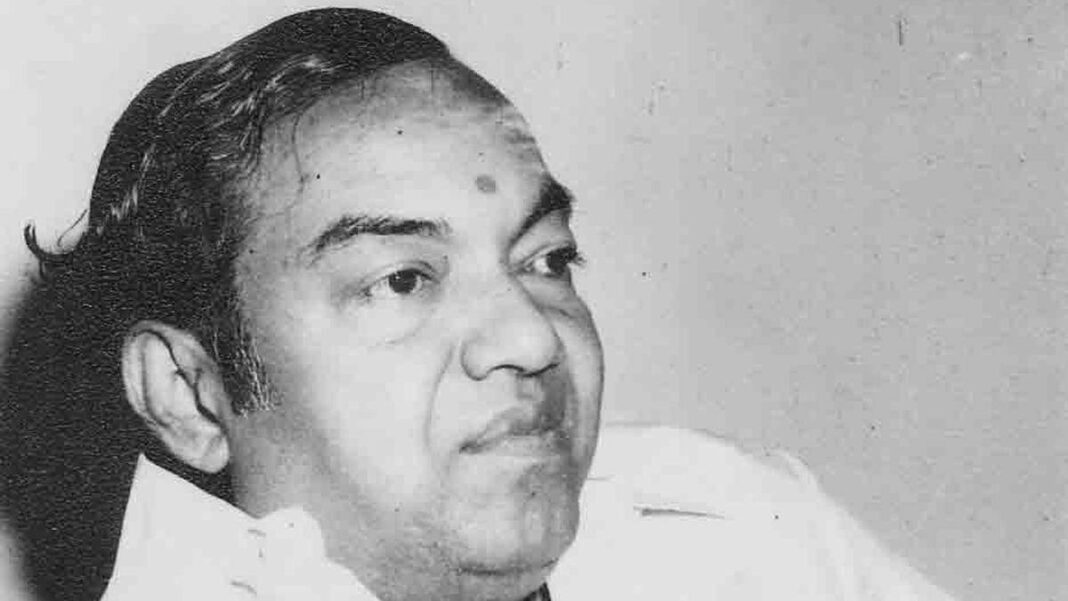
As Tamil Nadu marks the birth centenary of Kannadasan, generations of listeners continue to reach for the poet’s film songs in moments of nostalgia, solace and quiet contemplation. Few lyricists have stitched together such an enduring tapestry of emotion, philosophy and cultural memory — lines that caress like a peacock feather and remain lodged in the public imagination decades after they were written.
Gandhi Kannadasan, the poet’s son, has recalled how, at the turn of the millennium, Tamil IT professionals habitually returned to the lines of one of his father’s most reflective songs: “Amaithiyaana Nathiyinile Odum Odam, Alavillatha Vellam Vanthaal Aadum” — a boat that glides smoothly on a still river will sway when the waters rise. It is the plainspoken wisdom and tender empathy in such lines that cemented Kannadasan’s singular place in Tamil popular culture and letters.
Early life, a name in a flash, and the making of a poet
Born Muthaiah in 1927 in Sirukoodalpatti in Chettinad, then in the erstwhile Ramanathapuram district (now Sivaganga), Kannadasan was given in adoption, a long-standing custom among the Nattukottai Chettiars. He left school after class VIII and travelled to Chennai seeking work. After several false starts, he found employment with Ajax Company in Tiruvottiyur. Not far from the factory stood the memorial of Pattinathar, the revered Tamil philosopher-poet and fellow Nagarathar — a quiet sanctuary that proved formative for the budding writer.
In his searing memoir Vanavasam, Kannadasan describes how he would sit by the shrine after work, allowing his mind to wander and his imagination to unfurl. He later wrote that it was Tiruvottiyur that created the “conducive atmosphere” for him to become a poet. The memoir is candid to a fault — an unvarnished account of his own failings and encounters, including a meeting with a sex worker who, he wrote, once asked him to marry her and promised to leave her profession. Years later, when they met again, she recognised him only as a luminous personality from the film world.
The name “Kannadasan” itself, he once said, was born in an instant. In Pudukkottai, when a magazine owner asked him for his name as he was about to join the publication, he offered “Kannadasan,” and it stuck for life. From there, he delved deep into Tamil classics, Hindu philosophy, the Puranas and the Vedas, absorbing and re-expressing their riches in approaches that felt both timeless and strikingly modern.
Though his Vanavasam is often cited by critics of the DMK to target its leaders — particularly the late Chief Minister M. Karunanidhi — Kannadasan was unsparing yet generous on the page. He also recorded his admiration for Karunanidhi as a writer, noting how the latter’s dialogues for the film Veera Abimanyu continued to echo in his ears.
A language of images: classical echoes in a modern voice
Kannadasan’s lyricism could summon centuries of Tamil tradition with a single image. Across Tamil Nadu’s villages, mornings still begin to the devotional strains of “Krishna Ganam,” an album featuring the much-loved “Pullangkuzhal Kodutha Moongilkale.” One line in particular captures a seasonal and spiritual mood with painterly delicacy: “Margazhi Pani Naalil Mangaiyar Ilam Tholil Karkuzhal Vadivaga Kannan Vanthan” — Kannan (Lord Krishna) arrives like a dark-hued cloud, evoking the cascade of long tresses over young women’s shoulders on misty Margazhi mornings when girls observe Paavai Nonbu.
His keen reading of classical literature frequently surfaced in streamlined, resonant adaptations. From Kambaramayanam’s line “Nathiyin Pizhai Anru Narum Punal Inmai” (if there is no water, it is not the river’s fault), he crafted for the film Thyagam the crystalline: “Nathi Vellam Kaainthu Vittal Nathi Seitha Kuttram Illai.” The famous “Aattuvithal Yaroruvar Aadathare Kanna” traces its lineage to both Thirunavukkarasar’s Thevaram — “Aatuvithal Yaroruvar Aadathare” — and Vallalar’s Arutpa — “Aatuvithal Aadukindren.”
Music-room alchemy and a cinema legacy
Composers and actors who worked with Kannadasan have long extolled the ease with which philosophical ideas seemed to materialise as singable poetry when he heard a tune. Maestro Ilaiyaraaja frequently praised this quality, citing lines that feel chiselled out of classical Tamil while remaining entirely accessible. From “Senthazham Poovil,” the imagery of a princess drifting like a cloud remains unforgettable: “Azhagu Miguntha Rajakumari Megamaga Pogiral; Jarikai Nezhiyil Selaikondu Malalai Moodaparkiral.”
Actor Kamal Haasan has recounted how, during the making of Apoorva Raagangal, Kannadasan wrote all the songs and left quietly after director K. Balachander expressed anger about delays in writing. The album would go on to make history: “Ezhu Swarangalukkul Ethanai Padal” earned Vani Jayaram the National Award for Best Female Playback Singer.
Faith, doubt, and the freedom to change
Kannadasan’s ideological journey is central to his oeuvre. An avowed atheist during his early years in the Dravidian movement, he later embraced spirituality and authored multiple volumes of Arthamulla Indhumatham. Critics accused him of inconsistency; Kannadasan saw it as fidelity to his conscience. He changed course, he wrote, whenever an ideology diverged from his inner convictions.
That creative self-conviction found bold lyrical expression. In the film Raththa Thilagam, he wrote: “Padaippathanaal En Per Iraivan” — I am God because I create. Elsewhere, he declared an artist’s immortality with characteristic certainty: “Naan Niranthramanavan; Azhivathillai. Entha Nilaiyilum Enakku Maranamillai.”
Politics, principle and the Dravidian churn
Alongside cinema, Kannadasan was an active political figure and a prominent voice in the Dravidian movement. He wrote rousing songs for M.G. Ramachandran and others that wore their ideology on their sleeves. In Mannathi Mannan, he thundered, “Acham Enbathu Madamaiyada; Anjaamai Dravida Udaimaiyada.” In Sivagangai Seemai, he proclaimed, “Veerargal Vaazhum Dravida Naatthai Vendravar Kidaiyaathu.”
Yet he was no mere propagandist. When DMK founder C.N. Annadurai dropped the demand for a separate Dravida Nadu, Kannadasan publicly questioned the shift, even while his admiration for Annadurai was evident in his poems. In hindsight, separating from Annadurai when power was within reach might appear politically unwise. But at a time when poets often courted authority through flattery, Kannadasan chose to act on principle — a choice that would define both his political arc and his literary character.
Critics, comparisons and a place in the canon
Some have argued that Kannadasan’s popularity owed primarily to the reach of cinema. Tamil scholar Pazha. Karuppaiah has pushed back decisively against that reading, noting that not every film lyricist attains permanent residence in public memory. In Karuppaiah’s view, Kannadasan belongs in the league of national poet Subramania Bharathi and his disciple Bharathidasan — modern voices who reflected their times, spoke truth through their verse and, each in their own way, contributed to a renaissance of Tamil.
Memory, monuments and the daily present
The poet’s presence in Tamil life is not only audible; it is visible. A statue of Kannadasan was unveiled by then Tamil Nadu Chief Minister J. Jayalalithaa on December 9, 1994, on G.N. Chetty Road in T. Nagar, Chennai. In his native Sirukoodalpatti, a memorial exhibits items from his childhood — quiet testaments to a life that began modestly and radiated outward through words.
His own description of artistic immortality has, with time, felt increasingly prophetic. The songs remain — in the hush of early Margazhi mornings, in the memory of political ferment, and in the private soundtrack of everyday lives. That endurance owes as much to his facility with melody and image as to the faith he placed in poetry’s power to endure the passage of time.
Conclusion
Kannadasan’s centenary is less a commemoration than a recognition of how thoroughly his lines have entered Tamil’s shared emotional vocabulary. He brought the cadences of classical literature to popular cinema, distilled philosophy into phrases that could be hummed, and never shied from letting his conscience lead him — across ideology, across art. In doing so, he wrote himself into the very fabric of Tamil cultural memory, just as he once declared: in any circumstance, there is no death for the word that continues to sing.