
How Omar Abdullah’s Statehood Resolution Puts the Autonomy Debate Back at the Centre
Jammu and Kashmir Chief Minister Omar Abdullah has thrust the autonomy debate back into the political spotlight after steering a resolution through the Assembly calling for the “immediate and urgent restoration of full Statehood to J&K.” Brought on September 25 and passed on September 28, the resolution presses the Union government to act without further delay, citing the Supreme Court’s 2023 direction to restore statehood “at the earliest” and “as soon as possible.”
The Resolution and Its Passage
Mr. Abdullah told the House the move was necessitated by the Centre’s continued delay in reversing the 2019 downgrade that followed Parliament’s abrogation of Article 370 during Prime Minister Narendra Modi’s term. The resolution received support from 61 of the 90 members, including legislators from the National Conference (NC), Congress, CPI(M), Peoples Democratic Party (PDP), J&K Peoples Conference (JKPC), Aam Aadmi Party (AAP) and Awami Ittehad Party (AIP). After the vote, the Chief Minister urged New Delhi to “fulfil its commitment towards restoration of Statehood.”
Why the BJP Stayed Away
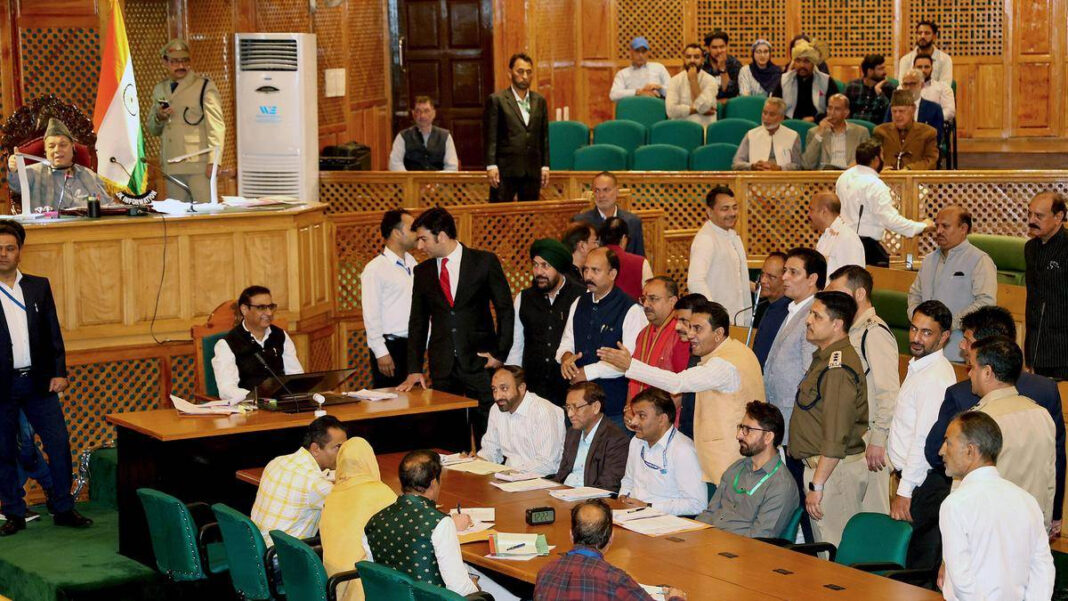
The Opposition Bharatiya Janata Party (BJP) boycotted the vote, objecting to wording that said the statehood resolution was “in addition to the resolutions passed by this House on June 26, 2000 and November 6, 2024,” references to the Assembly’s earlier autonomy and special-status assertions. BJP legislators protested on the floor of the House, stormed the well and staged walkouts. Leader of the Opposition Sunil Sharma called the references “unnecessary” and demanded a resolution focused solely on statehood. He argued that J&K is a sensitive region and warned against any “Pakistan agenda,” reiterating that the Union Territory is an integral part of India.
The BJP also targeted the NC’s Speaker Abdul Rahim Rather for allowing the resolution in its current form and moved a motion seeking his removal.
What the 2000 Autonomy Resolution Sought
The 2000 autonomy resolution was crafted against the backdrop of a violent decade in the 1990s that had driven then Chief Minister Dr. Farooq Abdullah from office and from the Valley, before he returned with a mandate in 1996. Seeking a constitutional path that could appeal to alienated sections and offer an alternative to separatist calls for independence or merger with Pakistan, the NC set up a committee to identify the erosion of regional autonomy since 1953.
On June 26, 2000, Dr. Abdullah tabled the autonomy resolution, which was adopted unanimously by regional parties. It proposed, among other measures, redesignating the Governor as Sadr-e-Riyasat (Head of State) and the Chief Minister as Wazir-e-Azam (Prime Minister); substituting the word “temporary” in Article 370 with “Special”; barring the use of Article 356 to impose President’s Rule; curbing the roles of the Election Commission of India and the Comptroller and Auditor General in the State; and rescinding all post-1954 Constitutional Orders. The Union Cabinet under Prime Minister Atal Bihari Vajpayee summarily rejected the recommendations as an attempt to “set the clock back.”
Why Omar Abdullah Cited Earlier Resolutions
With J&K’s downgrade to a Union Territory in 2019, Kashmir’s mainstream parties have sought once again to frame a constitutional alternative that speaks to anxieties over land, jobs and identity. By referencing the 2000 autonomy and the 2024 special-status resolutions, the ruling NC aimed to situate the new statehood push within that larger constitutional continuum and to address multiple political constituencies.
While clarifying that the current resolution dealt only with the restoration of statehood, Mr. Abdullah cautioned the Centre against tying the decision to the complete cessation of militancy or “allowing Pakistan to decide on it.” He insisted the decision should be taken in New Delhi on its own merits and not be contingent on any external factor. In pursuit of wider consensus, he also blocked attempts by eight NC legislators to insert references to Article 370, Article 35A and the pre–August 5, 2019 status, warning that such additions could give the BJP an excuse to withhold support and prevent a unanimous vote on statehood.
A Rift With the Bureaucracy
The resolution also triggered a confrontation with the Union Territory’s top bureaucracy. Mr. Abdullah informed the House that on September 26—one day after he moved the resolution—Chief Secretary Atal Dulloo and Law Secretary Achal Sethi sent separate communications to the Speaker, advising against allowing the debate on the grounds that the matter was sub judice. The Chief Minister said the letters were not shown to him.
“I don’t know on whose behalf they did this. Which State in the country will witness the Law Secretary and Chief Secretary oppose a resolution moved by the Chief Minister? It’s because of a Union Territory status,” Mr. Abdullah said, describing the move as an attempt by the bureaucracy to scuttle the exercise. The episode reignited debate over the powers of the legislature in a Union Territory and the degree of bureaucratic accountability to the elected executive.
Assembly Pushback and Legal Questions
Congress legislator Nizamuddin Bhat demanded that the letters be placed on the record and debated by the House. He called the intervention “a challenge to the prestige, dignity and powers of the Assembly,” questioned whether officers could act “as a government without consulting the government,” and said it undermined the authority of both the Speaker and the House. He maintained that the Assembly is governed by the same rules as a State legislature and argued that neither the Constitution nor the J&K Reorganisation Act supports preventing such a resolution from being discussed.
What Comes Next
With the resolution now adopted, the onus shifts to the Union government to respond to the Assembly’s call and to the Supreme Court’s earlier direction on statehood. Mr. Abdullah has framed the vote as a test of the Centre’s stated commitment to restoring Jammu and Kashmir’s full statehood, independent of security conditions or external considerations.
The political fallout, however, continues to unfold—between the treasury and opposition benches over the resolution’s framing, and between the elected government and the bureaucracy over the Assembly’s prerogatives—ensuring the autonomy and statehood debate will remain at the centre of J&K’s politics in the weeks ahead.