
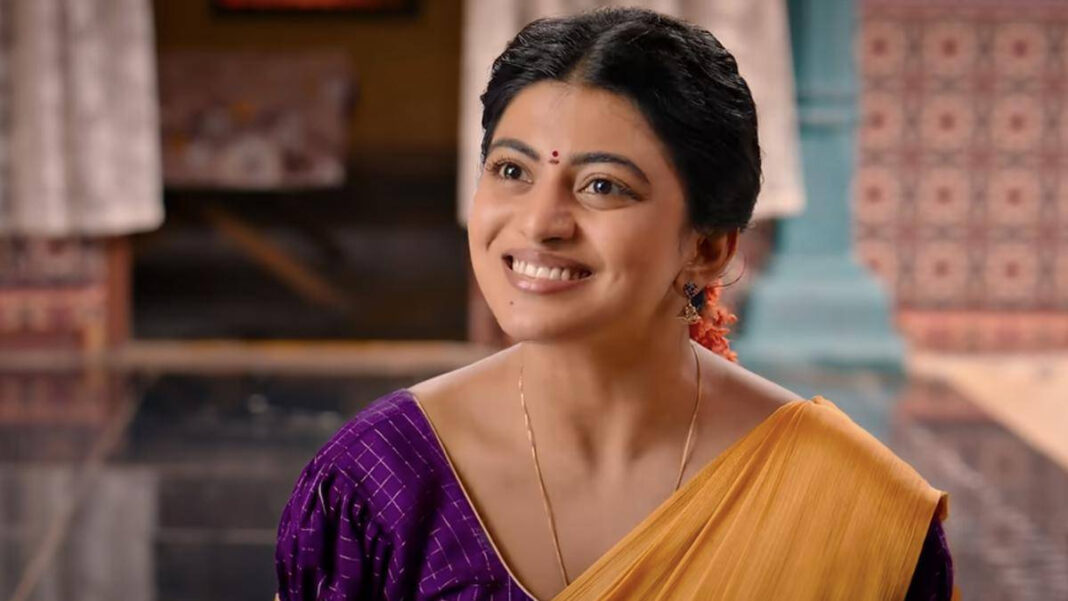

Anandhi has been on the move, promoting Garividi Lakshmi. The Telugu film narrates the story of Garividi Lakshmi, the Vizianagaram-based Burra Katha artiste, and seeks to give the folk icon her due.
Away from showbiz, Anandhi is Rakshita — the name she goes by back home in Warangal. She began acting while still in high school, yet managed to hold on to a life beyond cinema, travelling between her hometown and sets across Tamil Nadu and the Telugu states while completing her MBA. Despite the visibility that comes with cinema, she has kept a low profile, turning to social media only when she has a film to promote.
Excerpts from a conversation:
Garividi Lakshmi is the first time you have portrayed a woman’s life in its entirety, from her teens through middle age and into her later years. What was it like to play an older character?
Playing a woman through the highs and lows of a life spanning several decades was a first for me. I have done a few women-centric films, but this role required me to tap into a wider range of emotions. Portraying an older character came with challenges, particularly because of the prosthetics. Your face does not move as easily, and subtle expressions become difficult to convey. I was conscious of getting it right.
Costumes played a big part in shaping the character. From langa vonis (half saris) and cotton saris to silk drapes and a simple look in the climax, every detail contributed to her authenticity. Gradually stripping away the make-up to arrive at a more natural look felt important. Director Gowri Naidu, the costume designers and stylists took great care to ensure that the essence of the character came through.
How did you approach the performance?
It did not require greater effort than my other roles. I try to understand a character on a psychological level and don’t overthink. For most scenes, I did not need multiple takes. I wanted to stay true to the emotion and finish a scene in one or two takes.
My approach to acting is instinctive. Perhaps it is because I started acting when I was not too conscious of the process. Whenever I take up a film, I spend two or three days understanding the director’s expectations and then let the performance flow.
Rag Mayur and Anandhi
| Photo Credit:
Special Arrangement
Garividi Lakshmi was an active part of the promotional campaign. What was it like spending time with her?
The idea behind the film was to restore the identity that had been snatched from Garividi Lakshmi garu. Earning her approval of my performance felt surreal. The fact that she was there to witness the resurgence of interest in her made the entire journey, which spanned a couple of years, worthwhile.
The shoot was challenging both physically and mentally, but all the hardships feel trivial now. One of the most touching aspects has been the audience’s response to the climax, where the line between her reel and real life blurs.
A major part of the film unfolds in the 1990s and early 2000s. Did it bring back memories?
You bet! My love for music and rhythm dates back to when my father brought home a tape recorder while I was in kindergarten. It sparked my love for dance, which eventually led me to cinema.
The film’s underlying theme of how recorded performances gradually eclipsed live ones struck a chord with me. It highlights the bittersweet truth of how society has moved away from live art.
I do not relate much to the way of life today. I do not enjoy using phones. Staying constantly connected is a professional hazard. I love being on a film set. Everything else – the fame, promotional activities and interviews – takes too much effort.
You have lip-synced to more than a dozen songs in this film, whereas most of the songs in your career have been montage numbers. What was that experience like?
I fell in love with Lakshmi garu’s music and listened to the songs repeatedly, which made the preparation easier. During close-ups, I would sing aloud while lip-syncing so that my expressions looked and felt real.
Performing before huge crowds at night and filming the live stage sequences with junior artistes who had travelled from remote villages was quite a task. The songs and performances were filmed in full, from start to finish. It was challenging, but also refreshing.
You have worked with established filmmakers such as Vetrimaaran and Mysskin, and first-time directors (from Mari Selvaraj to Navaneeth Sriram and Gowri Naidu). How different are the working environments, and how do you adapt?
Debut directors give a project their all in every department. Experienced directors bring efficiency and speed, while newcomers come with fresh, unconventional concepts. Once I sign a project, I try to adapt to their style.
Garividi Lakshmi came with its challenges, because the team was relatively young. Coordinating live audio set-ups and shot divisions took time, and the meticulous approach meant the shoot often ran behind schedule. There were days when I had to accommodate two or three shooting schedules. Much of the burden of keeping the schedule on track fell on my shoulders. I pushed through because I believed this story had to be told.
An image from the film Garividi Lakshmi.
| Photo Credit:
Special Arrangement
There are parallels between Garividi Lakshmi’s life and that of an actress, particularly the transient nature of fame and the unpredictability of relationships.
I agree. Added to that, on a massive set with hundreds of people, an actress is often one of the very few women present. When dealing with fame and people at work, I don’t take success or failure too seriously. I live in the moment and enjoy the experience. Highs and lows are part of the process. I prefer to handle things independently. In that sense, I am introverted and practical.
When a reasonably good film, such as Premante…, tanks at the box office but finds an audience on OTT, what do you take away from the experience?
It taught me that even when you make a genuinely good film, getting it to reach audiences can be an uphill battle. Even with Garividi Lakshmi, we are up against massive projects such as Jailer 2 and Ranabaali. Limited theatre allocations and awkward show timings mean that family audiences often skip the film altogether.
So much is beyond our control. All I can do is give it my best shot and hope that the film finds its audience.
You maintain a low profile in an industry where social media visibility and PR have become indispensable.
Today, there is an expectation to broadcast everything, from what you eat to where you holiday. Until recently, I wasn’t even on social media beyond a Twitter account that I used only for movie updates. I created an Instagram account under pressure, but I don’t enjoy taking pictures and posting them for the sake of it.
When people curate flawless, aesthetically pleasing lives online, it can intimidate someone on the other side of the screen who is having a tough day. They may start feeling that everyone else’s life is perfect. I don’t want to contribute to that kind of quiet pressure. I’m confident in my work and my process, and that helps me feel secure.
You started your career while still in high school. Warangal remains your base, and you travel to film sets across Tamil Nadu and the Telugu states for work, all while completing your MBA. That’s a lot to juggle.
I credit my parents for keeping my feet on the ground. Shooting in Trichy and Madurai involves long hours of travel, but I deliberately wanted to maintain that separate world of my own. When I returned home, I was a different person, and I cherished that balance while completing my studies.
Being in showbiz made my MBA studies easier. Through film production, I had a practical understanding of finance and management, which helped me develop financial discipline. Reading books such as Rich Dad Poor Dad during my MBA days also shaped my perspective on life and money.
The exposure you get on a film set is something a college student rarely experiences. Meeting around 300 new people every day and adapting to different sets made me realise that I could never fit into a monotonous daily routine.
Looking back, there was a time when I felt nostalgic, wishing I could lead a normal life. Eventually, I realised that you cannot have it all. I finished my education, but movie sets became my school.
Published – October 28, 2026 07:00 am IST