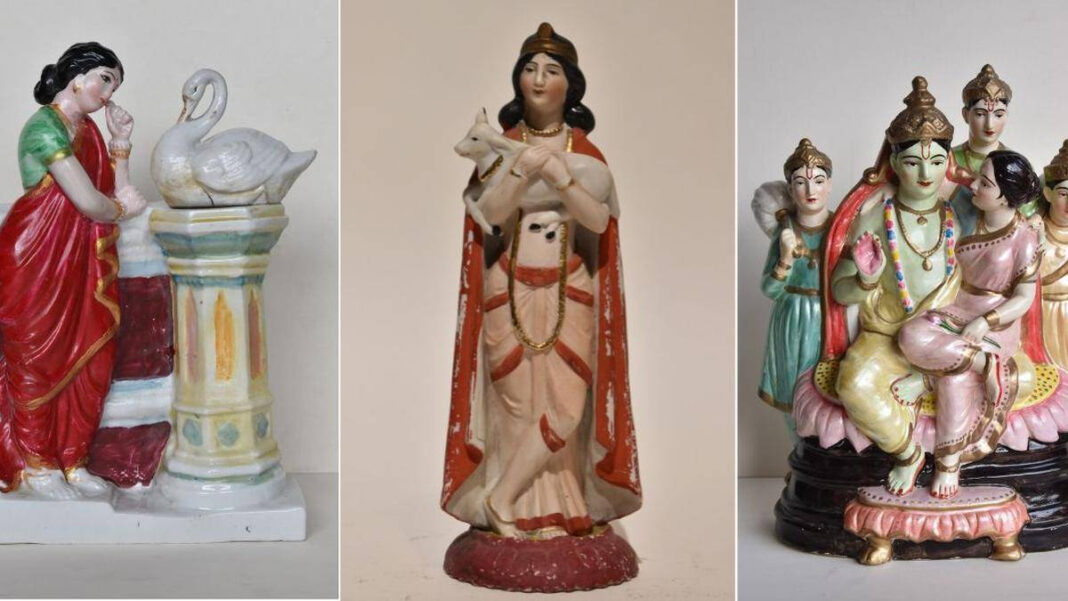

When art collector Anil Relia, 69, came across a delicate porcelain Krishna at an antique dealer’s shop in Surat in the early 1990s, something about the figurine seemed off. The deity had pink cheeks, a European-looking crown and an unfamiliar posture — it stood with the wrong (left) foot forward. Another figurine showed Krishna carrying a calf in his arms, in a pose reminiscent of Christian depictions of Christ with a lamb.
Krishna porcelain (circa 1880-1920)
| Photo Credit:
Courtesy: Anil Relia Collection
Rather than dismissing these peculiarities as mistakes, Relia says he became curious. “Where had these objects come from, and who had made them?” The search led him to an overlooked chapter in the history of Indian art: porcelain figurines of Hindu gods and goddesses, manufactured in Europe and Japan during the colonial period, using Indian lithographs as models. “They had never seen Indian gods and goddesses, or even Indian people,” he says, recalling one representation of Shiva, for instance, with distinctly Japanese features.
These objects, which travelled back to India to find buyers among its growing devotional market, are now the subject of Porcelain: The Lithographic Mold, a new exhibition at Ahmedabad’s Lalbhai Dalpatbhai Museum.
Menaka and Shakuntala
| Photo Credit:
Courtesy: Anil Relia Collection
From print to porcelain
The story begins with the spread of lithography in India during the late 19th century. Printing presses in Calcutta, including the Chore Bagan Art Studio, and presses in western India, such as the Chitrashala Press in Pune, helped circulate colourful images of Hindu deities and mythological figures. Painter Raja Ravi Varma’s prints further expanded the reach of this visual culture, bringing images previously associated with temples and elite patronage into ordinary homes.
For European traders, the popularity of these prints presented a commercial opportunity. Indian dealers supplied images to manufacturers in Germany, Austria and Japan, where artisans converted them into porcelain figurines. The finished objects were then exported to India where they offered an affordable alternative to the more expensive devotional sculptures of the time, made from bronze, wood or ivory. “For us, it was devotion. For the Europeans, it was business,” Relia says. “They saw the commercial potential because the lithographs were selling so well.”
Savitri Satyavan porcelain (circa 1880-1920)
| Photo Credit:
Courtesy: Anil Relia Collection
The figurines on exhibit also reveal the differences between European manufacturing techniques and the versions subsequently produced in India. The former was typically painted and then fired, allowing the colours to become part of the finished surface. Indian manufacturers, Relia explains, often applied colours over already-fired porcelain, making the decoration more vulnerable to scratches and peeling.
Savitri Satyavan (circa 1880-1920)
| Photo Credit:
Courtesy: Anil Relia Collection
As Indian traders began producing their own versions, they adapted details of the imported figurine. His collection includes examples of different sizes and craftsmanship. One of his prized objects is a Ram Panchayatan, a composition depicting Rama, Sita, Lakshmana, Bharata and Shatrughna. Measuring approximately a foot across, it is among the largest European-made porcelain compositions of its kind that he has encountered.
Ram Panchayatan (circa 1880-1920)
| Photo Credit:
Courtesy: Anil Relia Collection
The exhibition brings together 124 such porcelain objects and around 36 lithographs, allowing visitors to compare the two-dimensional printed images with their three-dimensional counterparts.
Porcelain: The Lithographic Mold at Lalbhai Dalpatbhai Museum
| Photo Credit:
Courtesy Lalbhai Dalpatbhai Museum
| Photo Credit:
Courtesy Lalbhai Dalpatbhai Museum
It was a Golu exhibition earlier this year at the Lalbhai Dalpatbhai Museum that gave Relia the idea for exhibiting the figurines. He approached museum director Sujata Parsai to jointly curate the exhibition. He even contributed display cabinets and books on Raja Ravi Varma and lithography. Relia has another 50-60 porcelain pieces at home, but decided not to show any whose origins or links to lithographs could not be established.
Porcelain: The Lithographic Mold
| Photo Credit:
Courtesy Lalbhai Dalpatbhai Museum
Visually, there’s a lot in common between Golu dolls and these porcelain figurines. But, as Relia notes, the latter have largely fallen out of fashion as household decorations in the last 30-40 years. Today, it is mostly collectors who continue to preserve them.
Hans Damyanti lithograph, late 19th-early 20th century (Ravi Varma Press)
| Photo Credit:
Courtesy: Anil Relia Collection
Hans Damyanti porcelain (circa 1880-1920)
| Photo Credit:
Courtesy: Anil Relia Collection
Who decides what art is?
For Relia, the show is an opportunity to reconsider objects that have occupied an uncertain place in Indian art history. Fragile and often poorly documented, these figurines have frequently been overlooked or discarded. He compares their neglect to the earlier marginalisation of art forms such as Nathdwara paintings and Company-period works.
Collector Anil Relia
| Photo Credit:
Courtesy Lalbhai Dalpatbhai Museum
Categories such as high art and low art, he argues, can obscure the cultural significance of objects made for popular consumption. “Why should we decide what art is?” he asks. The figurines, he adds, are imperfect records of a fascinating exchange: Indian images interpreted by artisans working thousands of kilometres away, shaped by the demands of commerce. Their unfamiliar faces and occasionally incorrect iconography are not errors, but clues to the journeys the objects have made.
Porcelain: The Lithographic Mold
| Photo Credit:
Courtesy Lalbhai Dalpatbhai Museum
or a collector whose interests span printmaking, photography and serigraphy, porcelain’s appeal also lies in its accessibility. “You enjoy it simply by looking at it,” concludes Relia, who keeps his collection of more than 200 porcelain figurines and a 1,000 lithographs, collected over 30-40 years, in a dedicated display cabinet, with additional pieces stored carefully in boxes at his Ahmedabad home.
Porcelain: The Lithographic Mold is on view at the Lalbhai Dalpatbhai Museum in Ahmedabad till November 1.
Published – October 28, 2026 12:09 pm IST