
More than 1,500 years separate the oldest and newest works in ‘Avatar: Forms of Vishnu’, yet they are bound by a single idea: to imagine and reinterpret Vishnu, one of the Hindu trinity — alongside Brahma and Shiva. He is revered as the preserver and protector of the universe.
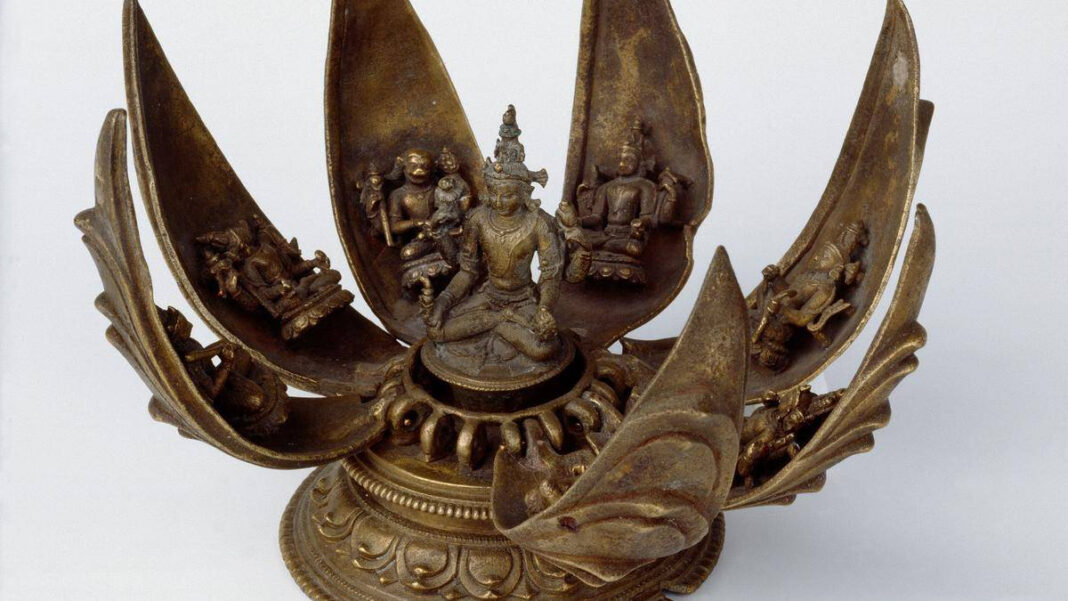
At the Art Gallery of New South Wales in Sydney, the exhibition brought together nearly 200 works from South and Southeast Asia, tracing the many forms of Vishnu. Through sculpture, painting, textiles, photography, jewellery and contemporary installations, ‘Avatar…’ explored not only the timelessness of the deity but also how artists across centuries have continually reinterpreted the Vaishnavite philosophy.
The exhibition was co-curated by Melanie Eastburn, senior curator of Asian art at the Art Gallery of New South Wales and Chaitanya Sambrani, associate professor of art history and curatorial studies at the Australian National University.
Installation view of 13th-century ‘Lakshmi Narasimha’ 1200s soapstone sculpture on loan from the Trustees of Chhatrapati Shivaji Maharaj Vastu Sangrahalaya, Mumbai, with Sumakshi Singh’s work ‘Threshold’ 2026, on display at the exhibition.
| Photo Credit:
Jenni Carter
It took place at a moment when mythology is increasingly finding new audiences. Co-curator Chaitanya Sambrani, points out that exhibitions devoted specifically to Vishnu have been surprisingly rare.
“There have been very few art exhibitions making specific reference to Indian mythology in Australia. ‘Avatar: Forms of Vishnu’ is the first such exhibition to take place in Sydney in two decades,” observes Chaitanya. Globally too, there have been only a handful of such exhibitions, the last major one taking place at the Brooklyn Museum in the United States 15 years ago.
For Chaitanya, the exhibition was more than presenting familiar religious imagery. “Our understanding of Vishnu is inclusive and expansive as a cultural, artistic and philosophical idea. Of course, devotion remains important for many, but for us, the driving force is artistic and philosophical,” he explains.
That approach was reflected throughout the exhibition.
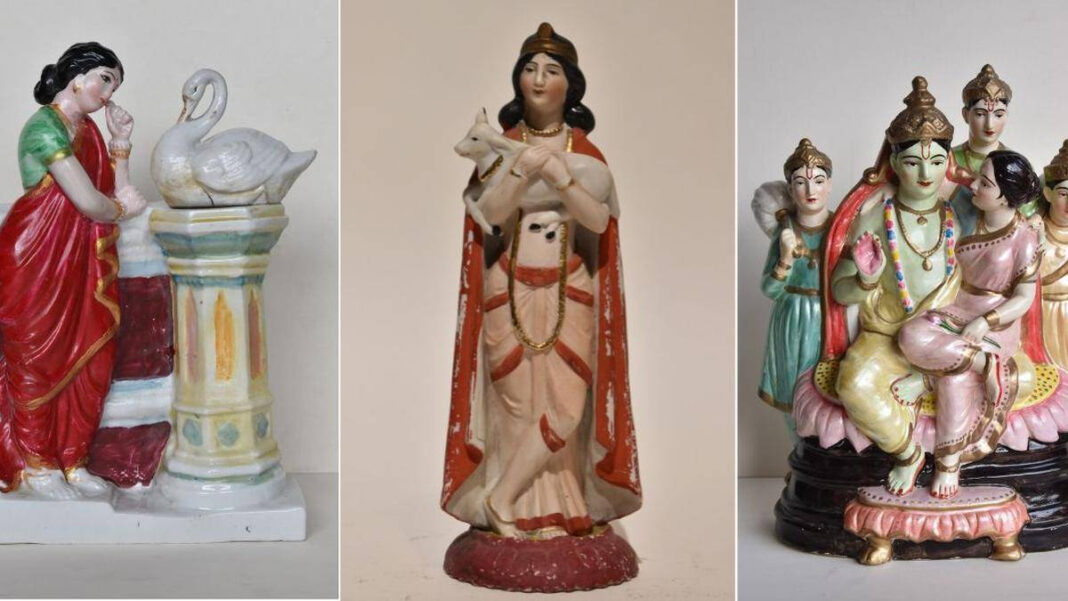
Visitors encountered Vishnu’s many avatars — from Matsya, the fish, and Kurma, the tortoise, to Krishna, Rama and the yet-to-manifest avatar — Kalki. Rather than presenting these figures as fixed icons, the exhibition revealed how artists, working across different regions and centuries, have imagined them in remarkably different ways.
India, Rajasthan, Jaipur ‘Vishnu reclines on the cosmic serpent’ mid-1800s, opaque watercolour, gold and silver on paper, 23 × 35 cm
| Photo Credit:
National Gallery of Australia, Canberra
Diverse expressions
One of the exhibition’s central themes was the diversity of artistic traditions across South and Southeast Asia. “We were interested in understanding the varied adaptations of iconographic features, artistic styles and storytelling traditions across South and Southeast Asia,” says Chaitanya.
The differences were particularly striking in depictions of the same deity. Narasimha , for instance, was portrayed in varied ways in Odisha and Tamil Nadu, while artists working for Khmer royalty in Cambodia envisioned Vishnu differently from sculptors creating works under the Chandela rulers of Khajuraho.
“For us, it is important to understand the transmission of cultural impulses alongside the role of artists as innovators and mediators rather than agents of rote repetition,” he adds.
That spirit of innovation extended into the contemporary section of the exhibition.
Nine contemporary artists — Nalini Malani, Pushpamala N., Sumakshi Singh, Gitanjali Das, Kalyan Joshi, Desmond Lazaro, Kalam Patua, Satyanarayan Suthar and Jumaadi — demonstrated that mythology continues to provide fertile ground for artistic imagination.
Some reinterpreted inherited visual traditions, while others revised mythology to address questions of gender, memory and power. Nalini and Pushpamala, for instance, engaged with the silences and omissions embedded within patriarchal narratives, while Desmond and Jumaadi returned to episodes such as the churning of the cosmic ocean of milk and the building of the bridge to Lanka, to explore fresh visual possibilities.
The exhibition also reminded visitors that mythology has always evolved rather than remaining static. For Chaitanya, one of the most memorable discoveries during a three-year research was a sixth-century pre-Angkor Cambodian sculpture depicting the adolescent Krishna lifting mount Govardhan. “The sculptor displayed formidable mastery of stone craft and engineering. It is a miraculously graceful figure of the young Krishna poised mid-action, his body flexing in exquisite tribhanga,” he adds.
The sculpture, the oldest work in the exhibition, sat alongside newly-commissioned works completed in 2026, stirring a dialogue that spanned 15 centuries.
Installation view of the ‘Avatar: Forms of Vishnu’ exhibition at the Art Gallery of New South Wales, featuring works by Desmond Lazaro and Cambodian Vishnu statue from the early 800s.
| Photo Credit:
Jenni Carter
In all, the exhibition featured around 200 works in stone and bronze sculpture, paintings on paper and canvas, textiles, jewellery, photography and large-scale installations, drawn from collections in Australia, India, Cambodia, Switzerland and the United Kingdom. Yet, it did not overly hinge on the past.
Chaitanya believes the current world situation gives Vishnu’s stories renewed relevance. “Given the multiple crises and existential threats that humanity and the natural world are facing, this felt like the right moment to speak about Vishnu, who is believed to return at crucial moments to restore balance and justice.”
That idea of restoration resonates throughout the exhibition in the way artists revisit ancient narratives to make sense of contemporary concerns.
Beyond art
The exhibition extended beyond the gallery walls through talks, workshops and an illustrated publication featuring essays by scholars from across the world. During its closing week, renowned Sri Lankan-Australian choreographer Anandavalli and the Lingalayam Dance Company presented classical Indian dance recitals, inspired by Vishnu.
In ‘Avatar: Forms of Vishnu’, mythology was not treated as something frozen in time; but emerged as a living tradition, one that continues to inspire artists, provoke new interpretations of the divine.