
The monkeys of the Jain Ramayana
High above Satana in Maharashtra’s Nashik district, two sheer rock spires rise like a pair of raised thumbs. The twin peaks of Mangi-Tungi, each more than 4,000 feet, draw steady streams of Digambara Jain pilgrims — not only for their dramatic setting, but for a single Prakrit verse. According to the Nirvana Kanda, it is here that Rama, Sugriva and Hanuman attained nirvana.
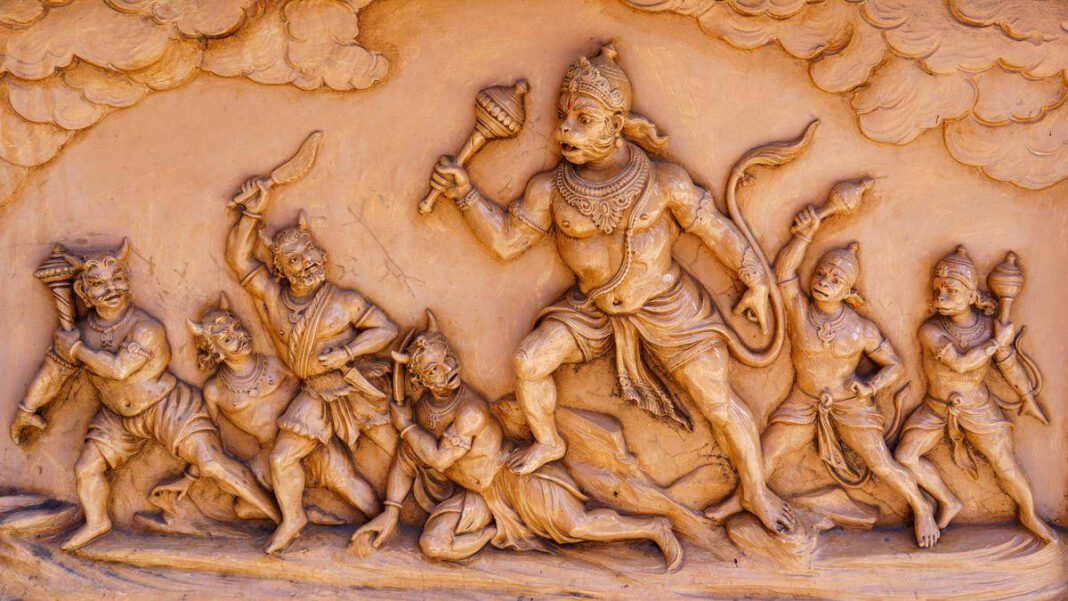
That verse anchors a strikingly different memory of the Ramayana’s vanaras. Far from ending in the monkey kingdom of Kishkindha, the Jain tradition carries several of Rama’s allies forward into a life of monastic renunciation, culminating on a wind-swept hill in Maharashtra. Carvings at Tungi show Hanuman, Gava, Gavaksha and Nila; one cave depicts Rama’s army chief, Kritantavakra, as an ascetic. The soldiers of the epic are portrayed in poses of renunciation — an artistic and theological coda carved into the mountain roughly 900 years ago by Rajput patrons of the Jain faith.
Two traditions, two kinds of vanaras
In Valmiki’s Ramayana, the vanaras are liminal forest beings — monkey-like, tailed, and divinely purposed. The Bala Kanda (sarga 17) describes Brahma instructing the gods to beget monkey sons as an army for Vishnu incarnated as Rama. Vali is born to Indra, Sugriva to Surya, and Hanuman to Anjana through the wind god Vayu (Kishkindha Kanda, sarga 66).
Jain storytellers took a decisively different path. In Vimalasuri’s Paumachariya — the oldest extant Jain retelling of the Rama story, variously dated between the 1st and 5th centuries CE — the vanaras are vidyadharas: humans endowed with magical knowledge, who travel the skies in flying vimanas. A prince named Srikantha receives an island of monkeys from the king of Lanka, takes to their image, and emblazons them on his royal insignia. His descendants become the Vanaravamsha, the “monkey clan.” Ravana’s descendants form the Rakshasavamsha. They are, in this telling, the same human peoples wearing different badges — no tails, no divine parentage.
Vali and Sugriva: a fraternal conflict reimagined
The contrast between the two traditions sharpens around the figure of Vali. In Valmiki’s narrative, Vali drives his brother Sugriva from the kingdom and keeps Sugriva’s wife, Ruma. Rama ultimately kills Vali with a concealed arrow (Kishkindha Kanda, sargas 16–18). As Vali dies, he condemns Rama’s act as cowardly; Rama responds with a political-moral defense of a king’s duty to punish the strong who oppress the weak.
The Paumachariya sidesteps this ethical knot entirely. Its Vali is a devout Jain, bowing only to the Jina (victor). After defeating Ravana, he grows weary of power, cedes the throne to Sugriva, and embraces monastic life on Mount Ashtapada near Kailash. When Ravana’s vimana stalls overhead, Ravana attempts to lift the mountain; Vali, pressing it down with a single toe to protect the temples, crushes the would-be conqueror, who then pleads forgiveness. The episode echoes the Uttara Kanda (sarga 16), where Shiva subdues Ravana with a toe — but in the Jain retelling, the heroism and restraint belong to Vali the monk.
Vali attains moksha at Ashtapada, not at Tungi. Even so, local accounts around Mangi-Tungi list Vali among the 356 carvings at the base of the Mangi pinnacle, suggesting that the site’s devotional imagination has absorbed him alongside Rama’s other allies.
Sugriva’s crisis, recast
Where Valmiki centers the brothers’ conflict on exile and betrayal, the Jain narrative introduces a different crisis for Sugriva. A vidyadhara named Sahasagati desires Queen Tara and, by wielding a shape-shifting vidya, assumes Sugriva’s exact form. Rama kills the impostor. In the Jain version, Tara is Sugriva’s wife; in Valmiki’s, she is Vali’s widow who later marries Sugriva. Yet both traditions retain an unflattering continuity: after victory, Sugriva lapses into complacency, and Lakshmana must rouse him to duty.
Two Hanumans: name, nature and family
Hanuman’s childhood marks a clean divide. In the Uttara Kanda (sargas 35–36), the child Hanuman leaps at the sun; Indra strikes him with the vajra, breaking his jaw (hanu), and the name “Hanuman” follows. In the Paumachariya, Anjana — unjustly expelled on suspicion of adultery — is ferried home by her uncle Pratisurya in a vimana. The infant Hanuman slips and falls onto a rock, which shatters beneath him. He is raised on the island of Hanuruha, and his name comes from that place. In one tradition, the baby breaks; in the other, the rock does.
Their adult Hanumans also diverge. The Hanuman revered in most Hindu temples is a brahmachari, a celibate exemplar of devotion, though Valmiki does not dwell on his marital status. Jain literature instead paints him as a Kamadeva figure — exceptionally handsome and married. Ravishena’s Sanskrit Padmapurana (677 CE) lists several wives, including Anangakusuma, daughter of Khara and Ravana’s sister. When Lakshmana kills Khara, Hanuman loses a father-in-law but aligns with Rama all the same.
Endings that define theologies
The denouements of the two traditions encapsulate their worldviews. In Valmiki’s concluding sargas, the vanaras follow Rama into the Sarayu River, returning to the divine abodes of the gods who sired them. Only Hanuman remains on earth, his life extended as long as the epic is told, a perpetual guardian of the story.
The Jain ending directs its heroes not back to heaven but out of samsara entirely. Rama, Hanuman, Sugriva, Nila and other companions ascend Tungi, undertake fasts, and attain nirvana. Their journey culminates, quite literally, in the Jain landscape of Maharashtra. The Hindu vanaras return to celestial origin; the Jain vanaras leave the world altogether, their presence marked by carvings on a hill in Satana taluk rather than by promised returns.
Mangi-Tungi: a landscape of memory
At Tungi, the visual program reinforces this Jain reframing. Images of Hanuman and other vanaras appear not as forest creatures with tails but as figures aligned with ascetic ideals. Kritantavakra, remembered as Rama’s army commander, is portrayed as a monk. Rows of soldiers adopt postures of renunciation, the martial identities of the epic softened into the stillness of spiritual discipline. The caves, hewn about nine centuries ago, transform a pan-Indian epic into local sacred geography grounded in Jain theology.
Why the differences matter
These contrasting narratives are not minor variations but deliberate reinterpretations that recalibrate ethics, divinity and destiny. Valmiki’s vanaras are instruments of a divine plan, their saga bookended by heavenly origins and returns. The Jain vanaras are human vidyadharas who renounce power, embrace monastic ideals, and transcend rebirth. Vali’s contested death becomes a model of Jain restraint; Hanuman’s celibacy yields to nuanced familial ties; Sugriva’s legitimacy is safeguarded by unmasking deception rather than by fratricide.
The result is a layered cultural memory in which the same heroes travel different paths: in one, toward the gods who made them; in the other, up a mountain where, by fasting and relinquishment, they leave even the gods behind.