
After Jantar Mantar, Delhi’s new protest sites face access, infrastructure, visibility hurdles
With Jantar Mantar denotified as a protest site, three alternative venues — Ramlila Maidan in central Delhi, the Central Business District (CBD) Ground in Shahdara, and Burari Ground in north Delhi — have emerged as the Capital’s designated spaces for demonstrations. A look at the sites, however, raises questions about accessibility, infrastructure, availability and the distance many protesters would have to travel, potentially diluting visibility near the country’s political nerve centre.
Ramlila Maidan: Proximity tempered by cost, congestion and limited windows
Located about 3–4 km from Jantar Mantar, Ramlila Maidan is the closest of the three alternatives and is steeped in the city’s political history. The 12-acre ground is capable of hosting large gatherings of around 50,000 people and has long served as a venue for rallies, marches and mass mobilisations.
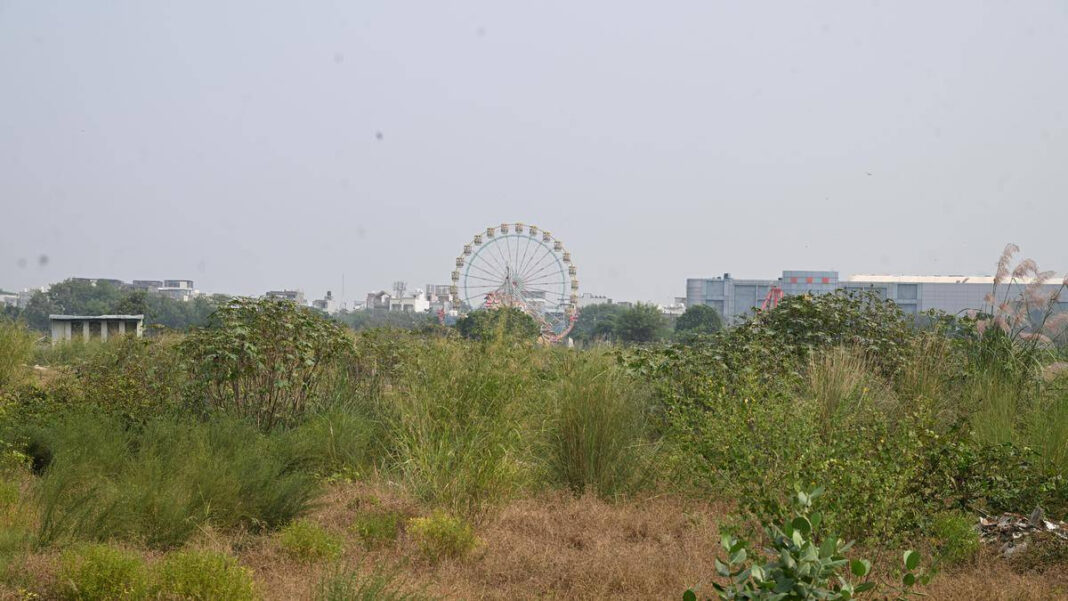
Its central location is both an asset and a complication. Nestled amid densely populated neighbourhoods and arterial roads, the ground presents a significant traffic management challenge whenever major events are scheduled. During recent days, Dussehra festivities dominated parts of the site, with conical tents, a giant wheel, amusement rides and food stalls in place; waterlogging left puddles scattered across the surface, making movement difficult in patches.
The ground is managed by the Municipal Corporation of Delhi (MCD), which charges a booking fee of roughly ₹50,000 per day, in addition to a refundable security deposit. Organisers also require a no-objection certificate from the Delhi Traffic Police. Year-round demand further complicates scheduling: beyond Ramlila and Dussehra, the venue routinely hosts political and community events, and a section is used for MCD parking — all of which can constrain the area available and the dates on which protests can be held.
CBD Ground, Shahdara: Uneven terrain in a busy urban hub
Roughly 13 km from Jantar Mantar, the CBD Ground in East Delhi’s Shahdara would pull protest activity away from the central political and administrative district. Spread over approximately 12 acres, one section of the ground can accommodate around 15,000 people.
Recent conditions on the ground highlight readiness concerns. While portions were taken up by a Ramlila celebration and a fair, other parts were overrun by grass growing as high as six feet, interspersed with muddy patches and scattered garbage. Such terrain and sanitation issues could impede the safe and swift assembly of large crowds.
The ground is ringed by residential colonies, markets, luxury hotels and other commercial establishments. It doubles as a venue for community gatherings and weddings for much of the year, complicating availability for protests. The site’s location — deeply embedded in a busy urban landscape — could also pose logistical and traffic management challenges when large numbers converge.
Burari Ground: Capacity meets distance — and access hurdles
Burari Ground, also known as Nirankari Ground, is the largest of the three options. Spanning roughly 50 acres along the Outer Ring Road in north Delhi, it lies about 23 km from Jantar Mantar and is the farthest from the traditional protest zone near Parliament and Central Secretariat.
On Saturday, October 17, 2026, the terrain presented a mixed picture. Waterlogged stretches coexisted with green patches where grass had grown to about four feet. While some tarred tracks criss-cross the expanse, many routes remain unpaved. Long used informally by locals for cricket, football and driving practice — and even for cattle grazing — the open ground is presently ringed by wire fencing, with wide pits dug at entry points to block vehicular access. A large yellow board outside identifies the Delhi Development Authority as the land-owning agency.
Unlike developed public venues, Burari Ground has virtually no shade, making temporary tents a necessity for prolonged demonstrations; depending on the section booked, those arrangements could significantly add to costs. The distance from central Delhi is another deterrent, both for participants travelling from across the Capital and for campaigns hoping to remain within sight and earshot of national institutions. During the 2020–21 farmers’ agitation, unions rejected the government’s proposal to move their protest to Burari, describing it as an “open jail.”
Why the loss of Jantar Mantar matters
For decades, Jantar Mantar functioned as the heart of civic dissent in the Capital, a symbolic and logistical alternative to marches towards Parliament, located less than 3 km away. The 18th-century astronomical observatory — built by Maharaja Sawai Jai Singh II — became the backdrop to some of the country’s most visible demonstrations, from the 2011 anti-corruption movement to the mass outpouring after the 2012 Delhi gang-rape. Tamil Nadu farmers’ dramatic 2017 sit-in and high-profile protests by wrestlers and student groups in recent years further cemented its status as an accessible and visible stage for national debates.
That centrality and symbolism are difficult to replicate. While Ramlila Maidan offers proximity and capacity, its crowded calendar and operational costs are significant barriers. CBD Ground and Burari Ground provide expansive spaces but at the expense of proximity to the political core — and with uneven infrastructure and access that may require substantial logistical planning and investment to overcome.
Next steps: SOPs promised, questions remain
The Delhi Police have said revised standard operating procedures will be issued for the three venues, laying out how demonstrations will be organised under the new arrangement. Until then, organisers face an evolving landscape: balancing costs, approvals and infrastructure gaps against the need for visibility and ease of access, even as many protesters weigh the trade-offs of moving farther from the Capital’s traditional locus of protest.
As Delhi recalibrates the geography of dissent, the viability of Ramlila Maidan, CBD Ground and Burari Ground will likely hinge on how swiftly authorities can address infrastructure shortcomings, streamline permissions and manage traffic — and on whether distance from the city’s political heart blunts the impact of public mobilisation.