
Two captive-bred Great Indian Bustards released into wild in Rajasthan under conservation efforts
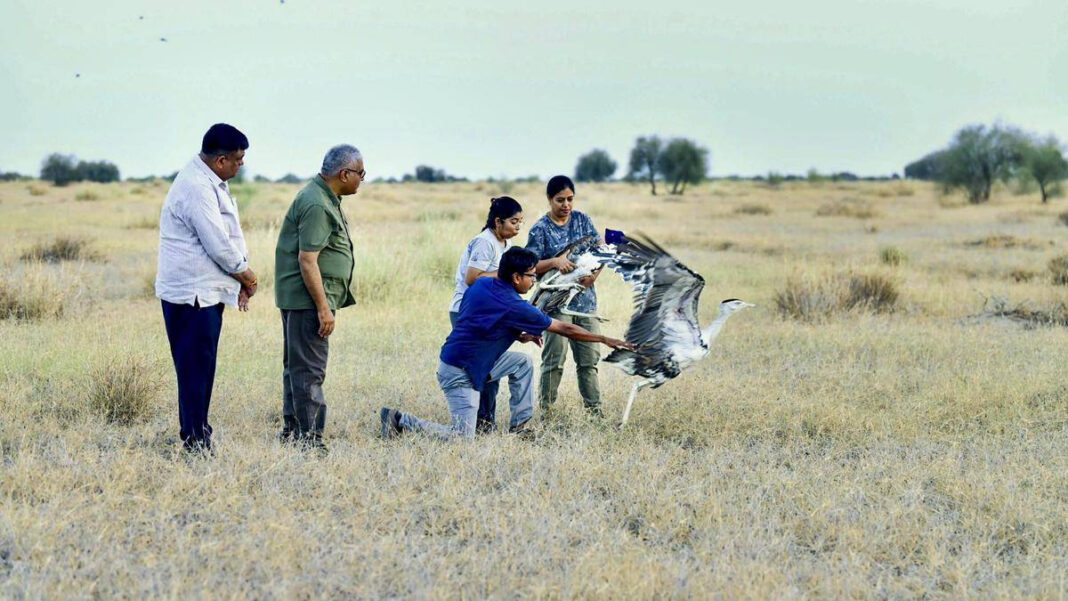
Environment Minister Bhupender Yadav on Sunday, October 3, 2026, released two male Great Indian Bustards into the wild at the Desert National Park in Jaisalmer, Rajasthan, marking a significant first step in rewilding the critically endangered species that has been bred in captivity.
A measured start to rewilding
The two birds, raised at dedicated conservation facilities in Sam and Ramdevra in Jaisalmer district, were released as part of a long-running programme to rebuild wild populations of the Great Indian Bustard. The release at Desert National Park — one of the species’ last remaining strongholds — is being viewed by officials as a landmark in efforts to restore the bird to its native arid grassland habitats.
‘Outcome of a decade of dedication’
Announcing the development on X, Mr. Yadav described the release as the outcome of “nearly a decade of unwavering dedication by our scientists, researchers, and ground staff” aimed at helping the Great Indian Bustard reclaim the deserts of Rajasthan. He added, “I thank PM Shri @narendramodi ji for his continued guidance, encouragement and constant support in ensuring our scientific community can work for the conservation of all our species, including the Great Indian Bustard.”
Collaborative conservation programme
The reintroduction is part of a collaborative initiative led by the Union Environment Ministry in partnership with the Rajasthan Forest Department and the Wildlife Institute of India (WII). The programme combines in-situ and ex-situ measures, including protection of habitat, collection of wild-laid eggs, and systematic captive breeding to build a viable population for staged release into the wild.
Breeding centres and current numbers
According to officials, the conservation facilities in Sam and Ramdevra currently house 97 Great Indian Bustards. Of these, 40 birds originated from wild-laid eggs collected and incubated under controlled conditions, while 57 have been bred entirely in captivity.
In terms of population management, 86 birds are being maintained for continued captive reproduction to strengthen the genetic and demographic base of the programme. Another 11 birds have been earmarked for release into the wild, indicating a pipeline for gradual reintroductions as part of the broader recovery strategy.
Breeding outcomes in recent years
Captive reproduction at the centres has shown steady results, with 24 live chicks recorded in 2025 and 29 in 2026. Conservation managers view these outcomes as critical to sustaining a structured release plan while ensuring there is a robust breeding cohort retained under managed care.
Significance and next steps
The release of the two male bustards represents the programme’s transition from captive breeding to carefully monitored reintroduction. With additional birds identified for release, the authorities are preparing for subsequent stages of rewilding, guided by ongoing scientific assessments and field preparedness in and around Desert National Park.
The Great Indian Bustard is listed as critically endangered, and officials say Sunday’s release underscores the commitment of central and state agencies, along with WII scientists and local field teams, to restore a self-sustaining population in Rajasthan’s desert landscape.