
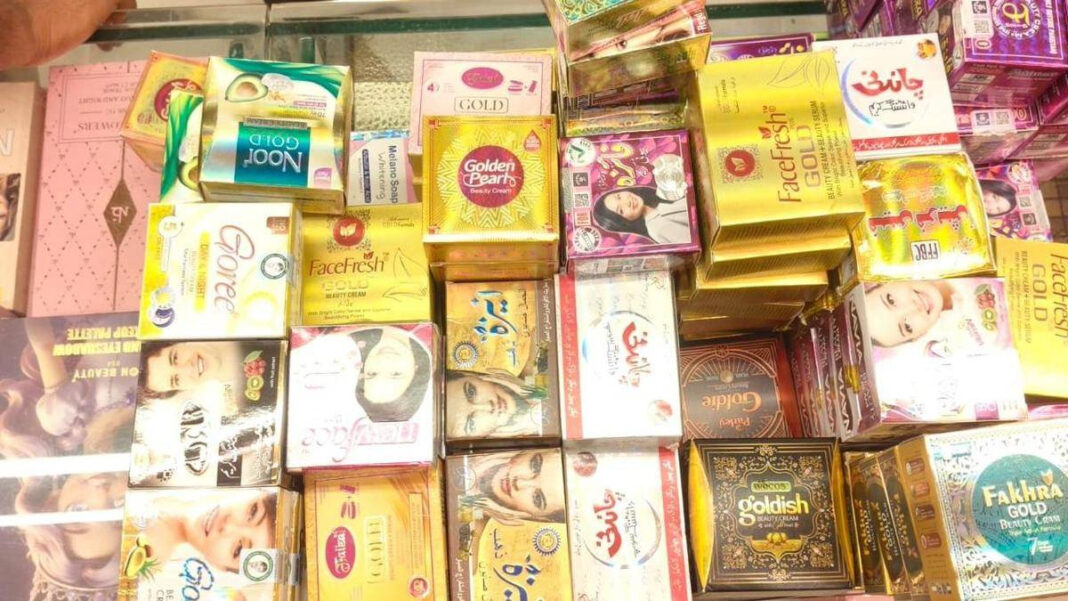

Pakistani cosmetics seized in Hyderabad traced to Mumbai’s Crawford Market
Pakistan-made cosmetics seized in Hyderabad have been traced to Mumbai’s Crawford Market, with investigators saying the trail points to a broader distribution network funnelling banned products into Indian retail shelves more than a year after New Delhi halted imports from the neighbouring country.
Raids in Hyderabad uncover banned imports
The fresh lead emerged after coordinated raids by the Hyderabad police and the Central Drugs Standard Control Organisation (CDSCO) earlier this week at three stores — Beauty Ladies Emporium, Beauty Queen Shop and S.J. Medical Shop — located in Habeeb Nagar and Nampally. Cosmetics valued at about ₹7 lakh were seized, officials said.
The stock included several Pakistan-made whitening creams, soaps and other cosmetic products. Among the items found were ‘Goree Beauty Cream’ and ‘Chandni Whitening Cream’, two brands that the CDSCO had warned consumers against last month after laboratory tests detected excessive levels of heavy metals.
Five persons have been identified in connection with the alleged sale and distribution of the seized products. Samples have been sent for forensic examination to determine their composition and to identify substances present in them, investigators said.
Link to Mumbai’s Crawford Market
An officer involved in the Hyderabad investigation said the seized cosmetics were allegedly being sourced from Mumbai’s Crawford Market, a major wholesale hub. “Investigators are now looking further up the chain to establish how the products entered India and reached wholesale and retail markets despite restrictions on their import,” the officer said.
The Crawford Market link comes against the backdrop of enforcement action in Mumbai itself. In July, authorities in the city seized Pakistan-made cosmetics valued at about ₹12 lakh during a raid, indicating that consignments of such products have been circulating in more than one urban market.
Import ban tightened since May 2025
India prohibited the direct or indirect import or transit of all goods originating in or exported from Pakistan on May 2, 2025. The Directorate General of Foreign Trade imposed the curbs through a notification citing national security and public policy concerns. The prohibition extends to goods routed through third countries, meaning indirect entry does not make such imports permissible.
Cosmetics imports are also governed by the Cosmetics Rules, 2020, which require products to be registered with the Central Licensing Authority before import and to comply with prescribed quality and safety standards. The CDSCO has been tightening oversight after instances of imported cosmetics being sold without valid import registration certificates.
In July, the regulator directed its zonal offices, State licensing authorities and port officers to maintain enhanced surveillance to detect and deter the entry of unregistered cosmetic products into the domestic market.
CDSCO warning over heavy metals
On September 8, the CDSCO issued a specific advisory to consumers regarding ‘Goree Beauty Cream’ and ‘Chandni Whitening Cream’. The regulator said neither product had been issued a registration certificate for import and that laboratory testing had detected heavy metals beyond specified limits. Such contamination, it warned, could pose health risks, including toxic effects. Consumers were advised not to purchase or use the products.
Both brands were among those recovered during this week’s raids in Hyderabad, reinforcing concerns that Pakistan-made cosmetics continue to circulate in Indian markets despite the import ban and prior alerts.
Possible adulteration with foreign ointments
The Hyderabad seizure has also opened an additional line of inquiry. According to the investigating officer, an ointment originating from the United Kingdom was allegedly being mixed with cosmetic products, and the resulting preparation was then sold for skin-lightening purposes. Officials have raised concerns about the possible presence of carcinogenic substances, though they underscored that conclusions will depend on laboratory findings now awaited from forensic analysis.
Authorities said the precise health implications of the seized preparations can only be established after the forensic results confirm their contents and concentrations. In the meantime, they cautioned consumers to avoid unregistered cosmetic products, particularly those claiming skin-whitening or lightening effects.
How the products may have slipped through
While investigators have not detailed the exact route into the country, the alleged link to a prominent wholesale market in Mumbai indicates a distribution network capable of moving goods across State lines and into retail outlets. With the DGFT prohibition covering both direct and indirect entry of Pakistan-origin goods, officials are now seeking to determine whether consignments were misdeclared, routed through third countries or blended with other products to obscure their origin.
The probing of wholesalers and intermediaries is expected to focus on documentation, import declarations and transport logistics, as well as the role of local distributors who supplied shops in Hyderabad and possibly other cities.
What happens next
Investigators said they are pursuing the supply chain “up the line” from retail shops to alleged wholesale sources and, ultimately, to the point of entry. Further seizures and questioning are likely as authorities analyze sales records, invoices and electronic communication related to the seized stock.
The CDSCO and local police are working in tandem, with the regulator focusing on compliance with cosmetics registration and safety standards, and law enforcement examining possible violations of the DGFT notification and other applicable laws. Forensic laboratory results on the seized samples will be central to any public health advisories or prosecutions that may follow.
Significance of the case
The Hyderabad case, and the reported Crawford Market connection, underscore continuing enforcement challenges in preventing banned goods from entering the Indian market through indirect channels. It has also sharpened scrutiny of skin-whitening products, a segment already under the regulatory lens for undeclared or unsafe ingredients. The outcome of the ongoing investigation and pending lab results will shape the next steps on enforcement and public health advisories related to these products.