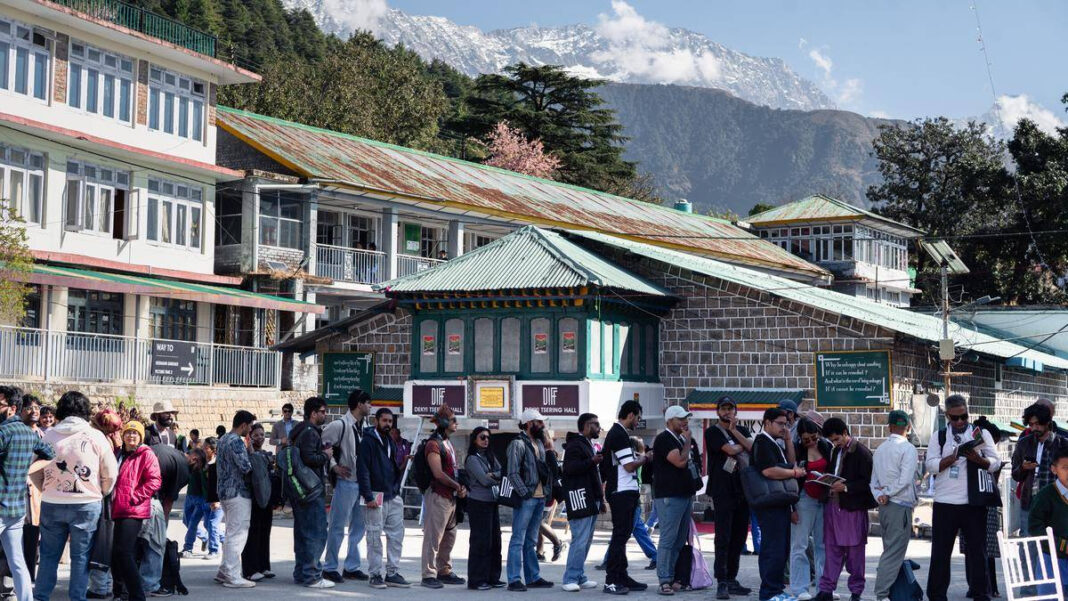

When the Dharamshala International Film Festival (DIFF) started in 2012, there were no cinema halls in McLeod Ganj. Films were shown on DVDs. Filmmaker couple-collaborators Ritu Sarin and Tenzing Sonam brought their experience of the hospitality of small towns overseas hosting film festivals to the Dalai Lama’s backyard. Fourteen editions later, DIFF, now held in Tibetan Children’s Village in Upper Dharamshala, has grown. From around 2,000 attendees in its inaugural edition to over 15,000 in 2025.
While Hansal Mehta’s career-pivoting directorial Shahid (2012), starring Rajkummar Rao, opened the first edition, a black-and-white Punjabi drama, Birds in the Dark/ Hanere De Panchi, produced by Mehta, will close the 15th edition today. The film recently won the prestigious New Currents Award and Songwon Vision Audience Award (Asia) at the Busan International Film Festival (BIFF).
Naseeruddin Shah in a still from Gurvinder Singh’s Rehmat.
A still from Birds in the Dark.
BIFF co-juror and Village Rockstars director Rima Das’s new Assamese film, Not A Hero [Crystal Bear Special Mention, Berlinale], opened DIFF 2026.
Rima Das
“I love DIFF and the way it has grown over the years, so consistently and patiently, bringing some of the best films and creating a space for cinephiles and filmmakers to come together, share their love for cinema, and have conversations freely. It’s a place that gives you hope and makes you feel at home. Sharing films, food, the beauty of the mountains, and the richness of the local culture makes it so special. It feels wonderful to have our film Not a Hero open this year’s festival that continues to create such a beautiful space for cinema.”Rima DasAssamese filmmaker
A still from Not A Hero.
The four-day festival is showing 95 films from 40 countries. “Most of the films this year could inspire a spark. The boundaries for telling stories are so non-existent today, from the short form to the long form, from slow to crazily paced, from fiction to non-fiction,” says director of programming, Bina Paul, adding that the only challenge she faces is organising premiere shows “since producers are attracted by competitions”. DIFF is one of the few Indian festivals to not have competitive segments. Paul brings to DIFF her nearly two decades of experience as former artistic director of the International Film Festival of Kerala (IFFK). Excerpts from an interview with Sarin and Paul:
DIFF co-founders Ritu Sarin and Tenzing Sonam.
When you started the festival, did you imagine DIFF would one day grow into a festival drawing filmmakers and audiences from across the globe?
Sarin: We just wanted to create a space for our local audiences to watch the kinds of films that we loved — non-mainstream, independent films — which were not easy to access. And we thought, let’s ask filmmakers to come in person so that there would be an opportunity for interaction and discussion. From our own experience at various film festivals, the ones that made the biggest impact were the more intimate ones where directors and audiences could easily meet. We tried to replicate that model at DIFF.
The way DIFF just grew from year to year, taking on a life and a momentum of its own was truly unexpected. But its growing success didn’t translate into more funding opportunities and this obstacle has plagued us year after year. Also, given the nature of McLeod Ganj, where DIFF is held — a crowded tourist town in the mountains with no cinemas, and with very little space to expand, the logistics of running the festival has exponentially mounted. There is only so much more the festival can expand, and we really worry about how to manage the increased expectations and exploding numbers of visitors who want to attend.
Actor Adil Hussain at 2025 DIFF Conversations
How do you protect the intimacy of a small festival as its reputation grows?
Sarin: A big part of DIFF’s intimacy is its pop-up nature where the venue is a school campus, where the school continues to function. But this quaint and unusual setup has built-in limitations in that it can only expand so much, and we have more or less reached that limit. This is a huge question for us and the DIFF team: how can we grow the festival without sacrificing its intimate quality?
Director Kiran Rao at 2025 DIFF Conversations.
Ritu Sarin, Kiran Rao and Tenzing Sonam.
Bina Paul.
IFFK’s loss has been DIFF’s gain. Bina, what does a smaller, independent festival allow you to do differently?
Paul: IFFK has become a kind of institutional festival and with that came the pressure of addressing a huge audience. With DIFF, the challenge is much sharper: fewer films, a very discerning and committed audience and a very clear vision. Leading a programming team to fulfil that vision is a task. As a person who has always believed that it is the small, perhaps, unheard film that is the gem, this offers me the space to explore.
DIFF was a well-established festival when I joined the team a few years ago. The emphasis on independent cinema already existed. What I do is try and strengthen this angle and bring a more pan-regional spectrum, whether Indian or from around the world.
How do you define independent cinema in 2026?
Paul: Today, the definition is undergoing a relook. Most films are made in a kind of hybrid manner when one looks at the economics of it, whether through country co-productions, crowdfunding, small investments, etc. DIFF looks for independent films that come from marginalised identities, fringe politics, regional realities, caste dynamics, urban alienation, rather than with sugarcoated storytelling. Filmmakers dealing with such content tend to carve out finance and keep their creative freedom.
What emerging trends did you observe in DIFF’s domestic submissions this year?
Paul: While traditionally, the south of the country has always had its share of independent cinematic voices, we see this happening a lot in the Punjab, Haryana and North Indian belt. Certainly, this delving into one’s own history and culture is unravelling a unique, deeply sensitive storytelling.
What’s new at DIFF 2026?
“This year, we’ve launched DIFFshala, a series of informal conversations with film professionals on a variety of subjects — from the importance of colour grading [with Bridge PostWorks colourist Sidharth Meer] to getting the legal aspects of filmmaking in place [with IP lawyer Xerxes Ranina] — as a resource for filmmakers.”
“And after a gap of eight years, we’re really excited to bring back the Himalayan Film Fellows initiative, where we provide in-depth mentorship to upcoming filmmakers from the Indian Himalayan regions. The Film Fellows mentorship extends beyond the festival date. In the past, Rahat Mahajan [Meghdoot/The Cloud Messenger], Siddharth Chauhan [Amar Colony], and Tribeny Rai’s [Shape of Momo] were all DIFF Himalayan Film Fellows, while Tribeny also attended the DIFF-PAS Producer’s Lab.”
— Tenzing Sonam
A still from The Calf Doll.
Which film best represents where independent cinema is headed?
Paul: Perhaps, a film like The Calf Doll [by Ankur Hooda]. I’m not commenting on the merits of the film but rather on what it represents. A local story, local actors, very much on the cusp of fiction and documentary. It’s quite an interesting mix of aesthetics, veiled social analysis and an atmosphere that seems familiar to the filmmaker. The film is steeped in animals, seasons, rituals, omens, which seem to come from a lived experience. For a first-time filmmaker, the film embodies the direction we are seeing in many films being made in India. Also, the film is produced and supported by another local filmmaker, Achal Mishra. That’s a new trend in Indian cinema, where filmmakers are supporting each other.
“DIFF is one of the rare festivals that provides truly independent films with a platform to showcase their work. I like how non-hierarchical the festival is. There’s no competition between films, and everyone has to stand in a queue to watch a film, regardless of who they are. So many other festivals in India, while claiming moral superiority, fail to practise what they preach. DIFF is a festival with a philosophy, and what it takes pride in is not the number of tickets sold. Very happy to premiere my film Ekadesham (The Uncertainty Principle) here.”Don PalatharaMalayalam filmmaker
Bold programming
Incidentally, Saim Sadiq’s Joyland, Pakistan’s 2023 Oscar entry, whose release was briefly banned in Pakistan, and it was rejected by IFFK Kerala in 2022, was screened to packed halls at DIFF that year, with mattresses laid out to accommodate the overflow.
Sandhya Suri’s Santosh (2024), Britain’s Oscar entry, was screened at DIFF, and later at MAMI Mumbai Film Festival, whose 2025 edition was cancelled and it might not return this year too. Its planned screening at PK Rosy Film Festival, Chennai, was cancelled after the Shahana Goswami-starrer police procedural and caste-and-crime neo-noir Santosh was denied CBFC certification for theatrical release in India.
What is the responsibility of a film festival when a film becomes politically uncomfortable? In DIFF’s 2024 edition, two Palestinian films were dropped after the festival began [From Ground Zero; and No Other Land, which later won the 2025 Oscars for Best Documentary Feature].
Sarin: All film festivals in India must obtain clearance from the I&B Ministry for every film they wish to screen. At DIFF, our policy is to find and select the best contemporary independent films we can. We try not to let political considerations shape our choices, but we recognise that some subjects are harder to clear than others. This was the case with the two Palestinian films: we didn’t receive clearance for them and had to withdraw them from the programme. It is a difficult dilemma, and one that every film festival in India has to navigate.
Published – October 29, 2026 04:34 am IST