 "
/>
"
/>

Gandhi through the Eye of the Artist
Artistic representations of Mahatma Gandhi often evoke the essence of his unwavering dedication and resolve, particularly as he embarked on his historic Dandi March. Iconically portrayed as a man armed only with a walking stick, Gandhi represented the triumph of non-violence and compassion over darkness and oppression. His legacy continues to inspire contemporary movements and artists alike, reflecting the deeper significance he holds in the struggle for justice and equality.
Historical Context of Gandhi’s Representation
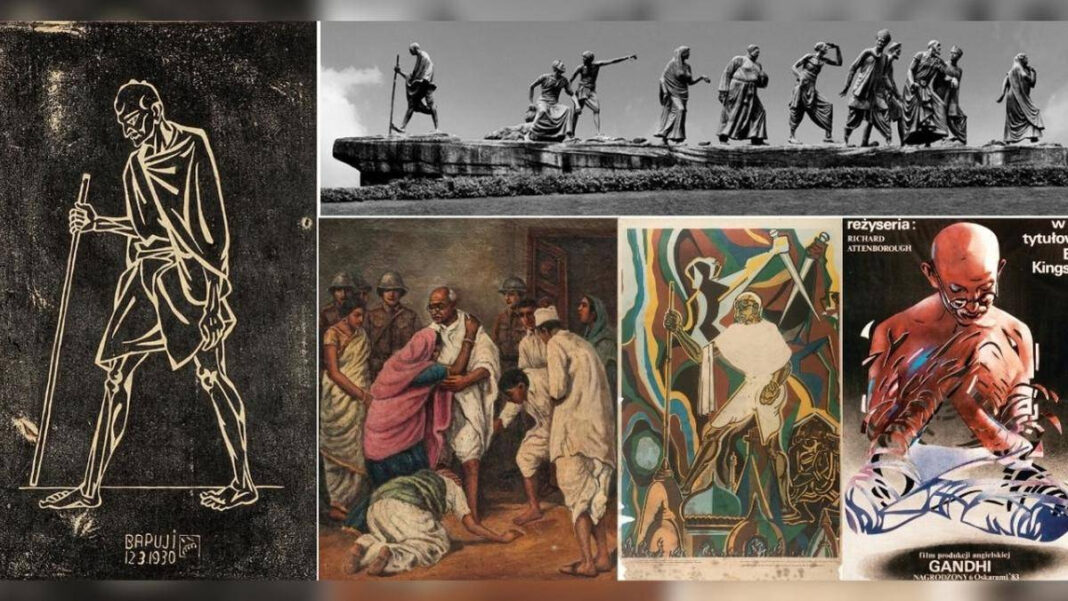
Nandalal Bose, a prominent artist, captured this pivotal moment in 1930 through his iconic linocut of Gandhi, who led the first mass civil disobedience movement in India. This movement, known as the Salt Satyagraha, signified a major turning point in India’s fight for independence. Notably, Gandhi’s methods of peaceful protest were not entirely new to the world, with instances of civil disobedience acknowledged in Hungary and South Africa prior to his endeavors. However, Gandhi’s perseverance and principles have now become integral to the concept of a satyagrahi, embodying eternal inspiration for both Indian and global audiences.

Bapuji – Dandi March (1930) by Nandalal Bose. | Photo Credit: Courtesy Tuli Research Centre for India Studies
Artistic Expressions of Gandhi’s Ideals
Throughout history, myriad artists have sought to capture Gandhi’s essence and his philosophies through their unique artistic expressions. In the fervent political climate of the 1930s and 1940s, for instance, Hemendranath Mazumdar poignantly utilized traditional oil painting to depict Gandhi’s arrest in 1932, showcasing a blend of Western techniques with Indian themes. A notable image from this era includes Chittaprosad’s graphic portrayal of children protesting during the Quit India Movement in 1942, despite the conflicting political affiliations of the artist.

Quit India (1942) by Chittaprosad. | Photo Credit: Courtesy Tuli Research Centre for India Studies
As articulated by observers, “Gandhi is by a very long way the most reproduced visual image, not only as a portrait but because of the legend of his deeds.” His actions have inspired individuals across demographics, pushing children towards activism and encouraging women into roles of leadership. Artists have echoed this ethos, emphasizing the need for honesty and accountability in society, resonating with Gandhi’s expectations for integrity in living one’s ideals.
Gandhi’s Legacy Through Photography and Film
A significant milestone in the visual chronicling of Gandhi’s life was marked by the renowned photojournalist Henri Cartier-Bresson, who captured the Mahatma’s final moments in January 1948. Among the poignant images is one depicting Gandhi leaving the dargah of Sufi saint Bakhtiar Kaki, supported by his grandnieces. Such visual insights contributed greatly to an ongoing narrative of Gandhi as a figure of peace and dignity during challenging times.

The Last Days of Mahatma Gandhiji’s Life captured by Henri Cartier-Bresson in 1948. | Photo Credit: Courtesy Tuli Research Centre for India Studies
In 1969, during the centennial celebration of Gandhi’s birth, artist Anil Sengupta presented a dynamic series of lithographs detailing moments from Gandhi’s storied life. This collection used vibrant colors and bold compositions to encapsulate his enduring legacy, reminding audiences of his moral and ethical influences.

A lithograph from the series on The Life of Gandhiji published in 1969. | Photo Credit: Courtesy Tuli Research Centre for India Studies
By 1982, global recognition of Gandhi’s impact culminated in film, illustrated by the Polish poster for Richard Attenborough’s film Gandhi, highlighting his influence even in lands far removed from India. This illustrated the reach of Gandhi’s message of non-violence and peace and how it inspired movements worldwide, such as the Solidarity movement in Poland.

Polish poster of Richard Attenborough’s film Gandhi (1982). | Photo Credit: Courtesy Tuli Research Centre for India Studies
The Significance of the Tuli Research Centre Exhibition
The recent exhibition, titled SWARAJ: Revisualising India’s Political History, hosted by the Tuli Research Centre for India Studies at Delhi’s Visual Arts Gallery from August 12-16, 2026, brought together a plethora of modern and contemporary artworks alongside archival materials. Curated by Neville Tuli, the exhibition explored India’s pursuit of political self-rule and national identity through the lens of visual culture. It aimed to breathe life into historical narratives through art, illustrating how art intertwines with political events and societal changes.
Modern Interpretations of Gandhi
In the evolving discourse around Gandhi, particularly among younger generations, there is a resurgence of critical engagement with his legacy. Contemporary artist Gigi Scaria, for example, addresses this introspection in his piece Who Deviated First?, which provokes thought on how the present generation aligns with Gandhi’s values of compassion and idealism. The piece critiques the extent to which these ideals are upheld in today’s society, reflecting a broader conversational landscape regarding the relevance of Gandhi’s teachings in contemporary life.

Who Deviated First? (2010) by Gigi Scaria. | Photo Credit: Courtesy Tuli Research Centre for India Studies
Conclusion
The artistic community’s ongoing engagement with Gandhi contributes significantly to our understanding of his relevance in today’s world. Every new work serves to question, interpret, and celebrate his ideals, maintaining a continuous dialogue on the moral imperatives of justice, non-violence, and compassion that Gandhi championed. As we explore these various artistic representations, we are reminded that his journey and teachings are deeply woven into the fabric of contemporary discourse, encouraging future generations to seek truth and reflect on their own contributions to society.
The writer is the founder and trustee of The Tuli Research Centre for India Studies.