
After 14 years, Tamil Nadu records lowest Cauvery realisation
Tamil Nadu has recorded its lowest southwest monsoon realisation from the Cauvery in 14 years, receiving just 44.208 thousand million cubic feet (tmc ft) between June and September 2026 against a historical quota of 123.14 tmc ft for the period. The shortfall of nearly 79 tmc ft has heightened concerns over irrigation needs in the Cauvery delta, where the samba-thaladi paddy season is gathering pace.
Monsoon inflows and historical context
Data for 2026 indicate that the State’s Cauvery realisation during the southwest monsoon is not only the lowest since 2012 but also ranks as the fourth-lowest since 1974–75, when certain provisions of the 1924 Tamil Nadu–Karnataka water-sharing agreement came up for review. By comparison, Tamil Nadu received around 45 tmc ft during the 2023–24 southwest monsoon, placing this year’s inflow almost on par with last year’s weak performance.
Measured against the monsoon-period quota of 123.14 tmc ft, the 2026 receipt of 44.208 tmc ft underscores a severe deficit. The shortfall has revived long-standing anxieties over dependable water availability for agriculture in the delta and the adequacy of releases from upstream reservoirs in Karnataka.
Mettur reservoir: tight storage and limited cushion
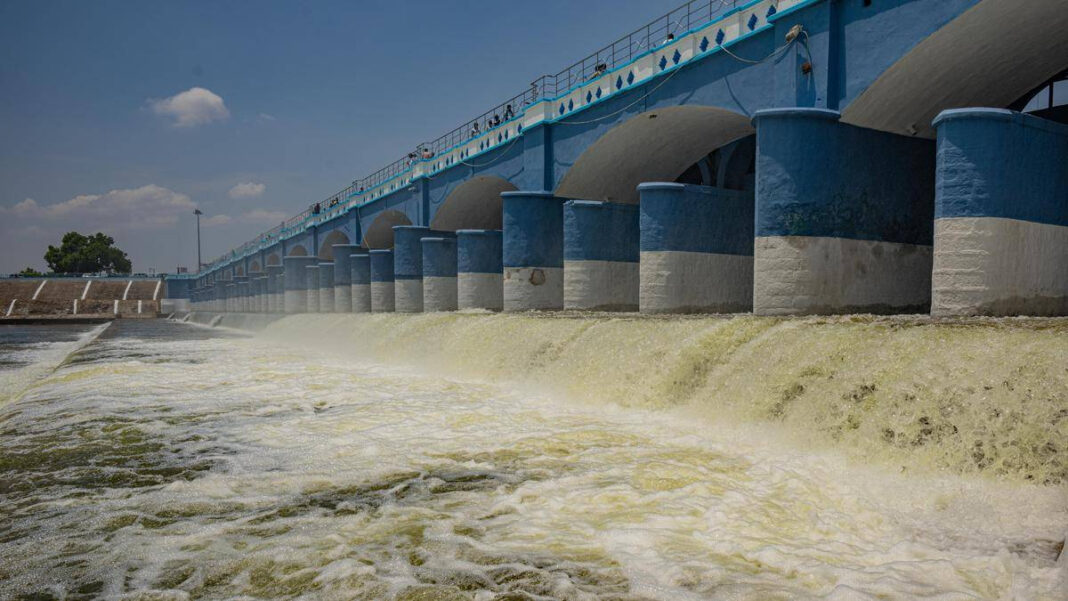
The Mettur dam, the lifeline of delta irrigation, began releases for agriculture about a month ago. As of the latest review, storage stands at 36.639 tmc ft (against a full capacity of 93.47 tmc ft). With the current discharge of 15,003 cubic feet per second—equating to 1.2963 tmc ft per day—official estimates indicate that the existing storage would sustain roughly 18 days of outflow at this rate.
Within the existing storage, an allowance of 10 tmc ft must be ringfenced for drinking water requirements, environmental flows and dead storage. This constraint narrows the volume available for irrigation and intensifies pressure on the system should inflows fail to improve quickly.
Interstate releases and CWMA directives
The Cauvery Water Management Authority (CWMA) directed Karnataka to release 5.18 tmc ft to Tamil Nadu over a 15-day period beginning September 24, 2026. However, between September 24 and October 4, Tamil Nadu received about 3.35 tmc ft, even as Karnataka has been protesting the CWMA’s prescription on releases. The gap between ordered and realised flows has added to downstream stress and uncertainty among farmers awaiting timely water for crop establishment.
Delta agriculture: acreage slips as farmers adapt
Paddy coverage in the Cauvery delta region is down by about one lakh acres compared with the corresponding period last year. As of October 5, the area under paddy stood at 1.68 lakh acres, against 2.64 lakh acres in 2025–26 at the same stage.
Notably, farmers have pivoted towards water-conserving practices. Of the current area, nearly 1.27 lakh acres have been taken up through direct sowing, reflecting a shift away from conventional transplantation methods that are more water-intensive. This adjustment suggests farmers are responding to the constrained water supply with lower-input strategies.
Within the nine districts that comprise the Cauvery delta, just two—Cuddalore and Tiruvarur—account for about 72% of the current paddy coverage. Around 52,700 acres are under paddy in Cuddalore and 68,400 acres in Tiruvarur. By this time last year, the delta’s coverage had reached about 2.64 lakh acres, eventually climbing to roughly 13 lakh acres for the season. The target for the current year is nearly 12.7 lakh acres, and it remains uncertain how much of this will be achieved without stronger inflows.
Outlook hinges on northeast monsoon
With Mettur storage tight and interstate releases below CWMA-directed levels so far, the immediate outlook for irrigation is fragile. Farmers and water experts warn that, unless the northeast monsoon sets in effectively and on time, the scope for expanding paddy coverage and sustaining existing fields could be compromised.
Significance
The fourth-lowest Cauvery monsoon realisation since 1974–75 has renewed attention to the dependability of interstate releases, reservoir management at Mettur and the practical constraints facing delta agriculture. As the samba-thaladi season advances, the balance between limited storage, mandated non-irrigation allocations and highly variable inflows will be decisive. All eyes now turn to the northeast monsoon to determine whether Tamil Nadu can narrow the acreage gap and secure water for both farms and households through the months ahead.