
Mysuru Dasara: When tradition meets novelty
In Mysuru, the Torchlight Parade at Bannimantap once glowed solely with burning flares and military drills as the Maharaja, on horseback, accepted a ceremonial salute. Today, the same grounds draw swelling crowds for precision motorcycle rides, equestrian displays—and a choreographed drone show that sketches the solar system, world map, tigers, peacocks, and Goddess Chamundeshwari in the night sky. The high-tech spectacle is emblematic of how Mysuru Dasara, a festival with more than four centuries of history, continues to evolve while wrestling with what to keep and what to change.
Tradition under a new steward
The 2026 celebrations are the first with Chief Minister D.K. Shivakumar at the helm as the State’s executive head, and he has signalled further shifts. He has proposed inviting Chief Ministers from other southern States and incorporating their tableaux into the Jumboo Savari to give the procession a broader regional character. More controversially, he announced the introduction of Kambala—the traditional slush-track buffalo race of coastal Karnataka—into the festival’s programme. The move has triggered debate among farmers’ groups, environmentalists, historians, and political leaders over whether this expansion enriches or dilutes the distinct cultural identity of Mysuru Dasara.
From imperial courts to a people’s festival
Dasara’s roots stretch back to the Vijayanagara empire. After its decline, Raja Wadiyar I formalised celebrations at Srirangapatna in 1610, and they later shifted to Mysuru after the fall of Tipu Sultan in 1799. Over time, the festival became a signature of the region’s royal heritage, with the Wadiyars patronising religious rituals, music, dance, and the arts.
That structure changed in 1970, when the abolition of the privy purse ended the official privileges of India’s former princely rulers. The Maharaja of Mysore ceased to ride in the golden howdah atop the State elephant during the Jumboo Savari and withdrew from organising the festival. Responsibility for Dasara passed to the Karnataka government, which branded it a “Nada Habba,” or festival of the region.
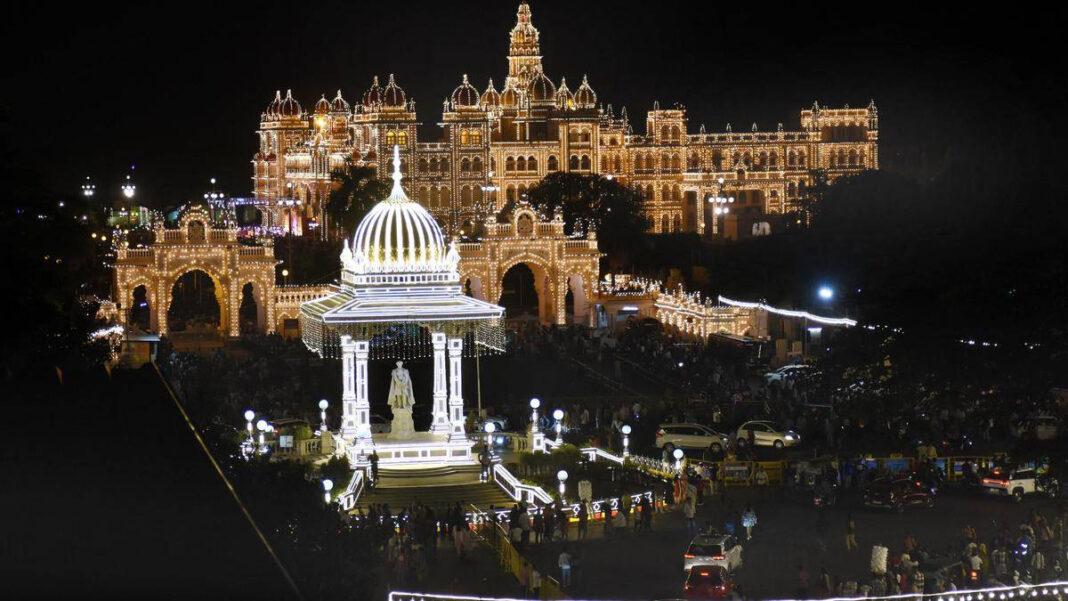
Even so, tradition endured: the idol of Goddess Chamundeshwari replaced the Maharaja in the golden howdah, and the procession maintained its grandeur with the cooperation of the erstwhile royal family. Palace illumination, music performances in the forecourt, and Vajramushti Kalaga—a traditional form of wrestling involving knuckle-dusters—continued alongside the Wadiyar family’s private Dasara, during which the Maharaja ascends the golden throne and holds a private durbar.
A broader canvas—and bigger crowds
The Jumboo Savari continued to command large audiences through the 1970s and 1980s, when there were fewer competing attractions and much of the city lined the route. According to veteran Mysurean writer and journalist Gauri Satya, the procession gradually gained additional pageantry, with tableaux joining folk troupes, marching contingents, and caparisoned elephants.
After 2000, Dasara steadily grew from a palace-centric event into a multi-venue festival designed to draw tourists and engage new audiences. Yuva Dasara emerged as a marquee attraction, bringing in performers such as A.R. Rahman, Sonu Nigam, and Shreya Ghoshal and drawing huge youth crowds. Prabhu Deva featured prominently in this year’s line-up. As attendance surged, authorities shifted Yuva Dasara from the congested Maharaja’s College grounds to a larger venue near the Outer Ring Road at Uttanahalli.
The administration also launched the Ahara Mela (food festival), which has quickly become one of the busiest hubs of Dasara. Its popularity was apparent this year, with nearly 700 applications received for around 100 available stalls. Other additions have rounded out the festival’s appeal: an air show by the Indian Air Force’s Surya Kiran Aerobatic Team; Raitha Dasara celebrating agrarian culture; Mahila Dasara for women; Makkala Dasara for children; the Kavi Goshti (poets’ meet); the Dasara Book Fair; and Yoga Dasara.
Technology meets ritual
Among the most visible recent changes is the drone show at the Torchlight Parade, which has added a high-tech overlay to a setting long dominated by military and police displays. For many visitors, watching precisely programmed, LED-fitted drones assemble complex formations has become an integral part of Vijayadashami night—coexisting, at least for now, with the torchlit tableaux of tradition.
Kambala’s debut and the debate over cultural boundaries
While concerts and drone shows alter how people experience Dasara, the decision to introduce Kambala marks a substantive shift, bringing a coastal Karnataka tradition into an event rooted in Mysuru’s royal heritage. Kambala is scheduled to debut on a specially prepared slush track at Sathagalli on the outskirts of the city on October 18 and 19, with around 400 buffaloes and their jockeys expected from Dakshina Kannada.
The move has divided opinion. Yaduveer Krishnadatta Chamaraja Wadiyar, scion of the erstwhile Mysuru royal family and BJP MP from Mysuru, has questioned the fit of Kambala within Mysuru’s cultural milieu. On the other side, Congress leader S. Rajesh has asked why Kambala should be excluded when Dasara already showcases art forms from beyond the region, including Kathak and Kuchipudi dances and Chenda percussion from Kerala. In his view, Kambala is a spectacular traditional sport and part of Karnataka’s cultural heritage.
Chief Minister Shivakumar has defended the inclusion, arguing that the festival should reflect the diversity of the State’s traditions. During the inauguration of Dasara, he suggested that the Vijayanagar rulers had a tradition of bringing buffaloes to the celebrations—an assertion disputed by historian N.S. Rangaraju, a retired professor of ancient history and archaeology at the University of Mysore, who said there is no historical record to establish this.
Drought-year optics and costs under scrutiny
Opposition has also coalesced around the cost and logistics of staging Kambala in a drought year. Parashurama Gowda of Parisarakkagi Naavu questioned the use of scarce resources for transporting buffaloes and teams from the coast and for preparing the slush track. Officials have estimated expenditure on Kambala between ₹5 crore and ₹8 crore, and farmers’ groups have raised concerns about the use of several lakh litres of water for the event.
Rangaraju contrasted this outlay with the modest remuneration provided to folk artistes from across Karnataka who participate in Dasara and are housed in basic facilities such as marriage halls. The dispute has sharpened a broader discussion: how to balance spending on new attractions that draw headlines and footfall with sustained support for long-standing traditional programmes and the artistes who keep them alive.
Continuity amid change
Even as new elements proliferate, the enduring rituals of Dasara continue to anchor the festival’s identity. The procession of Dasara elephants from Aranya Bhavan to the palace, the gilded presence of the goddess’s idol in the golden howdah during Jumboo Savari, and the ceremonial rhythms of the Torchlight Parade all persist—now framed by sound-and-light shows, mass cultural programming, and the demands of a modern tourist economy.
The proposal to invite other southern Chief Ministers and carry their tableaux in the procession points to a future in which Dasara might serve as a platform for regional cultural exchange. Supporters see this as a way to reflect the interlinked histories and contemporary ties of southern India; critics worry it could blur what makes Mysuru’s festival distinct.
What comes next
As Kambala makes its debut at Sathagalli, stakeholders across the spectrum—organisers, cultural custodians, artistes, environmental groups, and political leaders—are likely to watch closely how it is received and how resources are allocated. The administration faces a familiar but increasingly complex challenge: to innovate in ways that amplify, rather than overshadow, the traditions that give Mysuru Dasara its character.
For a festival that has repeatedly adapted to changing times—from palace durbars to State stewardship, from torchlight to drones—the debate over Kambala is less a rupture than a reminder. Mysuru Dasara’s vitality has long depended on negotiating the line between preservation and reinvention. How that balance is struck this year may shape not only what audiences see on Vijayadashami, but also what the festival stands for in the years ahead.