
The fuel frenzy: rising kerosene prices in Keralam
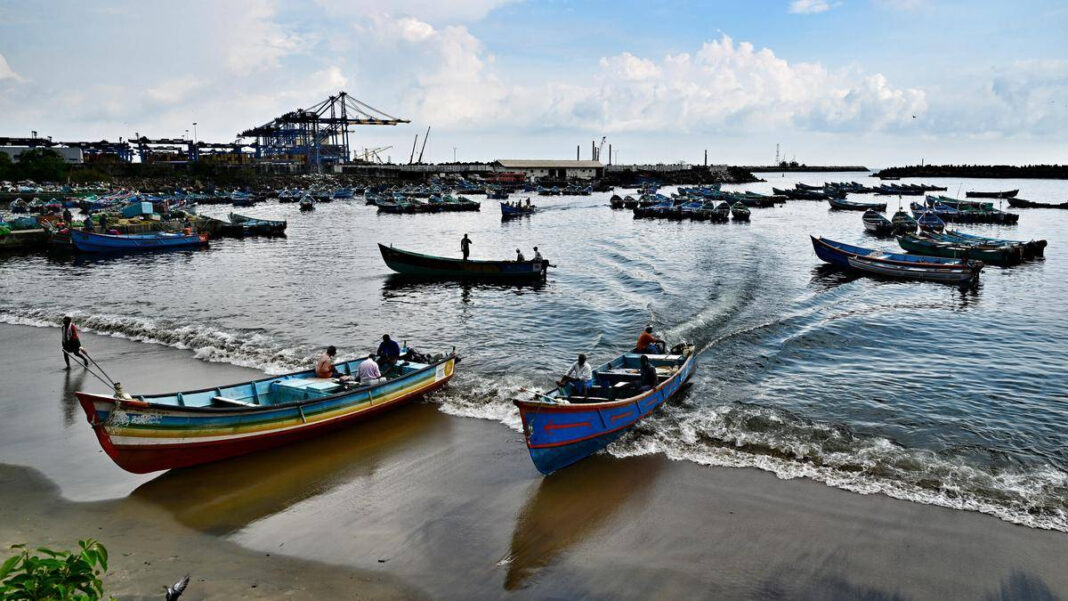
As storm clouds rolled over Vizhinjam fishing harbour on the outskirts of Thiruvananthapuram, fishermen weighed their options: risk the sea or lose another day’s income. Cans of kerosene and petrol lined the quay as crews readied their small boats. But beyond the weather and the uncertainty of a catch, another calculation now determines whether they can sail at all — the soaring price and shrinking supply of kerosene.
Prices surge, supplies thin
For traditional fishers who rely on kerosene-powered outboard motors (OBMs), fuel costs have spiked at a precarious moment. “Kerosene prices have climbed from around ₹103 to ₹157 a litre within six months. With the subsidised supplies available through Matsyafed outlets, the government-run cooperative, insufficient to meet our fuel needs, we are forced to procure the balance from retailers at higher rates,” said Muthappan K.J. of Chowara.
He added that while the government has announced subsidy hikes, delays of up to six months in reimbursing suppliers have disrupted the supply chain, forcing more fishermen to turn to the black market. “Kerosene stocks brought in from Tamil Nadu are part of such ‘informal arrangements’,” he said.
Changing fishing patterns are also compounding costs. “Higher temperatures and the movement of fish into deeper waters have forced traditional boats that normally operate closer to the coast to travel farther in search of catches,” said Johnny, a fisherman from Vizhinjam. Longer trips mean higher fuel bills that many crews can no longer absorb.
Centre’s allocations shrink year after year
A senior Food and Civil Supplies Department official said the immediate trigger for scarcity is the steady reduction in the quantity of subsidised kerosene allocated to Keralam by the Union government. The State has long depended on kerosene for operating OBMs in small fishing craft, with subsidised fuel distributed through the public distribution system (PDS) offering vital support to coastal communities. But as part of a broader clean-energy transition, the Centre has progressively curtailed kerosene availability and tightened the purposes for which it can be used.
Earlier, subsidised and non-subsidised kerosene were available under different categories, and central supplies could meet a portion of fishing-sector demand. Subsequently, Keralam was directed to use white kerosene specifically for fishing, triggering a separate arrangement under which Matsyafed supplied fuel on a non-subsidised basis. A separate allocation of non-subsidised blue kerosene that could be diverted for fishing was discontinued around two years ago.
The annual allocation fell sharply over recent years: from 37,056 kilolitres (KL) in 2020–21 to 25,920 KL in 2021–22, 15,552 KL in 2022–23 and 7,776 KL in 2023–24. It declined further to 3,120 KL in 2024–25 and 1,854 KL in 2025–26, according to officials.
“The Centre’s allocation is now intended primarily for distribution through ration shops. However, the State government continues to earmark a portion of available quantity for fishing activities, considering the dependence of traditional fisherfolk on kerosene,” the official said. Even so, the current allotment is insufficient to maintain existing PDS distribution for ration-card holders, let alone meet fishing-sector needs. Reflecting market pressures, the PDS retail price of kerosene rose from ₹71 to ₹77 a month ago.
Fishing fleet still tied to kerosene
Keralam has about 36,000 outboard engines, the majority of which use kerosene as their primary fuel, according to the Fisheries Department. While the department acknowledges the need to shift to cleaner energy, it faces a significant transition gap. The government recently sanctioned an outlay of ₹1.95 crore for the current financial year to support conversion of kerosene-operated OBMs to petrol- and LPG-run engines through subsidies.
The department says the changeover would reduce maintenance and repair costs associated with kerosene engines and lower greenhouse gas emissions. Yet officials concede they must overcome a widespread perception in the fishing community that Japanese kerosene-powered engines are more reliable — particularly for acceleration and navigating choppy waters. They plan awareness drives to highlight the long-term advantages of petrol and other cleaner propulsion systems.
Matsyafed, which is implementing the conversion programme, has targeted about 200 boats a year. An official said 177 engines were converted under the scheme last year.
“Make fuel affordable during the transition”
Jackson Pollayil, president of the Kerala Swatantra Matsyathozhilali Federation, said fishermen are hesitant to undertake expensive engine conversions without firm assurances that technical issues will be resolved. He also cited concerns over the availability of LPG supplies and the role of intermediaries in setting prices.
“The immediate priority should be to ensure affordable fuel supplies while the transition takes place,” he said. The federation has called for fuel to be supplied at fair and affordable rates, exempt from the Goods and Services Tax, through existing Fisheries Department outlets and without restrictive quantity limits for fishermen using outboard and inboard engines.
PDS disruption spreads to households
The kerosene crunch is not confined to harbours. Reduced allocations have disrupted supplies through ration shops, leaving households uncertain whether they will receive even their curtailed entitlements. During 2023–24 and 2024–25, the PDS kerosene allocation stood at 11,076 KL and 4,368 KL, respectively. Although the allocation rose in 2025–26 to 24,420 KL, supply has again fallen. For the October–December quarter of 2026–27, the Centre has allocated 4,068 KL — down from 5,676 KL in the previous quarter.
T. Muhammedali, general secretary of the All Kerala Retail Ration Dealers’ Association, said many shops cannot supply kerosene to even half their cardholders. “The reduced allocation makes it difficult for dealers to ensure supply for all beneficiaries. For instance, a shop serving 800 cardholders may receive enough kerosene for only 400 people. Those who arrive first receive the fuel, while others have to return empty-handed. This has led to arguments with consumers at various places,” he said.
Under the PDS, pink (priority households), blue (non-priority subsidy) and white (non-priority non-subsidy) ration-card holders receive half a litre every three months, while yellow card holders under the Antyodaya Anna Yojana are entitled to one litre every three months. In addition, nearly 1% of families without electricity are provided six litres. Recent power cuts have further fuelled demand, with some households, especially in remote areas, seeking kerosene for lighting and other needs, ration dealers said.
State seeks relief; Centre cites clean-energy goals
Keralam estimates it needs at least 15,792 KL of kerosene per quarter to meet current demand — 9,600 KL for the PDS and 6,192 KL for the fishing sector. Food and Civil Supplies Minister Anoop Jacob has taken up the issue with the Union Ministry of Consumer Affairs, Food and Public Distribution, but the State has yet to receive a favourable response.
According to the Minister, the Centre’s position is that Keralam’s near-total electrification and high LPG coverage do not justify a larger allocation. The State has challenged that assessment, citing continued demand in coastal and hilly regions and among economically weaker sections. Kerosene is still used for domestic purposes, including cooking, lighting and to start fires for cooking with firewood, he said. The State also argues that current allocations do not adequately account for the needs of coastal communities who have received kerosene through the distribution system for decades.
Officials nonetheless acknowledge that the request may go unheeded, given the Centre’s broader policy to reduce fossil-fuel dependence and encourage cleaner alternatives — a push that intensified after India co-founded the Global Biofuel Alliance during its G20 presidency in September 2023. Nationwide, 21 States and Union Territories have already been declared kerosene-free, with efforts ongoing to extend the status across the country.
A difficult road to kerosene-free status
For Keralam, becoming kerosene-free remains a distant and complex undertaking. Despite the State’s support for converting OBMs to alternative fuels, the sheer scale of the fishing fleet and the immediate livelihood risks for coastal communities mean the transition will require significantly greater financial support — and cooperation with the Centre.
Back in Vizhinjam, whether fishermen push off now depends not just on the weather or the promise of a shoal offshore, but on whether they can fill their tanks at a price that leaves enough to pay the crew. For traditional fishing communities, the success of the clean-energy transition will be measured not only by converted engines or reduced kerosene consumption, but by whether the occupation remains viable while that change unfolds. Until affordable alternatives are available at scale, the withdrawal of subsidised supplies risks leaving those who rely on kerosene trapped between a dwindling allocation and a market they can barely afford.