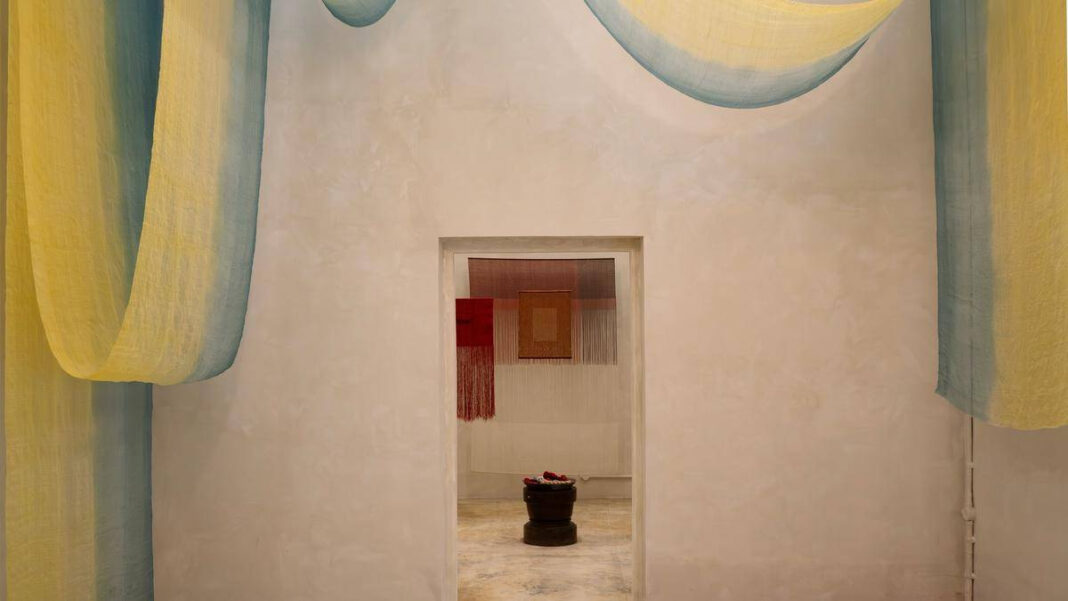

The rooms at KAASH Bangalore have no curtains, and the doorways in the 1800s colonial bungalow are left open. Through one you see a textile panel, and behind it, faintly, another. Manju Sara Rajan, the curator of The Quiet Hand, calls what she has built “portals”.
The show is the work of Chiaki Maki, a Japanese weaver and artist who studied at the Rhode Island School of Design, worked in New York and Tokyo, and now has her studio in the Himalayan foothills, in Uttarakhand. There she also grows fibres for yarn making and natural dye materials such as indigo and henna. And this is her first solo exhibition in southern India.
Japanese weaver and artist Chiaki Maki
Rajan is struck by how rare it is for an artist with a body of work of this scale to still make it with her own hands. “Chiaki is literally physically present and doing things,” she says, “not just the agricultural part of it, which she’s very involved in, but also the dyeing, the weaving.”
Maki’s studio, Ganga Maki, sits on 2.5 acres outside Dehradun, designed by the architect Bijoy Jain, in earth, stone, lime, brick, wood and bamboo. She did not wait for the building to finish before she started working. “As soon as I chose the site, I began planting indigo seeds, basho [banana plants grown for fibre], and cho-ma [ramie, a type of linen],” she says. “I wanted to grow the things we eat, the plants we use for dyes, and the plants that provide our fibres.” Seventeen years on, she harvests about 1.5 tonnes of indigo leaves a year. About 2,000 banana fibre plants grow there, alongside ramie, indigo and night-flowering jasmine. “A basho plant takes around three to four years to mature,” she says. “It is important to observe the plants closely and know when the time is right.”
Tsunagi layered by Yuragi (VI) in the centre, flanked by the 80 Cocoons Red (V) on its left and Tsunagi (III) on the right
Listening to the colours
Walk the rooms with this in mind and the colours start to read as season. “Sometimes I find myself thinking, ‘Ah, this is the colour we have this year,’” Maki says. And what she does with that is listen. “I listen to what the indigo reveals, discovering colours I could never have planned.” In the Koshi series, tall panels of grid run from deep navy to the palest asagi blue, made of all the indigo grown that year.
Koshi (I), Yuragi (I), and Tsunagi (I) on display at the KAASH gallery
“There’s this double layer,” Rajan says, pointing me to a piece from the Yuragi series and drawing me closer to its double weave. Yuragi, as Maki translates it, is the fluctuation found in nature. “Even a single strand of silk is never perfectly straight,” she says. “Whether I combine silk from 10, 40, 80, or 100 cocoons to make yarns of different thicknesses, these natural fluctuations remain. I gently draw the silk from the cocoons with the tips of my fingers, loosen and gather the fibres, and let them dry naturally. Rather than making the yarn uniform, I weave while respecting its inherent qualities.”
The yarn displays the fluctuations found in nature
Among the visitors, Shalini Raman, a visual artist, was most fascinated by the Yuragi series. “I’ve only seen silk smooth and straightened, but these kept the natural fluctuations of the cocoons and enhanced them with light twists, resisting the usual tension. It reminded me of curly hair resisting being straightened.”
‘A moment when movement pauses’
Each piece in the 80 Cocoons Red series is built on a single airy thread drawn from 80 cocoons and dyed with madder and sappanwood (Indian redwood), a ground onto which countless fibres are spun and woven, just like for a painting. In Tsunagi, the end of one warp is tied by hand to the beginning of the next. “Sometimes it is up to a 1,000, 2,000 of these threads that are physically connected,” Rajan says. “So the reds are ending and the whites are beginning – they’re connected and the left over strands hang.”
A work from 80 Cocoons Red
Then there is the yellow. Maki collects the flowers of night-flowering jasmine, harsingar, by hand. “They bloom in the evening, release their fragrance throughout the night, and fall by morning. I collect them every morning, drying most for use throughout the year, while also dyeing with fresh flowers during the flowering season. They produce an extraordinarily luminous, translucent lemon yellow,” she says.
In the work Two Plants, which runs to nearly 18 metres, that yellow is set against the emerald-tinged blue she gets by squeezing indigo leaves. Rajan calls it “very emblematic” of her practice. “It’s the botanicals, it’s the dyeing, it’s the weaving, it’s the simplicity of it,” she says. “You can paint it beforehand, but how it reacts in real life is not something you can predict unless you have that kind of experience.”
The Sacred Skirt made with basho and bheemal dyed in indigo
Another visitor, a design historian and curator Ishita Shah, was seeing Maki’s work for the first time. It evokes, she says, “a strong sense of immersion, and continuous exploration.” The exhibition, she adds, “continuously takes us through different cycles of time.”
Maki would say the cycle would keep evolving beyond the doors. “Everything continues to move and change. Each work has a history before it comes into being, and its life continues after it is exhibited. What we see is simply one moment in that ongoing process, a moment when the movement has paused.”
The Quiet Hand is on at KAASH in Bangalore until November 21.
The writer is a fashion researcher and brand strategist whose work is rooted in textiles, crafts and culture.