
In 2000, when Minal Vazirani co-founded Saffronart, for many Indians buying a painting meant buying blind. “Access to information was limited,” she recalls. “It was difficult for a buyer to understand the market, research an artist or assess the value of a work. Public pricing information was not readily available.”
A quarter century later, buyers across the country have auction archives, digital catalogues, and the research of galleries and institutions worldwide within easy reach. They have changed, too. International interest has grown, more female buyers have emerged, tastes have shifted, interest in buying art has bypassed socio-economic standing, and the very intent behind collecting has morphed.
When Art Mumbai opens its fourth edition at the Mahalaxmi Racecourse on November 12, with 94 exhibitors — 73 of them Indian and 21 international — it is this new buyer the fair is counting on.
Who is buying now?
“The collector base in India has become considerably more diverse,” says Minal, who co-founded the fair with Dinesh Vazirani, and gallerists Nakul Dev Chawla and Conor Macklin in 2023. She describes younger entrepreneurs, professionals and first-time buyers walking in alongside collectors who have been at it for decades. Many, she says, are now curious about “artists and categories beyond the familiar names of Indian modernism”.
(L-R) Co-founders Nakul Dev Chawla, Dinesh and Minal Vazirani, and Conor Macklin
| Photo Credit:
Courtesy Art Mumbai
The numbers reflect this. “Ticket sales have jumped 170% since the inaugural edition in 2023, and VIP tickets are up 250%,” she says. “The number of participating international galleries has more than quadrupled, to 21, including Perrotin, Richard Saltoun and Night Gallery taking part in an Indian art fair for the first time.” For her, however, it is breadth, not any headline-worthy figure, that matters most. “What I find particularly encouraging is that collecting is no longer a small circle,” she says. “This diversity is important for the long-term health of the Indian art ecosystem.”
By the numbers
94 exhibitors: 73 Indian, 21 international
Galleries from 27 cities, up from 10 in 2023
Ticket sales up 170% since 2023; VIP tickets up 250%
Exhibitors up 80% since the first edition
Foundation presentations up 150%
A sculpture by Aaditi Joshi
| Photo Credit:
Courtesy Art Mumbai
This year’s theme, Where Collections Take Shape, treats collecting as closer to education than transaction. A collection may begin with a gut response to a single work, she says, but research gives it form. “A considered collection is not simply an accumulation of works but a reflection of knowledge, conviction and engagement built over time.”
Equal roles for public and private
If the fair wants better-informed buyers, it also wants people who may never buy at all, Dinesh asserts. Guided walks, the Speaker Series, performances, music and late evenings on Friday and Saturday are meant to “bring different aspects of the city’s cultural life together under one roof”. This year, there are also walks designed for children, extending that invitation further.
Anish Kapoor’s Purple and Wild Cherry Mix to Pagan and Lime Gold Mix
| Photo Credit:
Dave Morgan | Courtesy Lisson Gallery
Does a commercial fair conflict with the sense of discovery one usually finds at a biennale or museum? He believes not. While Venice showcases national pavilions and museums offer retrospectives, a fair provides variety through numerous artists, galleries, and practices gathered in one place over a few days. “At a fair, discovering something new and finding something you might want to collect can go hand in hand,” he says.
Anju Dodiya’s Chapters in Healing
| Photo Credit:
Courtesy Art Mumbai
Minal, however, is careful not to cast private foundations as a stand-in for public institutions. Foundations, she says, “can be nimble, develop focused collections, support research and exhibitions”. Public museums carry “a distinct civic responsibility” to serve audiences across generations and economic backgrounds. “Ideally, we should build a stronger ecosystem in which public museums, private foundations, galleries and collectors work alongside one another.”
First-timer’s tip
Start small — prints, works on paper and smaller works are a way in. Ask galleries about the artist, provenance and condition. And, in Minal Vazirani’s words, “Buy something you would be happy to live with.”
Co-founder Minal Vazirani
| Photo Credit:
Courtesy Art Mumbai
That idea expresses itself in Voices from the Earth: Women, Nature, Power, a joint presentation by the Kiran Nadar Museum of Art and the Saffronart Foundation. It looks at folk and tribal traditions through the women who were among their original practitioners, “but whose role has not always received the recognition it deserves,” says Dinesh. With interventions by the Vayeda Brothers, two young artists from the Warli community, and Savita Jha (who has spent two decades in action research with marginalised communities), visitors can also help paint a mural alongside the artists.
Colombian textile artist Olga De Amaral’s Caliza II
| Photo Credit:
Mark Waldhauser
Don’t miss
The Sculpture Park, on the theme Material and Memory
Voices from the Earth: Women, Nature, Power (KNMA and Saffronart Foundation), with a mural visitors can join
A Wonder Room by Abu Jani Sandeep Khosla, their new art and design vertical
Guided walks across modern and contemporary art, plus weekend walks curated for children
Extended evening hours on Friday and Saturday
The booth arrives amid a wider reckoning, and Minal points to a run of recent international shows: Arpita Singh at the Serpentine, Nalini Malani at the Venice Biennale, Nilima Sheikh at MoMA. “These presentations point to a more sustained international engagement with the contribution of women artists from the subcontinent.”
Sculpture Park is a highlight
For Minal, part of the pleasure is watching the fair come together, “from the overall layout to the individual exhibitor booths, and, of course, the works on display”. Art Mumbai, she notes, marks the start of the South Asian art season, and many artists and galleries make new work for it. She is watching for debut artists and fresh contemporary work, along with prominent pieces by Indian modernists and international artists. “The Sculpture Park is a highlight I look forward to,” she adds.
Jonathan Trayte’s painted bronze work at the Sculpture Park
| Photo Credit:
Courtesy Art Mumbai
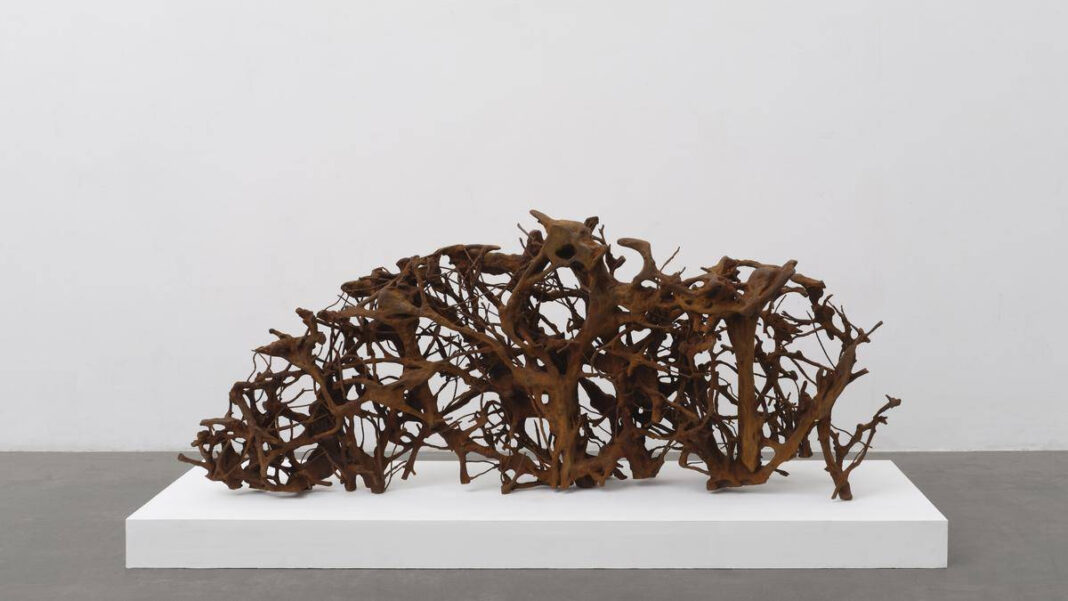
This year, out among the racecourse lawns, the Park takes up the theme Material and Memory. Its curator, Veerangana Solanki, has gathered works in wood, stone and terracotta alongside metal, fabric and found objects, materials that “hold histories, associations and traces of time”. The racecourse shapes how they are seen. “The Sculpture Park exists within an active public space, where visitors encounter the works from different directions and in different sequences,” she says. Some works were conceived in response to the site itself, strengthening the setting’s role in the experience.
Curator Veerangana Solanki
| Photo Credit:
Courtesy Art Mumbai
It is, in a sense, the fair’s argument in miniature. “Ultimately, I hope visitors take the time to engage with the material and the ideas behind each work,” Solanki says, “and make their own connections with the stories and memories they encounter.”
Art Mumbai is on from November 12 to 15 at the Mahalaxmi Racecourse, Mumbai.
The Mumbai-based writer, artist and editor reports on fashion and culture.