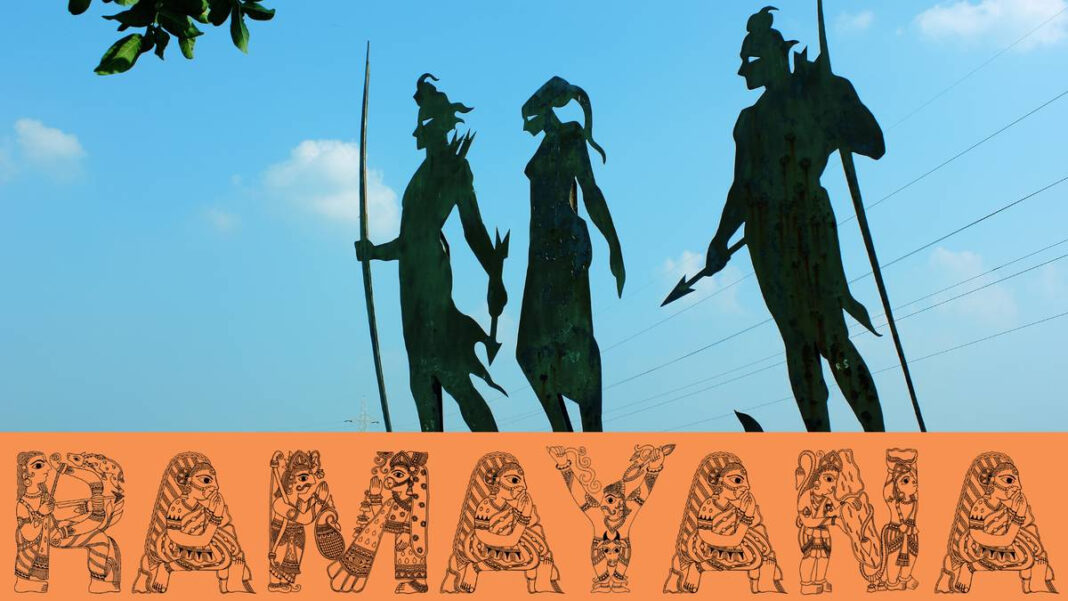

How do you fit the Ramayana, an epic of gods, demons, warring kingdoms and human frailty, into 26 letters? For Ishan Khosla, a Dehradun-based designer and educator with a fascination for the history of typography, the question was not entirely absurd. He had spent years thinking about the strange relationship between pictures and words: how Egyptian hieroglyphs represented objects and sounds, and how medieval European manuscripts turned their opening letters into elaborate miniature worlds, populated by saints, animals and sword-wielding men. Letters are things we read, but what if they could become pictures again?
Khosla had been exploring this possibility through The Typecraft Initiative, founded in 2011, born of a frustration with how little of India’s own visual culture he saw in contemporary design. “I also wanted to get out of the confines of the urban, air-conditioned studio,” he recalls, “and typography became a means of dialogue, through words as much as images.”
Working with practitioners of Gond art and Baiga tattoos, kolam and other visual traditions, he has sought to bring artistic knowledge passed down through generations into digital typography. Having previously collaborated with Madhubani artists Pradyumna Kumar and Pushpa Kumari on a Devanagari typeface, he wondered whether they might help him turn the Ramayana into an alphabet.
Ishan Khosla with Madhubani artist Pradyumna Kumar.
‘Rama is our jamai’
The artists come from Madhubani, in the Mithila region of Bihar, where Sita, the epic’s heroine, is believed to have been born. This gives the region, and its paintings, a peculiar intimacy with the story. Rama, the exiled prince of Ayodhya, may be worshipped as a god across much of India, but in Mithila he is also a jamai, or son-in-law. He belongs to the family, so to speak.
The Ramayana as a typeface
| Video Credit:
The Hindu
“Madhubani painting has traditionally been practised by women,” explains Kumari, recalling how she learnt the art by watching her grandmother, the pioneering Padma Shri award-winning artist Mahasundari Devi, paint the walls and courtyards of their home during weddings and religious ceremonies. Over time, the paintings moved from walls onto paper and canvas, finding audiences far beyond Mithila. The Ramayana, too, was part of everyday life, through prayers performed at home, songs sung during festivals and Ram Lilas staged in the streets around Diwali. Years later, when her brother-in-law Kumar had to leave his job as a land surveyor because of health problems, Kumari taught him to paint.
The collaboration unfolded between 2021 and 2024, with Kumar spending much of his time rereading Valmiki’s Ramayana, Tulsidas’s Ramcharitmanas and other retellings, searching for characters whose names could be accommodated by the English alphabet, while Kumari worked on the drawings. The two exchanged sketches and corrected each other’s work before sending them to Khosla, who responded with annotations and suggestions.
Madhubani artists Pradyumna Kumar and Pushpa Kumari.
Some letters offered obvious possibilities. ‘R’ could be Rama or Ravana. ‘H’ belonged naturally to Hanuman. Others required considerable imagination. What, for instance, was one to do with ‘X’? Or ‘Z’, a letter without a direct equivalent in Hindi? “We had to cheat a bit,” Khosla admits. Jambavan, the wise bear king, was recruited to become Zambavan.
‘H’ belonged naturally to Hanuman.
Working the illustrated alphabet
Each character is captured at a particular moment in their story. ‘A’ depicts Angad confronting Ravana in his court, as Rama’s emissary, making a final appeal for peace before the war. ‘J’ shows Jatayu, the great bird, wounded after attempting to rescue Sita from Ravana. ‘U’ belongs to Urmila, Lakshmana’s wife, who, according to one popular retelling, sleeps through her husband’s 14 years in exile. ‘W’ proved another challenge. Unable to find a character whose name began with the letter, the artists settled on the lesser-known Vajrajwala, Kumbhakarna’s wife in some retellings, depicted alongside weapons and war machines she is said to have devised to protect Lanka.
‘A’ depicts Angad confronting Ravana in his court.
‘J’ shows Jatayu, the great bird, wounded after attempting to rescue Sita from Ravana.
The figures stretch, twist and fold themselves into the contours of the letters, as though the alphabet were another kind of stage. There are smaller details, too. In the letter ‘R’, Rama is barefoot, while Ravana wears shoes. Why? “Rama was living in the forest, while Ravana was still ruling his kingdom,” Pradyumna explains.
In the letter ‘R’, Rama is barefoot, while Ravana wears shoes.
Over several months, Khosla and his Typecraft team painstakingly digitised the artists’ delicate outlines, transforming them into solid forms and adjusting their contrast, spacing and proportions. Several letters, including ‘A’, ‘N’ and ‘M’, have alternate forms that change depending on the word being typed. Type SITA, and the letters depict episodes from her life, from her childhood alongside Urmila to her captivity in Lanka. Type RAM, and they transform to tell his story, from Hanuman seeking his blessings to Bharata awaiting his return with his sandals. Type RAVAN, and the default ‘N’, depicting Nal and Neel, gives way to a scene of Sita’s abduction. This was not merely an illustrated alphabet, but a functioning typeface, capable of forming words and telling stories.
Made for film and museums
Khosla sees the project as a “double metamorphosis”. Madhubani painting has travelled through paper and canvas to the computer screen. At the same time, its figurative language of humans, animals, plants and gods has been transformed into the Latin alphabet, a writing system with a history far removed from Mithila, but one that now circulates almost everywhere.
The artists imagine the typeface — available to download on The Typecraft Initiative website — appearing on book covers, in museum exhibitions, on film and theatre posters, on artworks, or simply as a playful way for people to discover the many stories and characters of Ramayana. For Khosla, the hope is that it will travel widely, but also find its way back to the people whose artistic traditions gave it form. “Type carries a lot of knowledge and emotion,” he says. He hopes the community, and audiences far beyond it, will see something of themselves in the typeface and find their own uses for it.
The Ramayana has never belonged to a single book, language or storyteller. It has been sung, performed, painted, translated, disputed and retold for centuries. Now it can also be typed.
The writer specialises in reporting on art, design and architecture.