
Karnataka SIR: Civil society report flags large-scale voter deletions, ground-level discrepancies
An investigation by the Anti-SIR Alliance and the Citizens’ Vote Protection Committee has alleged large-scale deletions and procedural lapses in Karnataka’s electoral rolls following the ongoing Special Intensive Revision (SIR). Based on analysis of electoral-roll data, a survey of Booth Level Officers (BLOs) and door-to-door verification across 100 polling booths in 25 districts, the report says the State’s electorate dropped from 5,52,49,719 voters in 2025 to 4,44,53,380 in the draft roll — a reduction of about 19.5%.
What the report says
The organisations have questioned the scale and pattern of deletions, especially the large number of voters labelled as “Shifted” and “Absent”. Citing data compiled from district-level records, the report says that 65,45,679 voters were classified as “Shifted”, 16,39,864 as “Dead”, 15,17,042 as “Absent”, 7,09,870 as “Duplicate” and 3,83,884 under “Others”.
The “Shifted” category warrants particular scrutiny, the committee argues, because people who move for employment or change rented accommodation should be enabled to transfer their registrations rather than being removed from the rolls. The report also highlights the difficulties faced by migrant workers and those in precarious employment who may not be present at home when BLOs conduct verification.
Findings from ground verification
In a 100-booth sample across 25 districts, the Citizens’ Vote Protection Committee says its door-to-door verification uncovered instances where voters living at their registered addresses had been marked as “Shifted” or “Absent”. The team also claimed that some living voters were listed under the “Dead” category.
The report notes that some eligible voters did not receive enumeration forms and that several were unaware their names had been removed from the draft roll. While acknowledging that the survey covered only a small proportion of Karnataka’s polling booths, the organisations have called for wider verification and an independent assessment to determine the extent of wrongful exclusions.
Bengaluru numbers under the spotlight
The report singles out Bengaluru, stating that the electorate there fell from 1,11,16,111 to 48,48,574 in the draft roll. The committee has asked the authorities to explain the reduction, noting that the city has seen substantial population growth and inward migration in recent years.
Impact on marginalised communities
According to the organisations, deletions were particularly high in some backward districts and in constituencies with sizable SC, ST and Muslim populations. The report also states that women were disproportionately represented in the “Shifted” category, partly due to changes in residence after marriage. It raises concerns about the potential impact of the revision on nomadic communities, Adivasis, Dalits, migrant workers, Muslims and people living in informal settlements.
BLOs cite workload and training gaps
The report documents heavy workloads among Booth Level Officers — many of whom are teachers and Anganwadi workers — and points to training shortfalls. It says 23% of BLOs surveyed received no training, while 38% of those who did were trained for less than a day. More than 80% reportedly said they could not cope with the workload.
It also refers to the deaths of five BLOs during the process, which the report attributes to work pressure and mental distress. The report notes that the circumstances and causes of those deaths would require independent verification.
Notices and Form 6 applications
The report states that 43 lakh voters received notices: 23 lakh over alleged non-mapping with the 2002 electoral roll and another 20 lakh under the “Logical Discrepancy” category. As of September 24, 7,70,988 Form 6 applications had been submitted, covering both restoration requests and new voter registrations. The committee said these figures warrant closer examination as the revision advances.
Statements and reactions
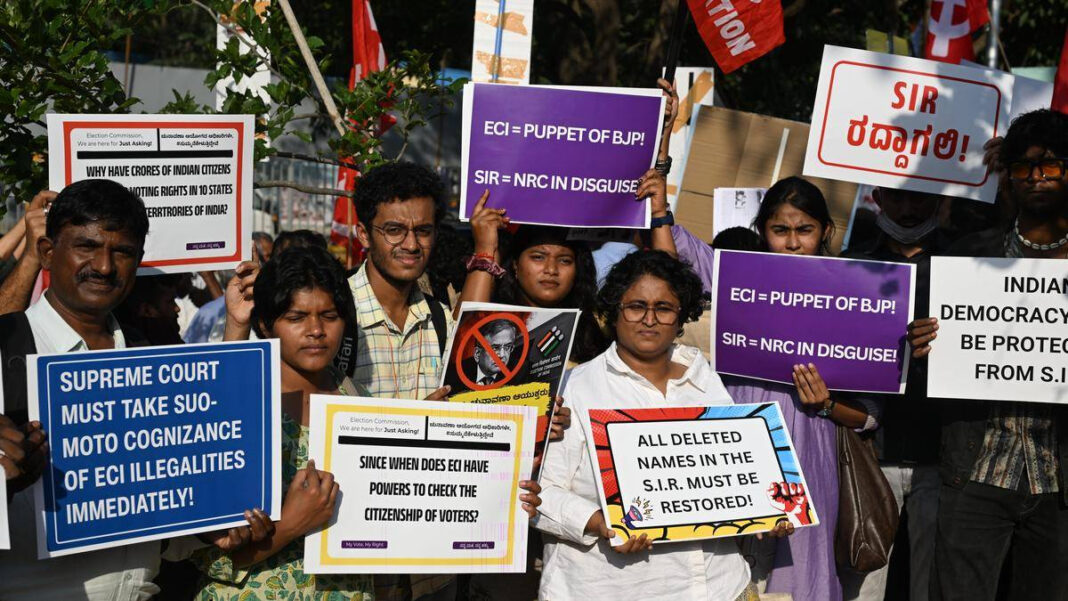
Calling for the SIR process to be scrapped in Karnataka, actor and social activist Prakash Raj said the issue goes beyond elections or political victory, alleging that an attempt was being made to “divide the country into two.” A delegation of the Anti-SIR Coalition, led by Raj, met D.K. Shivakumar at his residence on Wednesday and handed over the SIR Scrutiny Report.
On-the-ground process and next steps
Separately, the report and allied field accounts indicate that weeks into SIR hearings, many voters were still trying to locate their notices or understand why they had been summoned. Others who completed hearings sought clarity from Additional Electoral Registration Officers. The burden has been particularly visible among marginalised groups, especially women and daily-wage workers who face constraints in attending hearings and navigating documentation.
The Anti-SIR Alliance and the Citizens’ Vote Protection Committee have urged an independent, comprehensive review of the draft roll to determine the scale of any wrongful deletions, and to ensure that voters flagged as “Shifted” or “Absent” have a viable pathway to transfer or confirm their registration without being removed from the rolls.
Why it matters
The claims outlined in the report cut to the heart of voter enfranchisement and the integrity of the revision process. With millions of notices issued and substantial reductions recorded — including in rapidly growing urban centres — the organisations argue that heightened scrutiny is needed to address potential errors, ease administrative burdens, and ensure no eligible voter is inadvertently excluded ahead of finalising the rolls.