
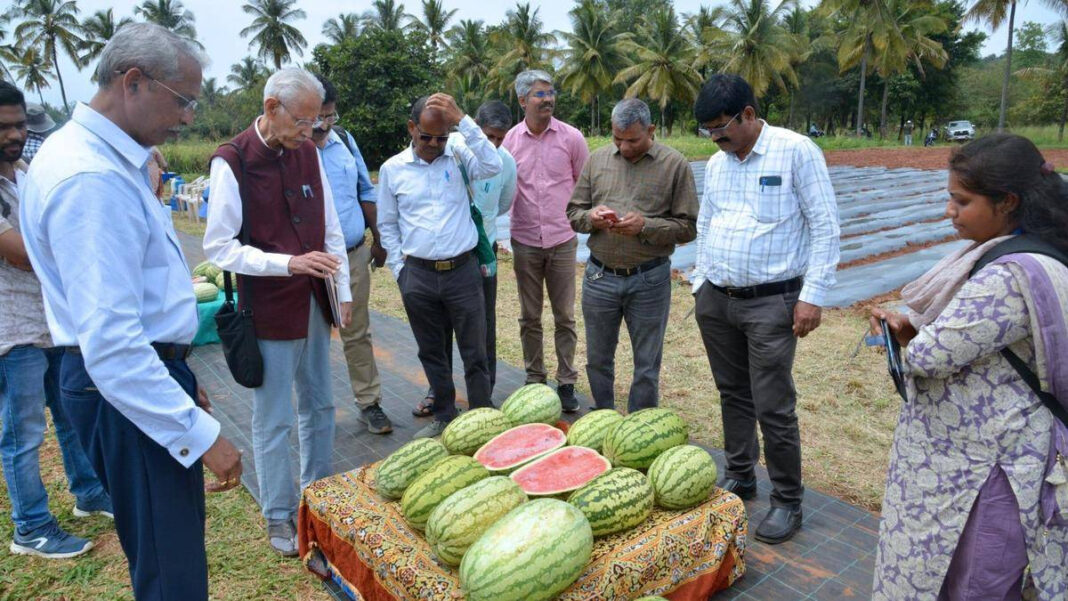

IIHR’s ‘Arka Shakti’ rootstock offers farmers a way to tackle Gummy Stem Blight in watermelon
In a development that could revive shrinking watermelon acreage across parts of India, scientists at the Indian Institute of Horticulture Research (IIHR) have introduced a hybrid rootstock, Arka Shakti, bred for resistance to Gummy Stem Blight (GSB)—a devastating fungal disease that has plagued watermelon crops for years. The institute says the new rootstock can be grafted with popular watermelon varieties to produce healthier, higher-yielding, and better-quality fruit.
Why Gummy Stem Blight matters
Gummy Stem Blight, caused by the fungal pathogen Stagonosporopsis cucurbitacearum, has become a major constraint for watermelon growers, particularly in Karnataka. According to Sreenivasa Rao, principal scientist in the Vegetable Science department at IIHR, the disease has contributed to a precipitous decline in the state’s watermelon cultivation.
“According to data from the Horticulture Department in Karnataka, the area under watermelon cultivation was 12,000 hectares in 2014, and had reduced to 1,300 hectares in 2024. Farmers in Chamarajanagar, Mandya, Bidar, and Kalaburagi districts grow watermelon. The reason behind the drastic decrease in the area of cultivation is susceptibility of watermelon to GSB disease,” he said.
Rao noted that the disease is often detected too late to prevent losses. “Farmers get to know of the disease in watermelons only during the harvest as it doesn’t show up earlier. GSB is caused by a fungal pathogen Stagonosporopsis cucurbitacearum, and, in most cases, occurs along with Fusarium, another fungal disease. This disease spreads through seed, soil, and air simultaneously. While seed and aerial infection can be managed by chemical management, soil infection is difficult to manage. Using resistant root stocks is a good option to overcome this problem.”
Continuous cultivation of watermelon in the same fields without crop rotation, the scientists added, accelerates soil-borne infections, making conventional disease control increasingly ineffective and costly.
How Arka Shakti was developed
Arka Shakti is an interspecific hybrid rootstock developed by crossing Citrullus amarus and Citrullus lanatus. The result, IIHR says, is a robust root system tolerant to key fungal diseases, including GSB, onto which commercial watermelon scions can be grafted.
Explaining the breeding rationale, Rao said, “When we develop a new root stock resistant to diseases, we must ensure to use the same genus. For instance, watermelon belongs to the genus of Citrullus, and Citrullus amarus also belongs to the same genus. It is also a wild species, which is less prone to disease. Farmers can bring whichever variety of watermelon seeds they buy from the market and graft it with Arka Shakti root stock. Once grafting is done, tiny plants are kept in a chamber maintaining required temperature and light. Later, the plants are moved to the fields to grow watermelon.”
IIHR’s Vegetable Science department has previously released two watermelon varieties—Arka Manik and Arka Shyama—through its improvement programme. With Arka Shakti, the institute is offering a disease-resistant foundation that can support those and other existing market varieties.
Economics of adoption
IIHR expects nurseries to be the primary channel for grafting and supplying Arka Shakti-based seedlings to farmers, leveraging their controlled environments and skilled labour. “Nurseries charge ₹6 to ₹8 for each plant,” Rao said.
He outlined the comparative costs and potential returns: “If a farmer is currently investing ₹60,000 to cultivate watermelon in one acre land, he earns ₹2.5 lakh per acre after harvesting and selling. If grafted using Arka Shakti root stock, farmers will incur ₹15,000 extra, which is ₹75,000 per acre. However, the watermelons will be disease free and the profits might also increase because of good quality and quantity.”
What early results show
IIHR has grown a limited quantity of Arka Shakti-grafted watermelon to assess field performance. Rao reported visible improvements in fruit appearance, taste, and size. “The colour of the watermelon is good, unlike the faded ones available in the market. Tastewise also, the fruit is sweet, and each fruit is 2 to 3 kg more than a usual watermelon. It weighs between 3 to 8 kg depending on the variety,” he said.
Scaling via nurseries
While demand for a disease-resistant solution is expected to be high, IIHR does not plan to directly commercialise Arka Shakti seedlings at scale. Instead, the institute aims to train nurseries across India in grafting techniques and production protocols, ensuring a broader and faster rollout.
“This new root stock can reach farmers through nurseries, which is a win-win situation. Nurseries can generate revenue while farmers can expect a good yield along with profits,” Rao said. Training nurseries would also help standardise grafting quality and post-graft handling, from controlled chamber care to field establishment.
Why it could change the calculus for growers
GSB’s simultaneous transmission routes—seed, soil, and air—have made it notoriously difficult to manage, particularly where soil-borne inoculum has built up over years. Chemical control can suppress seed- and air-borne infections but is less effective against entrenched soil pathogens. By shifting the focus to disease tolerance through rootstock resistance, Arka Shakti aims to break that cycle and make watermelon cultivation more predictable and profitable.
The road ahead
With Arka Shakti positioned as a platform technology—compatible with a wide range of market-preferred watermelon varieties—the next phase hinges on nursery training, farmer awareness, and early adopters validating its performance at scale. If the initial results hold, the rootstock could help reverse the acreage decline seen in districts such as Chamarajanagar, Mandya, Bidar, and Kalaburagi, and restore confidence among growers who have struggled with late-detected disease losses.
IIHR’s introduction of Arka Shakti marks a significant step in integrated disease management for watermelon, combining plant breeding with practical on-farm solutions to address a long-standing production bottleneck.