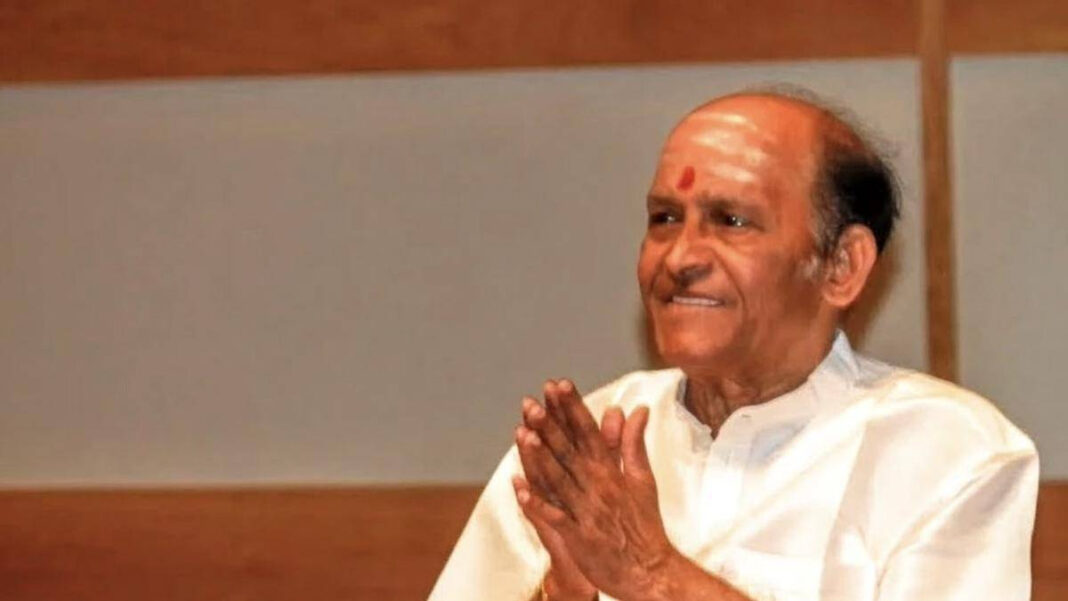

The passing of my mridangam guru, Guruvayur Dorai Sir, represents more than the loss of a legendary artiste; it marks the transition of a generation of artistic values, ideals and knowledge.
Dorai Sir was a gateway to another era, a formative time when Carnatic music was taking root as a public concert tradition in India, expanding globally to new landscapes, and engaging with other art forms. He bridged seven generations of musical knowledge from the revered Pudukkottai school, connecting a rich tradition to a rapidly changing world. Sir was universally admired for his kindness, selflessness, love, and humility towards everyone.
During my 30 years of training with him, he was more than a guru to me.
Growing up in Kalamazoo, Michigan, in the U.S., I began learning from Sir at the age of 10. It was a rare privilege to learn from him, whose significance I could hardly comprehend at that age. I first met him in 1996 in Michigan, when he was on a concert tour with flautist K.S. Gopalakrishnan and violinist M. Chandrasekharan. Before the concert, I went to meet the mridangam legend. Though I had been learning the mridangam for a year from my local teacher Damodaran Srinivasan, Dorai sir knew nothing about me, nor had he heard me play. but suddenly he asked me to sit on stage with him. I did not understand what that meant, but I sat the next four hours beside him during a marathon Carnatic concert. After the concert, he told my parents that he would be heppy to teach me the next time we visited Chennai. What would become one of the most defining relationships of my life seemingly came out of nowhere.
My parents followed up on this, and the following year we travelled to Chennai so I could begin my formal training during summer vacation, and during the December Music Season and winter holidays. I was fortunate to learn from him at a particularly active phase of his career, when he was performing, teaching and touring the U.S. almost every year. I also had the opportunity to watch him in close quarters as he was constantly exploring new musical ideas.
Lessons followed neither a clock nor a fixed syllabus; they unfolded according to his musical instinct. He rarely spoke during lessons; instead, he taught largely by demonstrating compositions, their nuances, and playing technique and explaining the history of the drum through his playing. He knew when a student was ready for a new lesson and introduced musical masterpieces at the right time.
I especially cherish the occasions when he sang a composition and guided me through its lines, showing me how to play it on the mridangam while accompanying.
Rohan Krishnamurthy with his guru during a concert.
| Photo Credit:
Courtesy: Rohan Krishnamurthy
Lessons could last 20 minutes or stretch up to three hours without a break. There were no phones, iPads, note-taking or other distractions, only total engagement between a guru and a sishya. For his undivided one-on-one lessons, he never charged me a fee. For him, the guru-sishya bond was sacred: knowledge had to pass from one generation to the next if the tradition was to survive. Students across generations, countries and cultures experienced his affection and wisdom.
By middle school, I had started performing across the U.S. and annually in India. I gradually realised the enormity of what he was teaching me. Back home, I would spend countless hours practising, notating and recording everything he taught me so I could save it for posterity. Sir offered us the seeds of knowledge; it was up to us to nurture them.
T
His musicianship deserves an account of its own. The tributes from senior musicians after his passing reflected the depth of his artistry — defined by true musicality and emotional impact. He performed with legendary artistes of Carnatic and Hindustani music, many of whom wanted to perform with him. A fine vocalist himself, he seemed to make the mridangam sing. His playing elevated the music without overwhelming it, responding to the nuances of the composition and the musicians around him. He knew the songs, sangatis and musical idioms of his time, and brought an instinctive understanding to every performance.
I have countless memories of sharing the stage with him in Chennai and the U.S. from 1996, including playing the mridangam alongside him with musicians many generations senior to me. One that remains vivid in my memory is the concert with legendary vocalist Nedunuri Krishnamurthy during the Chennai December Season in the 2000s.
During the niraval of the main piece, Sir started singing the lyrics while playing the mridangam, using his characteristic thoppi bass and chapu tonal strokes. Despite having performed together for decades, he was visibly moved by the music Dorai sir had created on that moment.
I remember similar instances at many of sir’s concerts, when his co-artistes would often acknowledge, sometimes with just a few words backstage, the magic they had shared on stage.
While Sir was a central figure in the Chennai music scene for decades, he also played a pivotal role in taking Carnatic music and the mridangam, especially to an international audience from the 1970s. His tours and teaching engagements introduced the tradition to new countries, audiences and cultures. Incidentally, I learnt that the father of a San Francisco-based pianist, with whom I perform, had taken summer lessons in konnakol from Sir at San Francisco State University in the 1970s. Decades later, Sir came to my hometown of Kalamazoo as a visiting scholar at the Western Michigan University in the early 2000s.
His teaching there introduced a generation of university students, many of whom were neither of South Asian origin nor percussionists, to Carnatic music and its rhythmic traditions. The music department was so impressed by his approach, which combined performance, teaching and student interactions, that it came to refer to it as the “Dorai Model.” He was invited again a few years later. On both visits, I had the privilege of observing him teach in an academic setting while continuing my private lessons with him for hours every day.
Rohan Krishnamurthy with the members of the Kalamazoo College Indian Percussion Ensemble.
| Photo Credit:
The Hindu Archives
During this time, he shared many gems of the Pudukottai bani, taught me how to compose and develop musical ideas, and deepened my understanding of song accompaniment. A few years later, Sir spent a week at Kalamazoo College, where I was an undergraduate student. He conducted several masterclasses and worked closely with students in my Indian Percussion Ensemble class.
Those who knew sir and his family were also familiar with Uzhavur P.K. Babu, his gurukulavasa student, caretaker and teaching assistant. Babu Anna and I arrived at Sir’s home in 1997 from different worlds but both of us were driven by the desire to learn from him. When Anna moved in with sir in 1998, he became a constant presence in sir’s life, helping with houshold chores and the many demands of concert life. This support was particularly importnat given sir’s mobility challenges following polio.
With Anna’s support and his own resilience, Sir continued to travel widely to share his musical knowledge. Sir taught us not just through his music, but also through the way he lived: with generosity, discipline, humility and an unwavering commitment to hsi art. Those of us who learnt from him have a responsibility to carry that legacy forward.
Published – October 24, 2026 02:50 pm IST