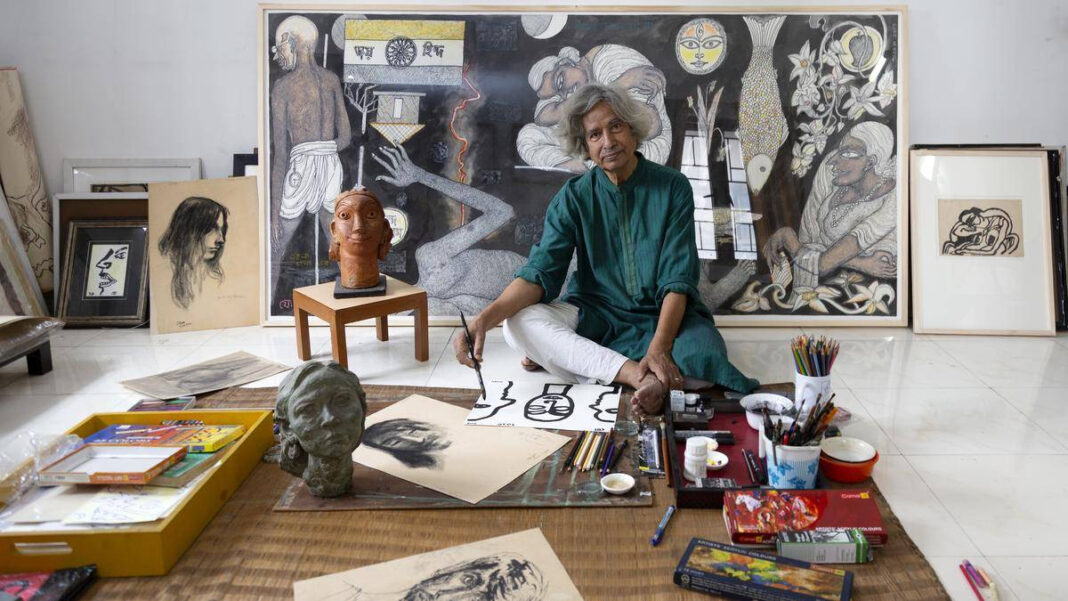

Inside Jogen Chowdhury’s Kolkata studio, the panoramic painting with the Mahatma in the background
| Photo Credit: Rohit Chawla
What was it about Mohandas Karamchand Gandhi that kept drawing Jogen Chowdhury to him? I found myself wondering this while photographing the artist in his Kolkata studio in 2020 with his panoramic painting with the Mahatma occupying a pivotal corner.
Over the years, Gandhi has been painted, photographed and appropriated so relentlessly that he has often become a familiar collection of symbols: the round spectacles, the frail body, the inevitable spinning wheel. Chowdhury, however, seemed to be searching for something beyond the icon — more human, intimate, a less easily resolved portrait of the man.
A portrait of Gandhi in the artist’s distinctive cross-hatched style
| Photo Credit:
Rohit Chawla
Perhaps it was not Gandhi the Father of the Nation who interested him so much as Gandhi the individual, who was vulnerable, contradictory, austere and stubbornly committed to an idea of how one ought to live. His interpretation had a painterly intelligence that made Gandhi feel less like a national emblem and more like a human presence.
‘His art carried its own authority’
Looking at that panoramic work in his studio, I wondered if he was also painting something of himself. There was, after all, a quiet Gandhian quality to Chowdhury’s own persona. He was understated, unassuming and seemingly untroubled by the need to advertise his importance. (Chowdhury was a child when Partition uprooted his family from East Bengal and deposited them in the precarious world of refugee Calcutta. He later acknowledged that those years had made him more socially and politically conscious.) His art carried its own authority; it required neither bombast nor an elaborate curatorial alibi. His distinctive fluid lines, with their twisting precision, seemed to arrive at their truths by an entirely personal route.
Art on the walls in Kolkata
| Photo Credit:
Rohit Chawla
Work surfaces in Chowdhury’s studio
| Photo Credit:
Rohit Chawla
I found a rather persuasive clue while visiting his modest MP’s flat (the Padma Bhushan awardee was also a Rajya Sabha Member of Parliament from 2014-2020) in the so-called Lutyens’ Zone, that grand Delhi preserve where even the furniture can occasionally appear to have political ambitions. His home, however, seemed to have missed the memo. There was little of the usual parliamentary self importance, no conspicuous display of cultivated power. Instead, its spartan minimalism felt closer in spirit to an artist’s ashram. Plain vanilla walls, a handful of books, the obligatory sketchbooks and a few ramblings on paper were the principal inhabitants. The silence was almost a piece of furniture in itself.
In the artist’s studio
| Photo Credit:
Rohit Chawla
I cannot say whether Chowdhury consciously aspired to be Gandhian. But perhaps the Mahatma offered him more than a compelling subject. Perhaps he represented an ideal of restraint and simplicity, and an inner life that needed no public performance. The Gandhian in Chowdhury may have been found as much in the man as in the sparseness that his paintings embodied.
A bit of mischief
I’ve met Chowdhury several times over the years. In 2019, at the India Art Fair, I remember him wandering past the Art Alive booth where my photographic sculptures of various artists stood assembled. He took a leisurely look at the company I had mounted on the walls and then, with that wonderfully dry economy of expression, wondered aloud why he was missing from the gallery. Had I perhaps decided he wasn’t photogenic enough?
Jogen Chowdhury at the writer’s Art Alive booth at the India Art Fair
| Photo Credit:
Rohit Chawla
Chowdhury with the writer-photographer
| Photo Credit:
Rohit Chawla
It was the sort of question that could puncture a photographer’s carefully cultivated vanity without so much as disturbing the air. I was left wondering whether I had been gently reprimanded, deliciously needled, or simply handed my next assignment. With Chowdhury, even mischief seemed to come without an entourage.
The writer is an artist whose lens has captured the pulse of contemporary India.
Published – October 30, 2026 01:13 pm IST