
In 1976, actor-director Dinesh Thakur launched the Ank Theatre Group to promote Hindi theatre in India. Its first production, Prastaav, ran for only 11 shows, but the group gained momentum after the launch of Prithvi Theatre in Mumbai two years later. Prithvi provided a dedicated venue and a thriving theatre ecosystem. Over the years, productions such as Hai Mera Dil, Beewion Ka Madarsa, Anji, Bhaagam Bhaag, and Jis Lahore Nahin Dekhya enjoyed tremendous success.
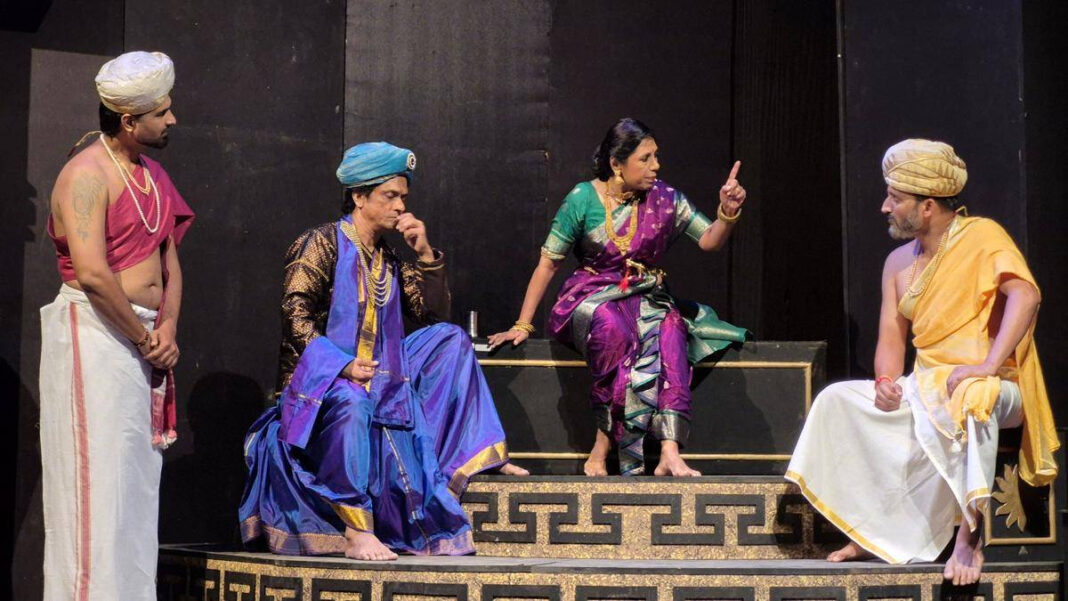
After Dinesh passed away in 2012, his wife Priita Mathur Thakur carried forward his legacy. To mark the group’s golden jubilee this October, she has launched an original play Veera Rani Abbakka: The Queen of the Seas, The Flame of Ullala. It recounts the story of the warrior queen of Ullala, a coastal principality near Mangaluru, who vows to avenge her mother’s defeat at the hands of the Portuguese. Priita has written and directed the play, besides essaying the title role herself.
“We wanted to create a play that would be in keeping with Dinesh’s vision. As a director, he worked across a variety of genres, ranging from comedies and farces to tragedies, courtroom dramas and adaptations of English plays. Although I first thought of Abbakka over a decade ago, the project has fallen perfectly into place as part of Ank’s 50-year celebrations,” says Priita.
The group’s golden jubilee celebrations actually began last year with Sita Banbas, directed by Atul Tiwari and based on Agha Hashar Kashmiri’s 1928 classic. Centred on the period following Rama’s banishment of Sita, the play follows the protagonist, portrayed by Priita, as she embarks on a journey of self-discovery and emancipation.
The portrayal of the sutradhars or bhagwats, who use Yakshagana mannerisms and costumes was one of the highlights of the play.
| Photo Credit:
Special Arrangement.
Priita’s association with Ank began in 1991. Among her early performances with the group were Adal Badal, Jaan Lijiye and Mausam Suhana, adaptations by Dinesh that allowed her to explore different facets of acting. In 1993, two productions based on Vijay Tendulkar’s works, Khamosh Adalat Jaari Hai and Anji, further established her as an actor, although both plays had earlier been staged by Ank with other performers. “Anji is one of my favourite roles. It is about a 29-year-old woman who is unable to find a husband. Eventually, I had to stop playing the part because there was a limit to how long I could convincingly portray a 29-year-old,” she says with a laugh.
After Dinesh’s passing, Priita took over the Ank leadership, and focused on participating in theatre festivals. She says, “We continued doing popular plays such as Hai Mera Dil and Jis Lahore Nahin Dekhya. Since we had discontinued Anji, I also wanted to add new productions. Before Sita Banbas, we staged plays such as Mitron Marjani, Atke Bhatke Latke Sur and Hamari Neeta Ki Shaadi. We also ventured into English theatre with William Shakespeare’s Much Ado About Nothing.”
Veera Rani Abbakka is Ank’s 88th production. The play began its Mumbai run with performances at the INT Aditya Birla Theatre and Prithvi Theatre, and is scheduled to be staged at the Experimental Theatre on October 18 and Thane’s Gadkari Rangayatan on October 24. Plans are also underway to take it to Bhopal in December for the Aadi Vidrohi festival, which celebrates historical rebels and resistance movements. “We also want to take it to Mangaluru. Some people from the region watched our Prithvi Theatre performance and expressed interest,” says Priita.
The idea for a play on Abbakka first took root about a decade ago, when Priita came across a video that mentioned the queen. She recalls, “Strangely, I found little mention of her in the historical texts I read. During the pandemic, however, I came across her story in an Amar Chitra Katha. I was fascinated by the fact that this queen single-handedly kept the Portuguese at bay and helped confine them to Goa when they sought to dominate the entire western coast.”
Priita approached Richa Sharad to write the dialogues. She says, “We based our work on accounts from various books, while also examining some conflicting reports. I conducted extensive research on the Deccan region, and learned that Abbakka’s story was often narrated through the folk theatre tradition of Yakshagana. Outside Karnataka, very few people knew about her. We pieced together the available material, carefully verifying its factual authenticity and chronological accuracy. In the process, we also discovered that the region followed a matrilineal system, and that there were three or four Abbakkas across different generations.”
Priita hopes the project will help audiences beyond Karnataka discover the legend of Veera Rani Abbakka.
| Photo Credit:
Special Arrangement.
One of the play’s highlights is its use of sutradhars or bhagwats, whose Yakshagana-inspired costumes and performance style lend authenticity to the narrative. To deepen her understanding of the queen’s world, Priita visited Mangaluru, spoke to local experts, and explored the region. “I also met Dr Tukaram, who set up a museum on Abbakka. The paintings and information preserved there helped us discover several lesser-known details about the queen, including her preference for wearing white during war,” she says.
Priita points out that her primary goal for Ank’s 50th year was to stage a new play. “Dinesh had been working on several original ideas but was unable to complete those plays. I am glad we could realise this project as a tribute to him,” she says. The production also seeks to introduce audiences beyond Karnataka to the story of Veera Rani Abbakka.
Published – October 12, 2026 07:12 pm IST