
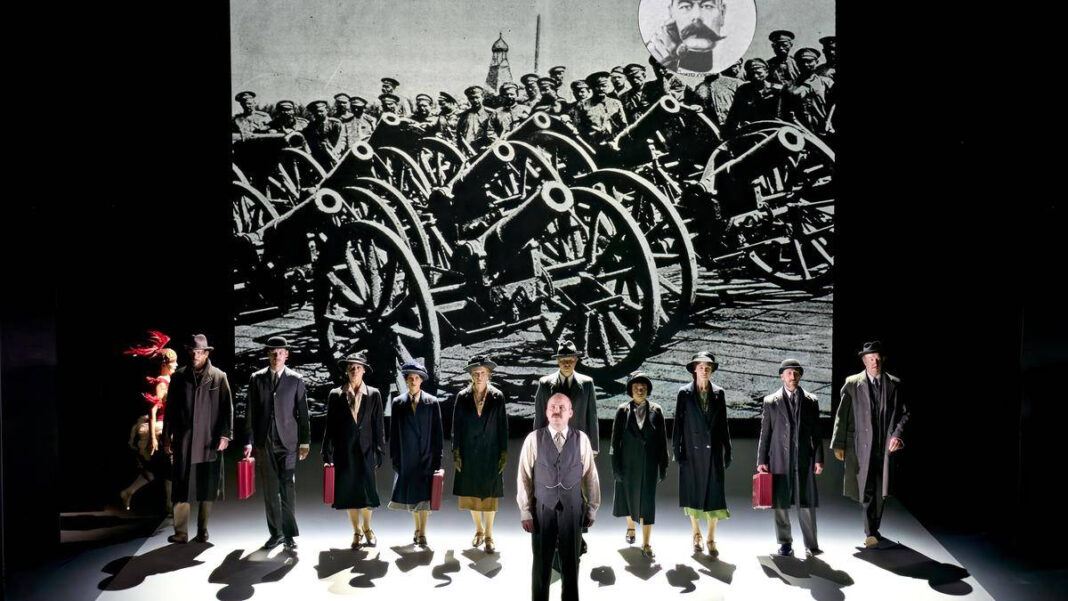

Rory Kinnear and the ensemble cast in the play –The Standard of Living
| Photo Credit: Manuel Harlan
London is a city where it is impossible not to be seduced by thousands of engaging activities — theatre, films, seminars, symposiums. I am on a short visit. But every evening some programme or the other seems irresistible. The British Film Institute had a great documentary Naza, by Yuval Abraham and Rachel Szor, that talks about the internal abhorrence to what the Israeli state has unleashed on the citizens in Gaza.
According to David Shulman, a scholar known to Indian readers, the name comes from the Hebrew acronym for the execrable term nezek agavi, meaning “collateral damage.” Mr. Shulman points to a particular tradition: “Ashkenazi Jews have an unwritten rule that one should never tell the goyim about Jewish misdeeds. There is a name in Yiddish for someone who does that: the despised moyser, informer.” It gives an idea of the high price the society has to pay to speak the truth to power, which is the kernel of the documentary.
Even before one could process the powerful documentary, London West End had the world premiere of The Standard of Living. Just over four decades in journalism made me take editorials seriously, and the edit in The Guardian said that James Graham’s latest play captures the zeitgeist while reflecting on the play that captured both sentimental and intellectual passions of John Maynard Keynes forced me — first to watch the play and second to write about it for Indian readers. The Guardian’s editorial and its long review by Arifa Akbar provided readers with the context to understand the war and the post-war years effortlessly. As Arifa Akbar points out, “John Maynard Keynes (Rory Kinnear) may not have cut a very bohemian picture in his three-piece suit but the foremost thinker of economic policy in 20th century Britain was also a card-carrying art lover, avant-gardist and bisexual who had affairs with Lytton Strachey and Duncan Grant, hanging out with the gang at their nerve-centre in Charleston. He is played with equal amounts of old-school reserve, and charm, by Kinnear, as state-of-the-nation writer, James Graham, audaciously brings economic theory to the West End.”
Rarely do we understand that economic theories from Adam Smith to Karl Marx derive their driving force from lived experience. The play opens with a fundamental question posed by Keynes: “What would good life look like to you? And can that life, a life that is enriched, and fulfilled, can it be quantified and measured: are there equations and formulae for that?”
Throughout the play dialogues capture the human spirit to restore a sense of hope and stability that were lost in the war years. It makes a point that economics is a social science for humanity rather than a knowledge for faceless entities such as markets, nation states and security apparatuses. In the play, Keynes asserts that economics is not a mere science but a moral science. He says: “containing value judgements about how we might live better together. If it is not that — then it is nothing.”
Published – November 26, 2026 08:30 am IST