
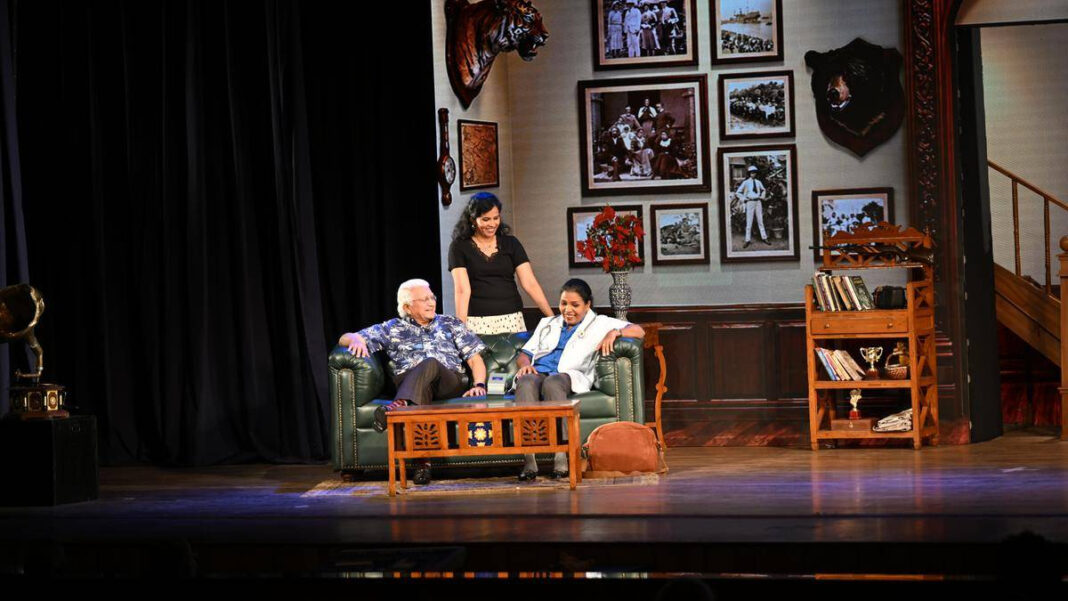

Balaji K. Moorthy won hearts with his magnetic portrayal of Ramanathan.
| Photo Credit: M. Srinath
The Madras Players’ latest offering Slaves (an English adaptation of Sujatha’s Adimaigal , translated and directed by P. C. Ramakrishna), recently premiered at Narada Gana Sabha.
Ramanathan, a tea estate owner, takes his brother’s children under his wings, while he himself remains unmarried. An autocrat in every sense, Ramanathan’s orders are carried out by his nephews — Sundaram, Saminathan and Sekar.
Saminathan unquestioningly falls in line with everything that Ramanathan says, because he hopes to inherit a share in the latter’s wealth. Sekar does protest, but the lure of money is too strong for him to sever ties with his uncle. Sundaram is a hyper-competent slave, who, along with Saminathan and the latter’s wife Savitri, keeps the household running like a well-oiled machine. He wants nothing more than the predictability of a quotidian existence, mundane as it may be. His trust in his uncle remains unassailable until he reads his wife Gomathi’s diary and realises that her end was brought on by the stirring of her conscience. She had done the unthinkable. While Sundaram was busy doing his uncle’s bidding, Gomathi, who was intellectually miles ahead of her husband, was having an affair with the uncle.
Sundaram and Saminathan take contrasting approaches to serving their uncle.
| Photo Credit:
M. Srinath
This revelation was handled sensitively by Sujatha. However, a lot could have gone wrong in a translation or in execution on the stage. That it did not is to the credit of P.C. Ramakrishna. There is an even more surprising twist in the tale, which reminds you that the love of money is the root of all evil.
At the end of the play, a new patriarch is in charge, leveraging his authority in much the same way that Ramanathan did, with the rest of the family continuing to be slaves. The play makes us question — who is more despicable in this sordid story — Ramanathan, Saminathan, Sekar or Savitri, who knew of Gomathi’s affair with the uncle but chose to wink at it?
The sterling performance by Madras Players did justice to Sujatha’s play. Balaji K. Moorthy’s performance as Ramanathan was magnetic, drawing every eye whenever he stepped on to the stage. S. Ram as Sundaram captured the complex emotional arc of the character beautifully. Anuradha Ramesh showed through voice modulation and facial expressions, Savitri’s resentment against the imposed docility. But Rithi Murari’s constant swaying movements looked contrived. Wasn’t there a better way to portray a bubbly character? A few characters were fleshed out for this production, but nothing felt overdone in this superbly directed play.
Published – October 26, 2026 04:35 pm IST