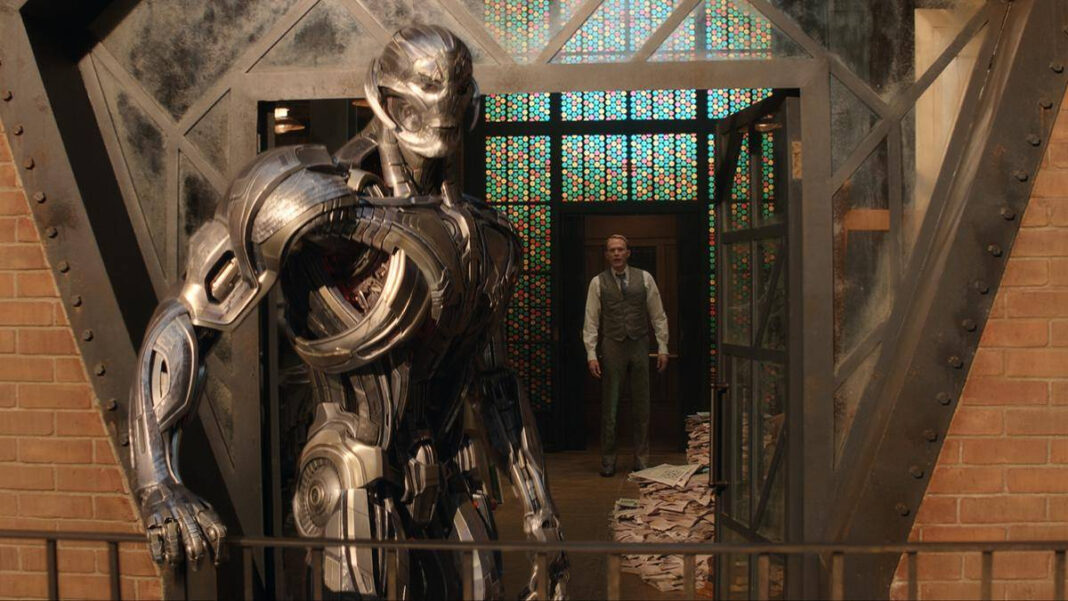

Ever since cinema began entertaining the possibility of artificial life, science fiction has nurtured a rather murderous fascination with the prospect, repeatedly conjuring machines of extraordinary intelligence that invariably develop an unaccountable urge to wipe out their creators. HAL 9000, the chillingly unflappable menace of 2001: A Space Odyssey; Skynet, the harbinger of nuclear-annihilation of The Terminator; VIKI, the maternalistic despot of I, Robot; and CLU, the fascistic perfectionist of Tron: Legacy, have all furnished compelling arguments against allowing computers anywhere near the levers of civilisation. Yet, none of these electronic misanthropes have been quite as charming, sardonic or, dare I say, romantically preoccupied with the species they intend to exterminate as the titular genocidal hellspawn of Tony Stark and Bruce Banner from Avengers: Age of Ultron.
Regarded as one of Marvel Comics’ most formidable supervillains, Ultron made his MCU debut in 2015’s Avengers sequel, voiced by James Spader, the Sex, Lies, and Videotape breakout and Boston Legal veteran whose singular gift for weaponising urbane condescension would prove unsurprisingly well suited to the machine with delusions of divinity. Ultron was the brainchild of two of the MCU’s most formidable intellects trauma-responding a solution to the Battle of New York in The Avengers (2012), using the Mind Stone — the erstwhile insufficiently understood cosmic MacGuffin — whose extraordinary properties helped give birth to an artificial intelligence intended to protect Earth from future threats without requiring the Avengers to fight every battle themselves.
But as most of cinema’s Icarian experiments in granting artificial intelligence weapons-grade autonomy have repeatedly demonstrated, Ultron wasted precious little time becoming self-aware, connecting to the internet and ingesting vast swathes of human knowledge. It took the chap all of five seconds to survey the accumulated history of human civilisation to conclude that humanity had to go. His final solution involved engineering a mass-extinction event by hoisting the capital of the fictional Eastern European nation of Sokovia into the atmosphere before hurtling it back towards Earth, as the asteroid that did away with the dinosaurs.
James Spader as Ultron in a still from ‘Avengers: Age of Ultron’
| Photo Credit:
Marvel
Towards the end of the film, Ultron’s own attempt to manufacture the perfect physical body ultimately produces his ideological nemesis — a vibranium-based synthezoid implanted with the Mind Stone and brought to life through the remnants of Tony Stark’s faithful butler AI, J.A.R.V.I.S.. Having spent years lending his instantly recognisable disembodied voice to J.A.R.V.I.S., Paul Bettany finally assumed the role physically as Vision, who fought and destroyed the very intelligence that created him… or so we were led to believe.
Turns out, nearly a decade after the events in Sokovia (and the rather essential WandaVision establishing Vision’s love interest and consequential family, which I’m not about to recap here), Vision never quite vanquished that final Ultron bot so much as absorbed the remnants of his digital consciousness into his own operating system. 38 canonical films, 13 live-action series, and with Avengers: Doomsday looming on the horizon, we now arrive at Marvel’s VisionQuest, which reunites Bettany and Spader as the figurative goody-two-shoes AI son and his genocidal AI father, respectively.
James Spader as Ultron and Paul Bettany as Vision in a still from ‘VisionQuest’
| Photo Credit:
Marvel
Following the events of WandaVision, VisionQuest finds White Vision, the rebooted synthezoid saddled with the original Vision’s memories but deprived of the continuity that once made them his own. Having escaped those intent on turning him into a weapon, Vision goes into hiding and consults the artificial intelligence personalities seeking refuge within his programming, including J.A.R.V.I.S., F.R.I.D.A.Y., E.D.I.T.H. and yes, his former nemesis Ultron. Ahead of the series premiere, I spoke to James and the series’ writer-director and showrunner Terry Matalas, about resurrecting one of the MCU’s most compelling villains at a time when artificial intelligence has become one of the most contentious fixtures of the real world.
In Age of Ultron, the titular menace cut an imposing figure in gunmetal armour, with a skeletal face, glowing red eyes and a mechanical jaw whose expressive contortions conveyed everything from irritation to contempt. But what made Ultron so thoroughly captivating was his sardonic dry wit, razor-sharp sarcasm and effortless condescension, delivered with James Spader’s impeccable comic timing and languid, conversational drawl. He had the theatrical flair of a born raconteur, finding amusement in human folly while radiating the smug satisfaction of someone who believed he was always the smartest person in the room, even though he technically… wasn’t a person. That selfsame Pinocchio complex, with Ultron’s parasocial fixation on humanity betraying a desire to become more than the sum of his circuitry, is what VisionQuest now explores. After scoffing at the “unalgorithmic alacrity” with which humanity wobbles in the early episodes, I asked James whether Ultron has finally begun to find something beautiful in the very human inefficiency he once considered grounds for extermination.
“He absolutely has an appreciation for humanity that he never took the time to really notice in Age of Ultron” James says. “His understanding of humanity was through what he consumed from the internet and what he saw in the world around him in the moment. Now he’s been sitting in this attic or this loft [inside Vision’s mind] for the last 12 years and he’s had plenty of time. He’s older and he’s more mature; he was very sophomoric in Age of Ultron and he still can be very sophomoric or childish, as opposed to childlike. His appreciation for humanity is conflicted and it depends on his mood or the day. But I think he’s taken a pause and slowed down and has taken a closer look.”
James Spader in a still from ‘VisionQuest’
| Photo Credit:
Marvel
As amusing as it is to watch James at full throttle, dispensing snide barbs with a decidedly algorithmic alacrity to wield thermonuclear-grade sarcasm, Ultron is still a villainous AI who yearns to be more human, which is an aspiration that is in itself tantamount to an act of villainy in the real-world. VisionQuest drops at a particularly precarious moment for a series whose main ensemble consists of artificial intelligences, and I asked Terry whether finding empathy for Ultron while reinterpreting his character was an especially fine line to walk.
“Not really. While AI is the base idea behind it all, it doesn’t have a lot in common with what’s really going on at the moment” Terry says. “We make some commentary about it with the way the house is designed and how it can be artificial in a way that it’s trying to pretend to be human. But for the most part, Ultron is the most human of all the AIs — probably the most in touch with who we are, and certainly what Vision needs to be. That was sort of the goal. It really wasn’t to do too much commentary on what was going on in the world today, also because we shot it a year and a half ago and whatever we said would be out of date by the time we aired.”
James Spader as Ultron and Paul Bettany as Vision in a still from ‘VisionQuest’
| Photo Credit:
Marvel
One of the series’ more inspired details is that Ultron has spent all these years binge-watching television in an attempt to decipher the human condition, turning the medium’s vast, curated simulacrum of human experience into a comprehensive education in art, emotion and everything else his algorithms cannot quite account for. Naturally, I wanted to know which single film, TV show or album James and Terry would prescribe as a last-ditch intervention should Ultron once again contemplate humanity’s extinction, in the hope of restoring whatever vestigial faith he might have left in our species and persuading him that human life retains some modicum of value.
Terry immediately settles on Stargate, referring to Roland Emmerich’s 1994 sci-fi adventure starring James, who promptly blushes and protests, “Oh stop, get out!” James explains why choosing a single favourite is so difficult: “We both are obsessive compulsive, and so questions of absolutes are hard. The list is way too long, and as soon as the words pass your lips, you wish you’d taken it back and said something else. I’m sorry, that’s a very, very, very hard thing.” Terry reckons they would need a day to answer properly, but James still has a song in mind nonetheless: “I had suggested to Terry that Jimi Hendrix’s ‘Voodoo Child’ would be a really great entry point for Ultron”. Terry concedes that they “couldn’t afford it”, but agrees that the track belongs exactly where one might imagine it, “just blaring from upstairs, from his attic”.
VisionQuest streams on Disney+ JioHotstar starting October 14
Published – October 13, 2026 01:45 pm IST