
Draped in a silk saree, with jasmine flowers adorning her hair, she walks with a quiet elegance. Wearing a large red bindi, the neatly pinned pallu sits snugly on her slightly stooped shoulder as if choreographed by years of discipline. Her kohl-lined eyes crinkle with every smile, revealing a flash of white teeth behind a sweep of bright red lipstick. This is none other than the legendary Manipuri dancer Darshana Jhaveri, who has spent a lifetime preserving and teaching the classical dance form. At ‘Satata Trimsat’, a festival recently organised by Mahagami Gurukul to mark its 30th anniversary, Darshana — adviser, mentor and a longstanding presence in the gurukul’s artistic journey — spoke about her passion to pursue the dance form. The students listened intently to her insights on dance and its traditions.
Darshana trained in dance alongside her sisters.
| Photo Credit:
Special Arrangement
The youngest of the four Jhaveri sisters, Darshana began learning Manipuri from Guru Bipin Singh and has played a pivotal role in popularising the dance on the modern stage.
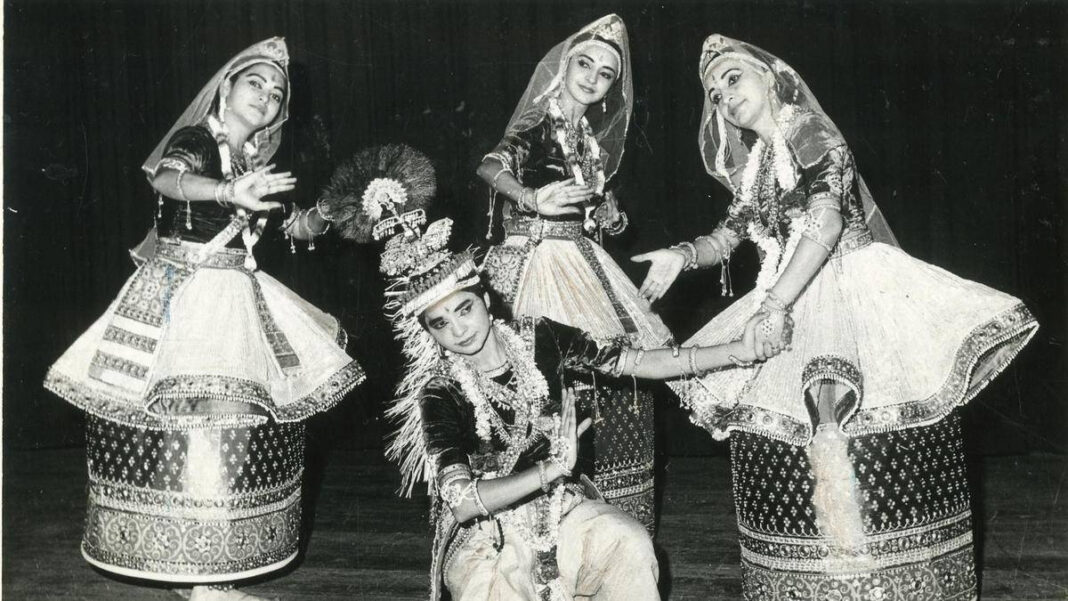
“Seventy years of my life,” is how Darshana describes her journey in dance. “My elder sisters — Naina and Ranjana — began training under Guruji in Bombay in 1943. I would watch them dance and was gradually drawn to it. When he was directing the Manipuri portions of a dance drama based on K.M. Munshi’s Jai Somnath, Naina was cast as Chauladevi. I too trained under him and was later cast in dance dramas, including ‘Amrapali’, ‘Mirabai’ and ‘Narsinhyo’,” says Darshana who has been performing since 1958.
Guru Bipin Singh believed in the philosophy of ‘learn, collect and preserve’.
| Photo Credit:
Special Arrangement
But how did a young girl, born in a Gujarati family, even take to Manipuri dance? “The credit goes to my artistically inclined father, who encouraged us to pursue our dreams. Our home functioned as a gurukul and a gathering place for eminent artistes such as Rukmini Devi Arundale and Pt. Omkarnath Thakur,” recalls the dancer.
Guru Bipin Singh taught them at home, while Darshana went on to study the sastras and Vaishnavite music traditions. “Our day would begin at 7 a.m. and go on till 6 p.m., learning music, dance and theory. Apart from the hours I spent at college, most of my time was devoted to creative pursuits. Looking back, I believe I grew up surrounded by the arts,” she says.
At the centre of Darshana’s journey was her guru, whom she remembers as “a visionary, driven by a thirst for knowledge. At 18, he joined Madame Menaka’s ballet in Khandala, where Kathakali, Bharatanatyam, Kathak and Manipuri were taught. Later, he travelled to Manipur, learning from traditional gurus and participating in Ras and Sankirtan in temples, where these art forms were also traditionally performed. Ras Leela and Sankirtan were the two classical forms in which we, the Jhaveri sisters, specialised in,” she says, adding that guru Bipin Singh began documenting these oral traditions with them.
“The process eventually grew into a collection of 150 hours of material covering Pung Ragas, Sancharas, Prabandhas and talas. To me, this reflected guruji’s far-sightedness. He believed in the philosophy of learn, collect and preserve.”
Jhaveri sisters at the Festival of India.
| Photo Credit:
The Hindu Archives
In 1972, Darshana co-founded Manipuri Nartanalaya with guruji and senior Manipuri artiste Kalavati Devi, establishing centres in Mumbai, Kolkata and Imphal — institutions that became vital to the dissemination of Manipuri dance beyond its traditional spaces. Alongside performing, Darshana has devoted herself to teaching, mentoring and choreography.
While her work in archiving dance works and research materials continues, she still conducts workshops across varied dance centres.
Her father’s influence too, she says, shaped her perception about education. Darshana is concerned about how the present education system leaves students with little time to pursue any discipline in depth, as they are expected to move from one subject or activity to another constantly. “Unless you immerse yourself completely in an art form, it becomes difficult to achieve a certain proficiency. Classical dance demands years of training, discipline and practice.”
For Darshana, dance has never been just about performance; it is also an act of preservation, discipline and devotion.
Published – October 29, 2026 05:06 pm IST