 "
/>
"
/>

Armenian Music Finds a Resonant Home in Chennai
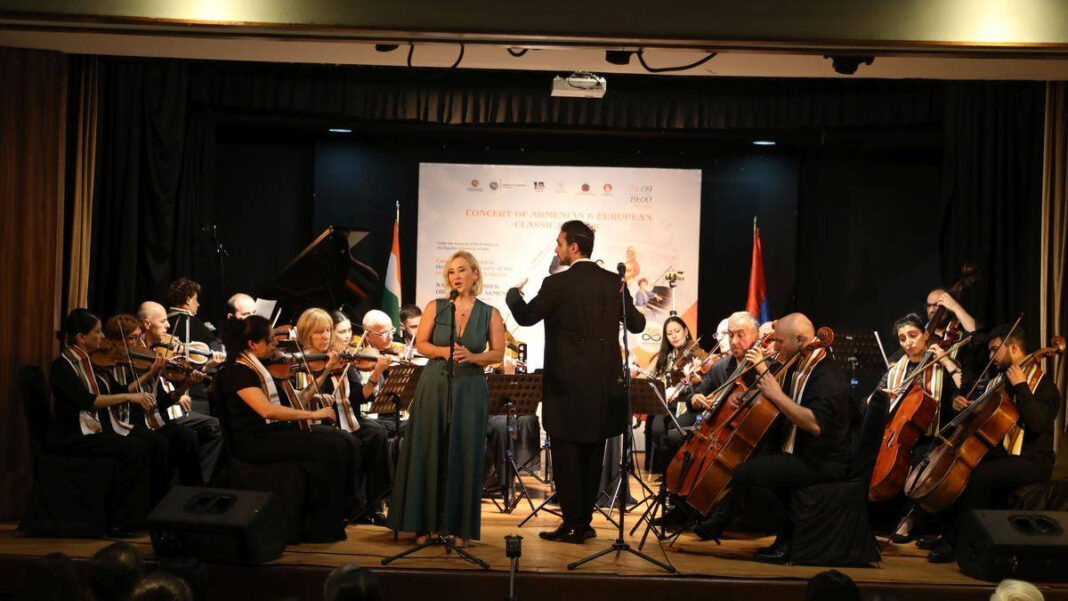
Music has an extraordinary ability to transcend borders and cultures, a sentiment powerfully showcased at the Armenian and European classical concert held by the National Chamber Orchestra of Armenia on September 24 at the prestigious Music Academy in Chennai. This event was part of the celebrations commemorating the 35th anniversary of Armenia’s independence and served as a beautiful reminder of music’s universal language.
Overview of the Event
Hosted by Shivkumar Eashwaran, the Honorary Consul General of the Republic of Armenia, the concert featured a 21-member ensemble guided by the insights of conductor and artistic director Sipan Olah. The musical evening boasted an impressive lineup, including talented soloists such as violinist Astghik Vardanyan, pianist Katarine Hovsepyan, and soprano Shoghig Torossian. Together, they transported the audience through a diverse program that ranged from Armenian classical compositions to folk-inspired pieces, ballet excerpts, and European compositions.
Exploring Armenian Musical Heritage
The essence of Armenian music embodies a rich tapestry woven with history, spirituality, and cultural resilience. Reflecting its profound traditions, which span the austere beauty of monophonic folk song to the complex layers of sacred and concert music, the orchestra’s program included 13 distinct pieces that provided insights into this vibrant landscape.
A pivotal figure in the establishment and preservation of Armenian musical identity is Komitas Vardapet. His meticulous documentation of folk traditions bridged the gap between the vibrant musical life of Armenian villages and the concert stage. During the concert, his piece Al Ailughs shone a light on the folk roots that continue to influence Armenian art music.
A Unique Intersection with Indian Music
Perhaps the most fascinating moment of cultural convergence occurred during the performance of ‘Nocturne’ by Arno Babajanian. Conductor Olah noted Babajanian’s visit to India in 1976, igniting the intriguing possibility of cross-cultural influences. The melodic contours of this piece bore striking similarities to the song ‘Tu mera jaanu’ from the 1983 Hindi film Hero, composed by Laxmikant-Pyarelal. Whether this resemblance is a coincidence or a reflection of shared musical traditions remains an open question, but the connection left a palpable impression on the audience.
Katarine Hovsepyan’s piano opened the piece, creating an enchanting nocturnal atmosphere, soon complemented by the orchestra’s strings. The overall effect of the performance was less of a straightforward depiction of night and more an evocative exploration of its stillness—music that lingered beautifully in the air.
Technical Mastery and Cohesion
Conductor Olah demonstrated exceptional sensitivity to the intricate relationship between individual sections and the overarching structure of the music. Each member of the ensemble displayed remarkable attention to unified bowing, intonation, phrasing, vibrato, and articulation. These elements coalesced to produce a rich and cohesive orchestral sound rather than mere technical feats.
In the piece ‘Blossomed Cherry Tree’ by Khachatur Avetisian, the interplay of piano, varied instrumental voices, and pizzicato passages crafted a nuanced sonic tapestry. The Italian romantic song ‘Parlami d’amore, Mariù’ shifted the focus to soprano Shoghig Torossian, who masterfully shaped the melodic line amidst the luxuriant string accompaniment. Her gradual ascent to higher registers was executed with delicate control, ensuring her voice harmoniously complemented the ensemble rather than overpowering it.
The diverse repertoire also included Charles Aznavour’s ‘She’, a piece expressive in its emotional intimacy. Olah took the lead on vocals, delivering a controlled yet personal rendering enhanced by the strings, encapsulating the essence of the song while inviting the audience into a shared emotional experience.
In a contrasting finale, Aram Khachaturian’s ‘Sabre Dance’ turbocharged the atmosphere with its dynamic rhythmic energy and rapid exchanges between instrumental sections. The precision with which the chamber ensemble navigated this iconic composition showcased both their technical prowess and artistic unity.
Closing the Evening with Harmony
The concert culminated with ‘Our Beloved Yerevan’, another work by Babajanian, where the harmony between Torossian and Olah created a stirring finale. By this juncture, the boundaries between the performers and the audience had beautifully blurred, with Olah inviting listeners to join in the celebration. The audience’s enthusiastic applause transformed into a shared conclusion, highlighting a collective embrace of Armenian musical identity.
Significance of the Performance
Having earlier performed in Kolkata and New Delhi, the National Chamber Orchestra of Armenia’s concert in Chennai provided a valuable opportunity for the city to engage with a repertoire that remains relatively uncharted in its concert culture. More significantly, the evening served as a testament to how musical traditions, while separated by vast distances, can still find commonality through melody, rhythm, tonal color, and—most importantly—emotional resonance.
For Chennai, a city deeply entrenched in a tradition of vibrant concerts, encounters like this hold immense value, underscoring the potential for more sustained platforms for international chamber music. Such collaborations allow audiences to discover artistic traditions that extend well beyond familiar locales and showcase the universality of music itself.