
By The Sampadak Express
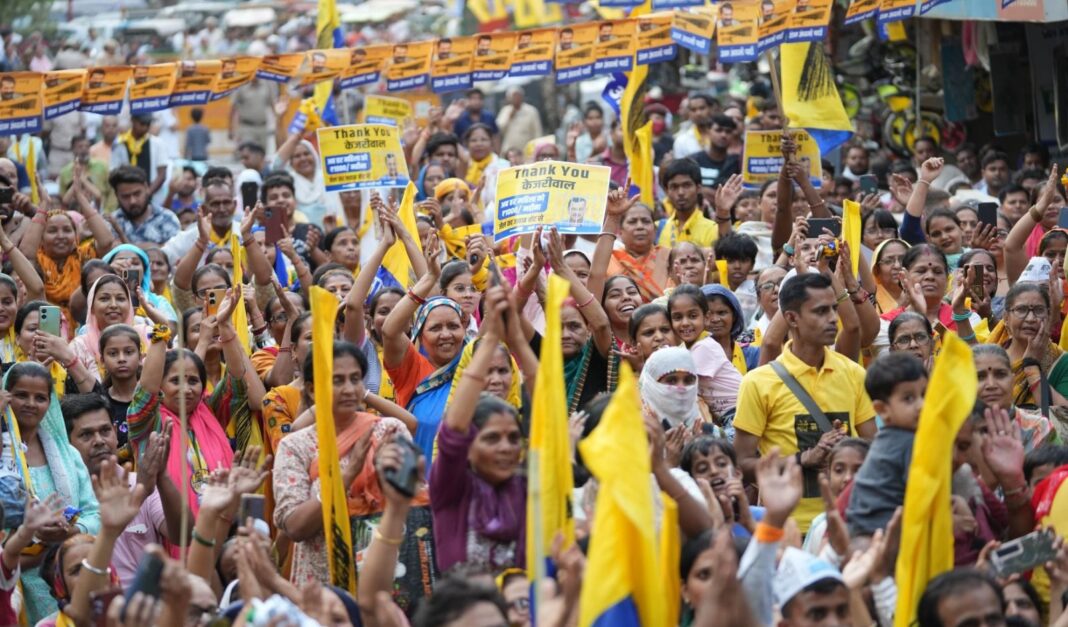
In a significant shift in voter demographics, women in Delhi surpassed men in voter turnout during the 2025 Delhi Assembly elections. This year, female participation not only matched but in many cases exceeded that of male voters, indicating a powerful trend in electoral behavior. With women now accounting for 45% of the electorate—approximately 71 lakh voters—their influence has become undeniable. This surge in female voter engagement is reshaping political strategies and could prove pivotal in future elections.
Key Trends: Female Voter Surge and Increased Turnout
The data reveals that women voted at a rate of 60.92%, surpassing men’s turnout of 60.21%. A closer look at constituency-level data provided by the Election Commission shows that more than half of Delhi’s 70 constituencies saw an increase in female voter participation compared to their male counterparts. Forty-one constituencies (over 50%) recorded higher female turnout, indicating a clear and growing shift toward greater female political engagement.
Constituencies Where Women Voted More Than MenIn several areas across Delhi, women outvoted men by notable margins. Some of the key constituencies where women led in turnout include:
Okhla: 5.73 percentage points higher
Burari: 1.78 percentage points higher
Adarsh Nagar: 1.69 percentage points higher
Timarpur: 0.64 percentage point higher
This pattern mirrors a national trend observed in states like Bihar, Madhya Pradesh, and West Bengal, where female voters have increasingly outnumbered their male counterparts at polling stations in recent elections.
However, there were exceptions. For instance, Matia Mahal recorded the largest gap, with a 5.08 percentage point lower turnout for women compared to men. Despite this, the overall trend shows a growing shift toward more active female participation in the electoral process.
Comparison with 2020 Elections: Rise and Fall in Female Turnout
Female voter turnout in Delhi has seen notable changes compared to the 2020 Assembly elections. While some constituencies witnessed an increase in female participation, others saw a drop. For instance, Badli saw a slight uptick of 0.40 percentage points in female turnout. On the other hand, constituencies like Narela, Timarpur, and Adarsh Nagar saw a decline in female turnout by two to four percentage points.
These fluctuations may be tied to a variety of factors, including local party campaigns, women-centric initiatives, and demographic shifts. Political parties’ approaches to women’s issues, particularly their election promises and welfare schemes, seem to be influencing voter behavior, making women a critical demographic to watch in future campaigns.
The Growing Political Influence of Women Voters
Women voters now represent a major force in Delhi’s electorate. With their increasing participation, politicians are adapting their strategies to cater to this influential group. For instance, the Aam Aadmi Party (AAP)’s free travel scheme for women, introduced in 2020, was credited with helping the party secure re-election. Similarly, in Punjab, the AAP’s initiative to provide Rs 1,000 per month for women voters was a decisive factor in the party’s landslide victory in 2022, where they secured a 79% majority.
Other parties have also recognized the power of female voters and tailored their campaigns accordingly. The Bharatiya Janata Party (BJP), for instance, has rolled out welfare programs for women in states like Madhya Pradesh, Odisha, and Maharashtra, with cash transfers and other financial support aimed at attracting female voters. Meanwhile, the Congress launched its own financial aid program for women in Karnataka.
This shift is indicative of a broader trend: women are no longer passive voters. Their increasing participation and engagement in the political process suggest that they are now becoming decisive in determining election outcomes.
What This Means for the Future
The growing involvement of women voters in Delhi’s political landscape is poised to be a game changer in upcoming elections. The trends seen in 2025 could reshape political campaigns in Delhi and beyond. Politicians are now acutely aware that women represent a substantial voting bloc that cannot be ignored.
The question now is whether the AAP’s strategy, which has resonated strongly with female voters, will continue to retain their support in future elections. Additionally, will the welfare programs introduced by the BJP and other political parties in other states have a similar influence in Delhi, or will they falter against the backdrop of AAP’s initiatives?
As female voter turnout continues to rise, the question of whether women voters will become the decisive factor in future elections remains a critical one. With their increasing influence, women could very well determine the outcome of the 2025 Delhi Assembly elections and beyond.
The trends in the 2025 Delhi elections signal that women voters are not just influencing political outcomes—they are defining them. The future of elections in Delhi, and potentially across India, will depend heavily on how political parties address and engage with this increasingly powerful and decisive demographic.