
Tiruppur Kumaran: A sacrifice that defied the British Raj
On a tense January morning in 1932, as the British Raj unleashed a fresh wave of repression against the Indian freedom movement, a young weaver from Tiruppur stood his ground. With the tricolour clenched in his hand, N. Kumarasami—revered thereafter as Tiruppur Kumaran—refused to let the national flag touch the ground even as police lathis rained down on him. His death during a peaceful protest turned him into a symbol of unyielding resistance, a martyr remembered across Tamil Nadu and beyond as “Kodi Kaatha Kumaran” (Kumaran who protected the flag).
A nation under crackdown
The year 1932 opened under forbidding clouds for the Congress and satyagrahis. In Britain, a “national” government under Prime Minister Ramsay MacDonald—backed by Conservatives led by Stanley Baldwin and supported by Liberals—tightened control over colonial policy after a landslide general election. In India, Lord Willingdon had replaced Lord Irwin as Viceroy. Unlike Irwin, who had signed the Gandhi–Irwin Pact with a conciliatory posture, Willingdon’s administration rolled back concessions and escalated repression across provinces such as Bengal and the United Provinces (now Uttar Pradesh). Rule by ordinance was in force. As historian Tara Chand recorded in History of Freedom Movement in India (Volume 4), the government “was committing harrowing barbarities and ruthless repression,” promulgating 15 ordinances in rapid succession. A “Civil Martial Law” had been imposed.
Mahatma Gandhi returned to Mumbai on December 28, 1931, after attending the Second Round Table Conference in London. Two days before his arrival, Jawaharlal Nehru had been arrested. On January 1, 1932, Gandhi informed Viceroy Willingdon that the Congress would resume the Civil Disobedience Movement. The response was immediate and severe: the Congress was declared illegal, Gandhi was arrested on January 4, and Rajendra Prasad the following day. “By January 10, leading Congressmen all over India were behind bars,” wrote D.G. Tendulkar in Mahatma (Volume 3).
A weaver who chose the struggle
It was against this charged backdrop that Tiruppur witnessed a fatal police assault on protesters on January 10, 1932. Among the demonstrators was N. Kumarasami, later known as Tiruppur Kumaran, part of a local satyagraha aligned with the Congress call to boycott foreign cloth and liquor. His story, detailed in a Tamil biography by B.S. Sundaram—a freedom fighter who led the agitation that day—speaks of a young man of modest means and resolute conviction.
Kumaran was born on October 4 in Chennimalai (now in Erode district) to a weaving family of the Senguntha Mudaliar community. He studied up to the fifth standard before taking up the family’s traditional occupation. In 1923, at age 19, he married 14-year-old Ramayee. He later migrated to Tiruppur and worked for six years as a clerk in a cotton ginning mill. The biography notes that he wore only khadi after arriving in Tiruppur and was eager to join the 1930 Vedaranyam Salt March led by C. Rajagopalachari (Rajaji). Persuaded by his parents and employer to desist, he nevertheless deepened his involvement in the freedom movement.
Kumaran became a member of the Tiruppur Desabandhu Youth Association and took part in various protests. Friends and relatives reportedly taunted him for his growing political commitment, but he remained undeterred, even after the death of his father, Natchimuthu Mudaliar, in 1931. On the day of the fatal protest, according to Sundaram, only Kumaran’s mother, Karupayee Ammal, was in Tiruppur; his wife was in Kumarapalayam. “Had she been there, she would have attempted to prevent Kumaran from going ahead with his decision,” the biographer observed.
January 10, 1932: The fatal march
The procession in Tiruppur, like many such demonstrations that day, was organised to reinforce the Congress-led boycott and civil disobedience campaign. But its course was harsher than anticipated. The original leader slated to spearhead the protest reportedly withdrew on the morning of January 10. Around 5 a.m., a migrant couple from Gujarat—enthusiastic supporters of the movement—were detained by the police and taken before the sub-collector in Pollachi. Leadership of the group fell to B.S. Sundaram. There were nine satyagrahis.
Kumaran volunteered to march at the front. The demonstrators moved through the town—then a much smaller Tiruppur than today—receiving moral support from local women who greeted them with arati at several points. As the procession reached the police station on the main road, Sundaram later recounted, about 30 police personnel and two officers launched an unannounced charge.
What followed was, in Sundaram’s words, a “rain of lathis.” Positioned at the head of the line, Kumaran absorbed the fiercest blows. The part of his skull above the left ear was fractured, and the assault continued on the same spot. Even as he fell, he kept the national tricolour clutched tightly in his right hand, refusing to let it drop.
Another protester, R. Raman Nair, also suffered a lethal blow. Sundaram noted that it was at Nair’s suggestion that he had agreed to lead the agitation; Nair had previously participated in the Civil Disobedience Movement and had served a prison term. After the two lay motionless on the road, policemen trampled on them with their boots.
A postmortem was conducted the following day. Official records put the date of Kumaran’s death as January 11, 1932. His funeral was carried out with minimal public visibility: the authorities permitted only two people to carry the body and barred a public procession.
Reactions and repercussions
The brutal suppression of peaceful demonstrators shocked the town. Tamil scholar M.P. Sivagnanam—known as Ma.Po.SI—wrote in Viduthalipporil Tamizhagam (Volume Two) that the circle inspector, Mohammed, who led the attack, was moved out of Tiruppur. “This was not a punishment to him. But it was protection to him from the people of Tiruppur who trembled with rage,” he observed.
In the immediate aftermath, Congress committees across Coimbatore, Tiruppur and other parts of the then Madras Presidency began commemorations to honour Kumaran’s sacrifice. His birth anniversaries came to be observed as “Volunteers’ Day,” and his death anniversaries as “Kumaran Day.”
Honours, memorials and a living legacy
Public remembrance soon took concrete form. In January 1948, Cutchery Road—the site where Kumaran was assaulted—was renamed in his memory, and the local body resolved to install his statue, according to a report in The Hindu dated February 5, 1948.
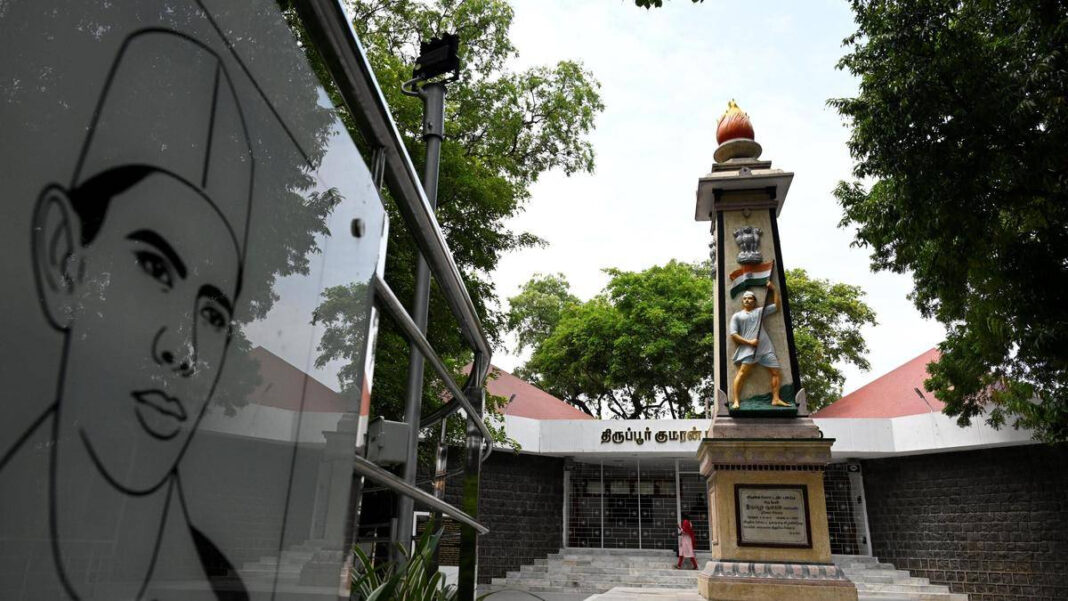
On August 18, 1957, then Chief Minister K. Kamaraj unveiled a memorial pillar near the Tiruppur railway station. As reported on August 20, the “stately column,” erected at a cost of Rs 8,000, rose 25 feet with a torch at the top and depicted a volunteer holding the Congress flag. It formed part of the centenary observances of the freedom struggle and was attended by Finance Minister C. Subramaniam, Sundaram, and Kumaran’s nephew, Lakshmanan.
The recognition of families of martyrs also continued. In January 1965, during the centenary celebrations of Lala Lajpat Rai at Rajaji Hall in Chennai, the wives of Kumaran and of Vanchinathan—who had assassinated the Tirunelveli Collector Robert William D’Escourt Ashe in June 1911—were honoured. Each was to receive a gold-plated silver medal and a white khadi silk saree. Vanchinathan’s wife, Ponnambal, received the award in person; Kumaran’s wife, Ramayee, could not attend, and her sister-in-law accepted it on her behalf.
In October 1979, at a conference of freedom fighters at Tamukkam grounds in Madurai, then Chief Minister M.G. Ramachandran announced financial assistance for Ramayee: a grant of Rs 10,000 and a monthly ex gratia payment of Rs 300 to Rs 500. In April 1991, the State government established a memorial in Tiruppur featuring photographs and exhibits dedicated to Kumaran and other freedom fighters of the district.
Ramayee passed away in April 1998; her mausoleum stands within the memorial complex. On the occasion of Kumaran’s birth centenary in October 2004, the Department of Posts issued a commemorative stamp in his honour. In October 2025, a foundation stone was laid in Chennimalai for a new Kumaran memorial, to be built at a cost of Rs 2.5 crore.
Why Kumaran endures
The power of Kumaran’s legacy lies less in grand speeches and more in a searing image: a young man, a worker of simple means, clinging to a flag as the state bore down upon him. In a year when top Congress leaders were jailed, civil liberties curbed by ordinance, and peaceful protest branded as subversion, his refusal to let the tricolour fall distilled the ethos of satyagraha into a solitary act of courage.
Conclusion
Ninety-five years after that bleak January day, Tiruppur Kumaran’s story remains etched in public memory—through pillars and plaques, stamps and ceremonies, and the continued observance of his birth and death anniversaries. Above all, it endures as an emblem of ordinary people’s extraordinary resolve in the long march to India’s freedom.