
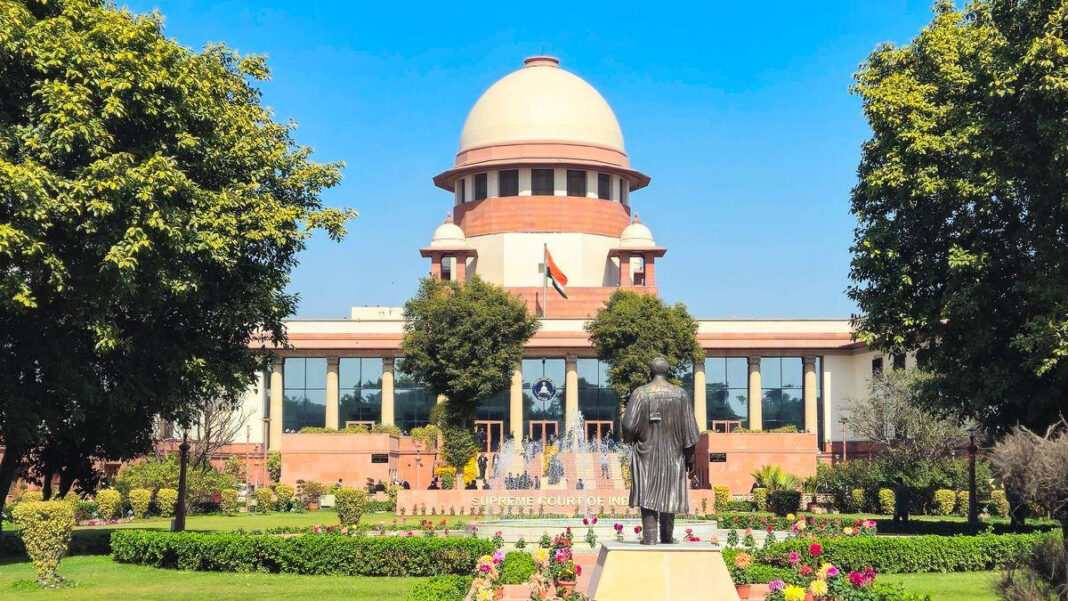

Supreme Court of India. File
| Photo Credit: Getty Images/iStockphoto
Underlining the need to strengthen the existing regulatory regime to curb unethical pharmaceutical marketing practices and ensure access to “ethical and affordable healthcare”, the Supreme Court on Thursday (October 8, 2026) directed the Union government to constitute an expert committee within two weeks. The committee has been asked to consult stakeholders and domain experts and submit its recommendations to the Centre within two months of its first meeting.
Also Read: ‘Broad daylight dacoity’, says Supreme Court on overpricing of essential cancer drugs
“The committee so constituted shall undertake a holistic and comprehensive examination of all issues relating to unethical pharmaceutical marketing practices, including the adequacy of the existing statutory and regulatory framework, the efficacy of the mechanisms presently in place for monitoring, oversight and enforcement, and the measures required to ensure greater transparency, accountability and effective compliance, with a view to strengthening the regulatory framework and safeguarding the larger public interest,” a Bench of Justices Vikram Nath and Sandeep Mehta directed.
The committee’s mandate brings into focus the long-pending issue of whether pharmaceutical marketing practices should be brought under a statutory regime instead of continuing with the existing voluntary framework. The Centre has itself acknowledged difficulties in using existing drug and essential commodities laws to give such regulations statutory backing.
The Bench also directed the Union government to take a “reasoned decision” on the committee’s recommendations and file a compliance affidavit within two weeks of the committee completing its exercise. It posted the matter for further hearing on January 29, 2027, to assess compliance with its directions.
The top court issued the directions while hearing petitions filed by the Federation of Medical and Sales Representatives’ Associations of India (FMRAI) and others, contending that expensive gifts, foreign trips, other freebies and aggressive marketing practices were being used to influence doctors to prescribe particular medicines. Such practices, they said, could have serious public health consequences, including adverse drug reactions and antimicrobial resistance.
‘Wellbeing of citizens’
The order, authored by Justice Mehta, also noted that the material on record indicated that the existing framework had not been entirely effective in curbing unethical practices in the pharmaceutical sector.
“The concerns brought to our notice are of considerable significance. In a sector which has a direct bearing upon the health and wellbeing of citizens, the efficacy of the regulatory framework cannot be assessed merely by the existence of prescribed norms; it must also be judged by their efficacy, implementation and enforcement,” the Bench said, adding that the proposed regime must ensure that the interests of the pharmaceutical industry are “balanced” against public health considerations.
The court also took note of the Union government’s submission that while the Uniform Code for Pharmaceutical Marketing Practices (UCPMP), 2024, had been largely effective, there was a need to examine whether pharmaceutical companies should be brought within a statutory regime. Solicitor General Tushar Mehta, appearing for the Centre, had pointed out that the existing framework primarily regulated the conduct of medical practitioners, while a separate mechanism was required to proceed against pharmaceutical companies for influencing prescribing practices.
‘Institutional boundaries’
The top court also clarified that its role was not to enter the domain of policy formulation but to facilitate a “meaningful and effective consultative process” so that the concerns raised and suggestions placed before it received due consideration.
“Such an approach would preserve the institutional boundaries between the judicial and executive domains while ensuring that the exercise undertaken by the competent authorities is comprehensive, informed and capable of translating into an effective regulatory framework in the larger public interest,” the Bench said.
It therefore asked the expert committee to undertake the consultative exercise and return with concrete recommendations for strengthening the existing regulatory regime.
The Centre had, in September 2022, constituted a high-level committee headed by Dr. V.K. Paul, former Member (Health), NITI Aayog, to examine international practices and the need for a legally enforceable regulatory mechanism. The panel had concluded that the UCPMP need not immediately be given statutory force and instead recommended strengthening the existing framework through safeguards such as independent scrutiny, better monitoring of complaints and greater disclosure requirements.
Published – October 08, 2026 01:04 pm IST