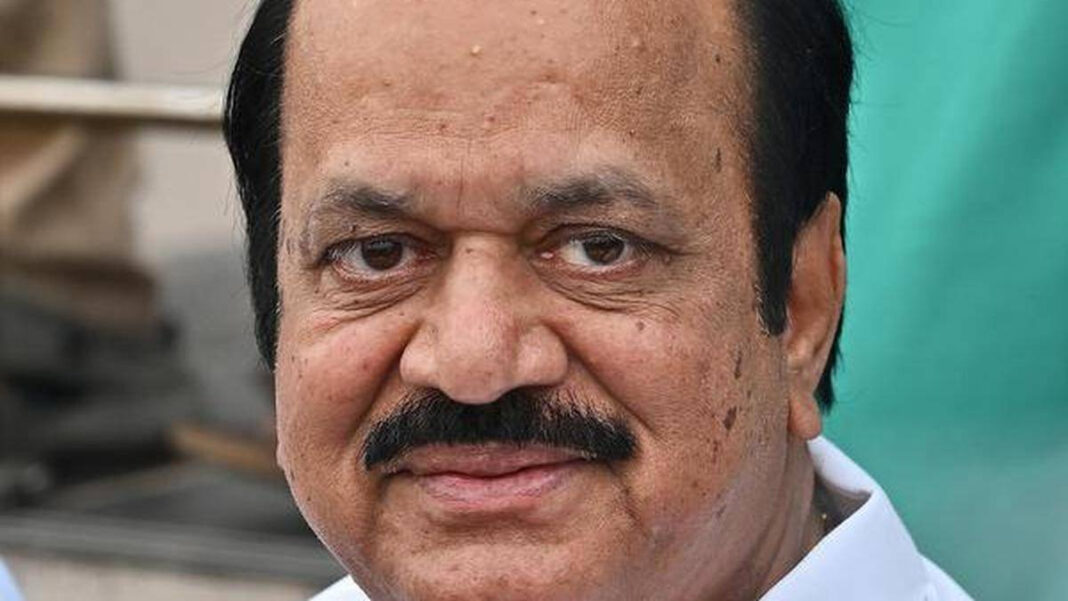

Tamil Nadu Legislative Assembly Speaker J.C.D. Prabhakar. File
| Photo Credit: B. Velankanni Raj
The Madras High Court on Tuesday (October 13, 2026) upheld the decision of Tamil Nadu Assembly Speaker J.C.D. Prabhakar to accept the resignation of six AIADMK MLAs, who later joined the ruling TVK, between May 26, 2026 and June 29, 2026. But it directed him to decide within two months the disqualification proceedings pending against four of them.
The First Division Bench of Chief Justice Sushrut Arvind Dharmadhikari and Justice G. Arul Murugan said the Speaker was duty-bound to rise above his individual predilections and respect the robe which the Constitution had gifted to him. “The Speaker is expected to respect the sensitive constitutional trust by acting on the said disqualification proceedings with utmost expedition,” it added.
The judges expressed surprise over the disqualification proceedings kept pending for the last four months against the four resigned MLAs — Esakki Subaya (Ambasamudram), S. Jayakumar (Perundurai), Maragatham Kumaravel (Maduranthakam) and P. Sathyabama (Dharapuram) — with the last two having been re-elected to the Assembly recently from the same constituencies.
The court directed the Speaker to prepare a timetable within seven days providing specific timelines and deadlines for various stages of the proceedings such as filing of replies by the defecting MLAs, receiving the complainant’s objections to those replies, finalisation of pleadings, and hearing the final arguments. Such a timetable must be made public for the benefit of all stakeholders, it ordered.
The Bench also directed the Speaker not to allow any of the defecting MLAs to unnecessarily delay the proceedings by seeking adjournments on flimsy grounds. In any case, not more than two adjournments should be given to the defecting MLAs since the proceedings were pending at the stage of issuance of notices to them for the last four months, the Bench reiterated.
“Needless to emphasize that the timeline of two months as fixed by this Court is sacrosanct and is required to be followed rigidly by the Speaker by rising above all the political ideologies and differences as the constitutional repository of the trust and faith reposed in him,” the Bench said. It made clear that any interested person could move the court if the timeline was not followed scrupulously.
Authoring the verdict, the Chief Justice relied upon a few Supreme Court verdicts to hold that the High Court could fix such a timeline for the Speaker to dispose of the disqualification proceedings. The court passed the orders while partly allowing a batch of writ petitions filed by AIADMK whip Agri S.S. Krishnamurthy and the Desiya Makkal Sakthi Katchi challenging the Speaker’s decision to accept the resignation of the six MLAs.
The disqualification proceedings had been initiated against them on AIADMK general secretary Edappadi K. Palaniswami’s complaint that 25 of his party MLAs had violated the whip to vote against a confidence motion moved by Chief Minister C. Joseph Vijay on May 13, 2026. However, on May 27, 2026, he had given a letter to the Speaker condoning the act of 14 out of the 25 MLAs.
Highlighting that the names of C. Vijayabaskar (Viralimalai) and M.R. Vijayabhaskar (Karur) found a place in the list of 14 MLAs whose act had been condoned by Mr. Palaniswami and since no request had been made thereafter to revive the disqualification proceedings against those two MLAs who too resigned subsequently, the Division Bench dismissed Mr. Krishnamurthy’s writ petitions with respect to them alone.
The Bench concluded that the handwritten resignations submitted by the six MLAs in person to the Speaker were genuine and voluntary and the latter was not required to undertake a roving or detailed inquiry into the alleged motives behind those resignations. “Accordingly, their acceptance and the consequential declaration of vacancies are constitutionally valid,” the judges said.
Further, holding that resignations and disqualification proceedings were two distinct constitutional processes, the court said that therefore, the Speaker was competent to accept the resignations notwithstanding the pending disqualification proceedings. It refused to concur with the argument that the acceptance of resignations would render the pending disqualification proceedings academic or infructuous.
Published – October 13, 2026 12:22 pm IST