

Census 2027: The pressures of counting India
Every morning for nearly a month, M. Soumina, a government-school teacher, climbed the stairwells of 17 apartment blocks in East Delhi’s Mayur Vihar, knocking on 150 doors under a baking sun. Her school was shut for summer break, but as a newly appointed Census enumerator she had a different routine: mapping and geotagging homes on a mobile app, and administering a 33-question survey—often with her husband by her side for safety.
Her experience, and those of thousands of others, speaks to the strain of India’s once-in-a-decade population count. The ongoing exercise, which will ultimately span close to a year and rely on roughly 33 lakh government teachers and other enumerators, aims to survey an estimated 1.4 billion residents on housing, amenities, and demographics. Even with a fully digital backbone designed for real-time monitoring, field workers say blistering heat, safety worries, network gaps and supervisory directives are complicating the effort.
A digital-first census on a delayed clock
The current phase, known as Houselisting and Housing Operations (HLO), is the first leg of the Population Census 2027. The questionnaire was notified by the Office of the Registrar General and Census Commissioner of India on January 22. This Census marks several firsts: it is India’s first fully digital Census, the first to collect caste data, and the first to allow residents to self-enumerate. Originally slated for 2021 but postponed due to the COVID-19 pandemic, the count is taking place six years behind schedule, with governments still dependent on 2011 data for planning and welfare programmes.
The HLO phase collects information on housing conditions, household composition, basic amenities, and assets. It records the structure of dwellings, access to water, sanitation and energy, ownership of consumer goods, the number of people in a household, and residents’ mobile numbers for official communication. The second phase—Population Enumeration—has been scheduled for February 2027, when detailed individual-level data, including caste and religion, will be captured. In Ladakh and the snow-bound regions of Uttarakhand, Jammu and Kashmir, and Himachal Pradesh, both phases must be completed by September 30, 2026, due to weather constraints.
Enumerators receive an honorarium of ₹25,000 for completing their assignment. According to officials, 23 States and Union Territories have finished the HLO phase so far.
On the doorstep: heat, access and safety
For Soumina, fieldwork began each day on May 19 and stretched across 26 days of temperatures hovering between 40°C and 42°C. “I had an app on my phone to record the data. Before asking the questions, the households also have to be mapped and geotagged on the app,” she said. Her essentials included a smartphone, a black bag, a QR-enabled identity card and a white cap with the Census logo. Her husband, who works in a newspaper’s production unit, accompanied her throughout. “I felt safer with him around,” she said.
Access was its own hurdle. With many residents at work during the day, Soumina made early-morning rounds. “Most residents leave for work around 8.30 in the morning. So I visited homes between 7 and 7.30 with my husband. While some were accommodative, others asked us to come again later or skip the exercise altogether.” Locked homes meant repeated visits, often in the evenings.
Female enumerators, many of them government school teachers, described similar safety concerns. Meenu Verma, a primary school teacher from Rae Bareli, Uttar Pradesh, said her husband and brother-in-law joined her on rounds. “I was assigned 172 houses. My husband and I used to wake up at 4 in the morning and reach the assigned village by 7. From 7 to about 11, we would find people in their homes, but after noon, due to the heat, the entire village would be deserted,” she said. “Many of them had no awareness about the Census, so we had to first explain it to them. I want to request the government to appoint enumerators in pairs. Or a male colleague should accompany a female enumerator. Not everyone is polite. And in villages, houses are spread afar.”
There have been flashpoints. On May 21, Delhi Police registered an FIR against a man accused of harassing a female enumerator while she was on duty; on June 13, a Delhi court convicted the accused, identified as 43-year-old Sandeep Panwar. On April 25 in Bengaluru, a female enumerator was allegedly denied entry into an apartment complex and abused, prompting another FIR.
Resistance was not limited to individual confrontations. In Haryana and Delhi, enumerators—mostly government school teachers—reported hostility from residents of high-rises and found themselves turned away by some resident welfare associations (RWAs). The Gurugram district administration wrote to RWAs citing Section 8(2) of the Census Act, 1948, reminding residents they are “legally bound” to answer Census questions to the best of their knowledge or belief.
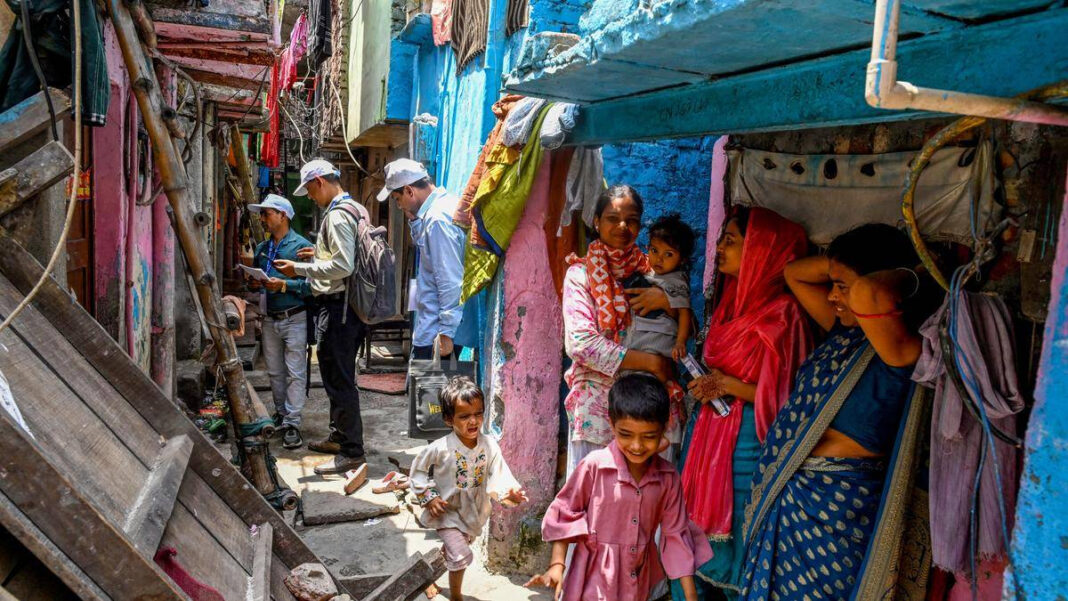
“Fetching data from slum clusters was easier than seeking information from multi-storey apartments,” said Dinesh Kumar Dwivedi, a Hindi lecturer supervising six enumerators and a field veteran from the 2011 Census. In slums, he said, there was initial hesitation amid fears of demolition, which eased once the purpose was explained. Some residents hoped participation might help them qualify for welfare schemes; others came with documents asking for assistance in applying. Compared to 2011’s paper-heavy process—where forms could be lost or damaged—digitisation has streamlined data capture, though not without its own challenges.
The digital divide and a struggling app
Connectivity gaps have forced improvisation. Enumerators in metros and large towns, where mobile networks are stronger, often enter responses directly into the Census app. In other areas, many recorded details on paper or in notebooks and uploaded data after returning home. An enumerator from Uttar Pradesh said: “Connectivity is a huge issue, especially in rural areas. Once an enumerator has logged in, it is difficult to make changes, and if the network is poor, the data can get corrupted.”
National sample data underline the gap. The Comprehensive Modular Survey: Telecom from the 80th round of the National Sample Survey (January–March 2025) reported that 83.3% of rural households and 91.6% of urban households had access to the internet. The survey covered 34,950 households and 1.42 lakh individuals, classifying a person as an internet user if they had gone online at least once in the past three months.
Enumerators, using their own smartphones, have been instructed not to delete Census applications during enumeration. But they report frequent app crashes. On the Google Play Store, the Census 2027 Houselist App has more than 10 lakh downloads and a 2.9 rating. The app—which only authorised users can access—has drawn 4,570 reviews, including 2,054 one-star and 1,735 five-star ratings.
Staffing crunch, court orders and FIRs
In Noida’s Sector-6, charge officer Indu Prakash Singh set up a camp office at the Indira Gandhi Cultural Centre to oversee operations. In a large hall, officials with technical expertise monitored progress on computer screens arranged in a semicircle. Singh’s responsibilities included the smooth survey of 2,309 house-listing blocks (HLBs), each covering 150–180 households and a population of 800–1,000. In Uttar Pradesh, the HLO phase ran from May 22 to June 20.
While Census work is typically handled by government employees, a shortage of government school teachers in U.P. prompted the enrolment of private-school teachers. “The district administration in Noida issued directions to engage teachers from private schools for Census work,” Singh said. Some of those teachers moved the Allahabad High Court, which ruled in their favour. “Fifty percent of the 1,000 teachers who were trained backed out at the last moment. We were forced to engage NGOs and other private people for the task,” a government official in Noida said.
In Maharashtra, more than 500 private unaided and minority schools approached the Bombay High Court in May, challenging notices, appointment orders, and coercive steps such as FIRs against teaching and non-teaching staff for failing to report for Census duty. On May 22, the court granted interim protection and observed that Section 4A of the Census Act applies only to “local authorities” and that, prima facie, the Census Act and the Census Rules, 1990, do not impose a statutory obligation on private unaided schools to provide staff as enumerators or supervisors.
Simultaneously, there have been FIRs against government-appointed enumerators who did not take up their assignments. At least two FIRs were filed in Haryana against 10 enumerators, and one case each in Noida and Greater Noida was registered on June 3 against more than 80 enumerators. Notably, National Crime Records Bureau reports for 2010 and 2011—the years when the last Census phases were carried out—do not list any cases registered under the Census Act.
Real-time oversight and disputed edits
Digitisation has enabled real-time monitoring through the Census Management and Monitoring System (CMMS) portal. Data entered in the field are visible to enumerators, supervisors and charge officers. Several enumerators say this visibility has translated into pressure to “correct” entries—particularly for questions on sanitation, electricity and fuel use.
A Delhi school teacher said that during training, enumerators were asked not to select the “No” option for “access to latrine,” a category that denotes households with no latrine and implies open defecation. An enumerator from Rajasthan said that after reporting households which said they defecate in the open, supervisors asked for revisits and revisions to show latrine access if any public toilet existed nearby.
Similar pressures were reported on water and cooking fuel. An enumerator from Uttar Pradesh said that when “tap water from untreated source” was recorded as the main drinking water source, supervisors and charge officers instructed them to switch the response to “tap water from treated source.” Under the Union government’s Jal Jeevan Mission, nearly 81.97% of households in India are reported to have tap water connections.
On fuel use, an enumerator from Rajasthan said entries showing reliance on firewood, charcoal or dung were sometimes changed to LPG, even when families had not refilled their cylinders for months and were primarily cooking with solid fuels. According to the Press Information Bureau, national LPG coverage rose from 55.9% in April 2014 to 107.2% in April 2026, with consumers increasing from 14.51 crore to 33.39 crore over the same period.
On June 2, the Director of Census Operations, Rajasthan, wrote to district functionaries noting “discrepancies” in field data and directing charge officers to verify block-level entries through the CMMS portal “in accordance with the actual field situation.”
Back in the lanes: multiple visits, incremental trust
On a June morning in Noida’s Sector-2, government employee Manish Kumar edged past an open drain into a three-storey building where many migrant workers rent rooms. Several doors were locked; a woman in the courtyard washed bedsheets in two tubs of water; a man bathed outside a one-room home that, he said, housed seven family members. Kumar knocked on every door, explaining the exercise, noting details, and then stepping outside to upload the information on his phone.
He planned to return in the evening and on weekends to reach those he had missed. “A household must be labelled vacant or locked only after multiple visits,” he said.
Why this count matters
India’s first fully digital Census is attempting to bridge technology and terrain, policy and lived reality. The HLO phase will determine the frame for the 2027 Population Enumeration, and the accuracy of responses—on everything from sanitation and water to fuel and household composition—will shape programmes and budgets for years. For the enumerators navigating heat, locked doors, patchy networks and wary residents, the task is as much about patience and safety as it is about pressing “submit.”