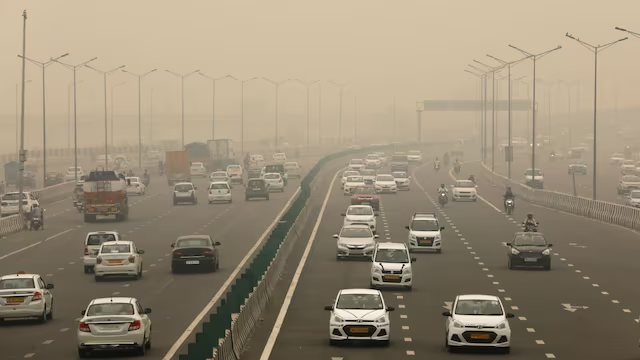

In a significant development, the Commission for Air Quality Management (CAQM) on Sunday, January 12, 2025, announced the revocation of Stage-3 Graded Response Action Plan (GRAP) restrictions in Delhi and the National Capital Region (NCR). This decision follows an improvement in air quality due to favorable weather conditions, including light rainfall triggered by a Western Disturbance.
The Stage-3 restrictions, which had been re-imposed on Thursday, included a ban on non-essential construction and demolition activities, as well as restrictions on the use of BS III petrol and BS IV diesel four-wheel vehicles. The measures, part of a broader set of emergency actions to curb pollution, were lifted after the city’s air quality index (AQI) dropped to 278 at 4 pm on Sunday. This figure is significantly lower than the 350 AQI threshold that necessitates Stage-3 curbs.
The CAQM attributed the improvement in air quality to the Western Disturbance, which brought light rains to the region on January 11-12. The rainfall helped reduce pollution levels, leading to a decrease in the AQI. The Commission noted that while Stage-3 measures were revoked, Stage-I and Stage-II restrictions remain in place.
As per the Graded Response Action Plan, Stage-1 applies when AQI levels are between 201 and 300 (Poor), and Stage-2 applies when AQI ranges from 301 to 400 (Very Poor). Stage-3 is triggered when AQI levels reach 401-450 (Severe), and Stage-4 applies when AQI surpasses 450 (Severe Plus).
Under the Stage-3 restrictions, measures such as the banning of non-essential construction work, a shift to hybrid classes for students up to grade V, and restrictions on the use of BS-III petrol and BS-IV diesel cars were enforced.
The CAQM’s decision comes as the AQI dipped below the 350-mark, but authorities have warned that air quality can fluctuate with future weather conditions. Another Western Disturbance is expected to affect the region around January 14-15, potentially influencing air quality levels once again.
The measures under the GRAP, which is implemented during the winter months when pollution levels tend to spike, aim to address the hazardous air quality caused by a combination of vehicle emissions, stubble burning, firecrackers, and unfavorable meteorological conditions.