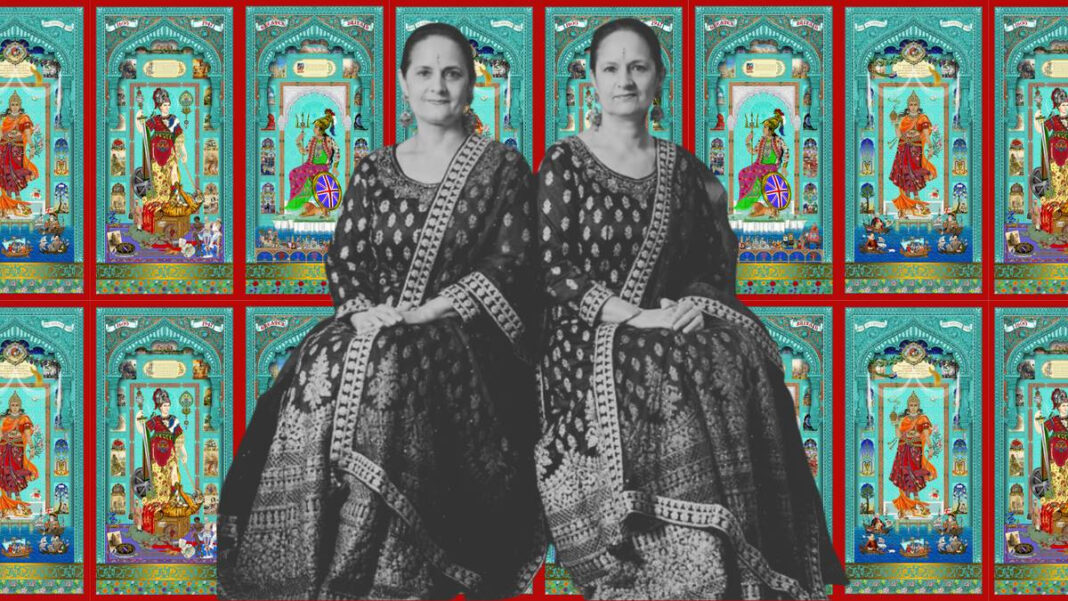

The first thing you always notice about The Singh Twins, Amrit Kaur Singh and Rabindra Kaur Singh, is the riot of colours in their works, which draw on the collage style of Jahangiri muraqqas (albums). The second is the British miniature artists’ uniform of identical salwar suits.
As you step closer to their art, the deep research behind their works reveal themselves. They use the miniature style not simply as an inherited artistic tradition, but as a means of historical inquiry: layering research, symbolism, personal memory and political critique to question how the histories of the British empire are constructed and remembered. And all of it is done with a blend of wit, mischief and seriousness.
“I first saw The Singh Twins’ work in Delhi in 2005 and was really intrigued by it,” says Sunaina Anand, director of Art Alive. The twins’ work is part of the group exhibition, A Moment in the Monumental, celebrating the gallery’s 25th anniversary. “I planned a trip to Liverpool [a couple of years later to meet them] in their family home. It was a heartwarming experience, interacting with them and engaging with their art. As contemporary British artists, their artistic practice is very powerful — looking at colonialism and Indian heritage through their distinct visual lens.”
Sunaina Anand, director of Art Alive
Miniatures in turquoise
At their latest showcase, their digital mixed media works feature their signature jewel-toned detailing and rigorous historical research. In Golden Bird: Envy of the West, for instance, the central ‘goddess’ is an allegorical figure with a jewelled crown and a tiger at her feet, representing pre-colonial India. She is surrounded by smaller vignettes ranging from Portuguese explorer Vasco da Gama to royalty, denoting a country with the world at her feet before the British arrived.
Golden Bird: Envy of the West
Imperialism: By the Yardstick and Sword, with its warrior-like central figure — the tiger now in chains, a ruler stuck down its throat — highlights the impoverishment of India under western colonial expansion, especially the British. The third artwork, Brit-Asia: Making Our Mark, explores postcolonial identity and the contributions of the diaspora. Earlier this year in April, larger versions of the three works (and others) were exhibited at Kew Gardens in the U.K. as the show Botanical Tales and Seeds of Empire.
Imperialism: By the Yardstick and Sword
At a time when South Asians are grappling with their personal relationships with partition, division and imperialism, the sisters’ work forces you to return to the macro-view that a South Asian living in the U.K. is grappling with. And by extension, the divide between the Global North and South at a time when we believe that the two are coming closer.
Deeply political
The sisters, born in 1966 in Richmond, Surrey, have always credited their work together, as The Singh Twins. While some critics initially dismissed their style as decorative folk art or commercial kitsch, the art world now widely recognises it as a deliberate, intellectual strategy.
The Singh Twins, Amrit Kaur Singh and Rabindra Kaur Singh
| Photo Credit:
Courtesy Art Alive
It was a trip to India in the 1980s that introduced them to Mughal miniature painting. They were drawn to the rich narrative and symbolic character of the style, and wanted it to have a place in contemporary art. The duo call it Post Modern, combining Eastern and Western aesthetics: the ultra-detailed, flat perspectives of traditional Indian miniature painting layered with pop culture icons, historical figures, and political symbols.
They use “pretty” surfaces to lure viewers in before confronting them with harsh realities, such as the transatlantic slave trade, colonial exploitation, institutional racism, globalisation, migration. Their pieces require thousands of hours of meticulous, single-hair brushwork, seamlessly fused with cutting-edge digital collage and large-scale lightbox installations. Their deeply political and sharply satirical works are now part of private and public collections, and even taught in art curricula.
Brit-Asia: Making Our Mark
But perhaps the most interesting detail is also one of the most personal. How memory plays a key role in how they challenge stereotypes and redefine Eurocentric perceptions of art. In one of the paintings being shown in Delhi, a crocodile devours a charkha. It is a private tribute to the sisters’ first meeting with Anand. Taken from their 2019 work J’allianwala: Repression and Retribution, the image represents British colonialism consuming India’s economic independence and indigenous heritage. Anand, a founding trustee of the Partition Museum in the capital, has her own long engagement with the histories of colonialism and division.
It is a small detail in a stupendously layered body of work, but one that reminds us that history is made up of encounters and relationships. Perhaps that is what makes The Singh Twins’ work so compelling. They ask us to consider what happens when identities refuse to remain within the neat boundaries drawn by history, geography and politics.
The writer is an expert on South Asian art and culture.
Published – November 13, 2026 10:54 pm IST