
Jinson Abraham’s photography exhibition Kollavarsham 1202: Munnē: Ippōzh: Ini, currently on at the College of Fine Arts (CFA), Thiruvananthapuram, defines time or kalam, as a goddess. An extension of his earlier work on Kollavarsham calendars, this show focuses on the interrelation of body and fabric, and how the latter was used as an identifier and, in some instances, turned into a constraint.
The exhibition is divided into two parts: Udal or The Body and Archives of Uprising.
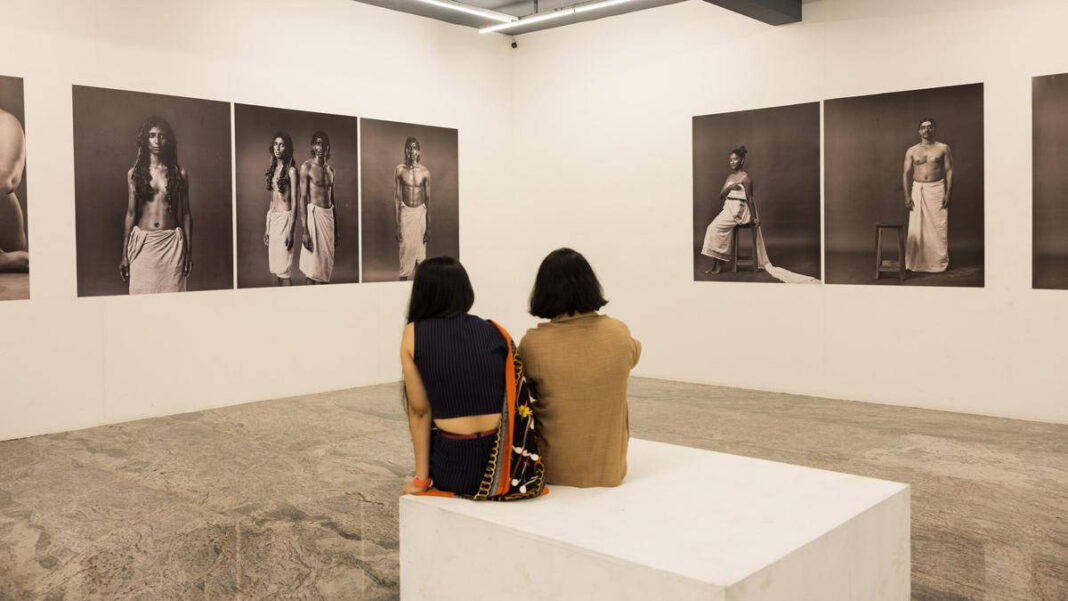
In Udal, Jinson transforms the body into a living archive for the marginalised, who were denied space in much of Kerala’s history, carrying traces of “dispossession, labour, caste, and resistance”. These people, who were “denied landownership, caste privilege and basic human dignity”, are absent from history books, the photographer notes. This set of 15 sepia-tinted monochrome pictures, shot on a Sinar F2 camera, recreates that historical presence and human values, placing the subjects as “bearers of agency, memory and dignity”.
Jinson begins this series with a set of nude photographs to establish the idea that the body was itself in Nature for years. “Nobody thought about covering the body for years. However, they may have been forced to do so, to protect themselves from the wind, rain, cold or animals. The body can exist without a cloth. People would have depended on it to protect them, but then the clothes would have been the same for men and women.” Says Jinson.
Jinson Abraham
| Photo Credit:
SPECIAL ARRANGEMENT
The following portraits show how fabric becomes an identifier in the Keralam context, deciding who deserved rights and who would be oppressed. In one portrait, a woman clad in kasavu doesn’t have the right to wear the fabric she wove, but the photograph reclaims her agency by dressing her up in that attire.
Furthermore, Jinson shows how people were allowed to wear a single piece of cloth that was fashioned to cover their bodies. A pair of photographs explores the moustache tax, or meeshakaram, and breast tax in 17th-century Keralam, posing questions about gender inequality. “While men paid taxes for moustaches, women didn’t have to. But here’s the interesting question. Men could eliminate the tax by shaving their moustache off, but what do you do about breasts?” asks Jinson.
Visitors near the photographs from the Udal series
| Photo Credit:
Jinson Abrabam
The exhibition further showcases how women ultimately took control of their own bodies, deciding how they want to cover themselves. A photograph of a man wearing a kurta represented social reformers like Sreenarayana Guru, BR Ambedkar and Ayyankali, who rejected notions of how members of their caste should dress.
The last few pictures in this series also trace how fashion, especially women’s fashion, was subjected to an animal gaze, followed by a colonial gaze and ultimately the male gaze. “It was at this juncture, where we see people attributing violence against women to the length of their clothes, holding it responsible for crimes against them,” says Jinson. The series ultimately ends with a couple’s portrait, with a message on how men are taught about women’s empowerment, without understanding how to coexist with them, says the photographer.
Archivals of uprising
The Archivals of Uprising section features photographs, representing the goddess of time, Kalam, and the 12 months of the year. The Kollam Era calendars, or Malayalam calendars, use Malayalam numbers and feature the portraits next to them. The first month in the Kollam Era calendar is Chingam and the last is Karkkadakam.
“It has 13 components, with 12 rashi chakras and one sun,” says Jinson. The photos of the Kollavarsham 1202 calendar explores the evolution of women’s clothing. The portraits are shot on 4 x 5 square inch sheet films and are developed by photographer Alekh Ajay Ghosh. The photos show how women fashioned a single piece of fabric into their attire, with draping depending on weather, livelihood and other factors. The latter photographs also trace the evolution of a blouse, showing how it came to its present form.
Goddess Kalam as envisioned by the photographer in the calendar cover
| Photo Credit:
JINSON ABRAHAM
The 13 portraits are also arranged into a single image resembling Leonardo da Vinci’s The Last Supper, with Kalam at the centre and each subject related to the central character. The characters wear handmade fabric clothes designed by Dinu Elizabeth Roy. One of the portraits also showcase a woman, clad in just a necklace made of rocks, presented as a predecessor to the other female subjects.
Jinson, who has drawn inspiration from the style of works by photographer Keerthana Kunnath and the Bengali Nayika painting traditions, says, “I wanted to produce something that celebrates the past, identifying what we have missed. The problem with these portraits is that we don’t have actual images from that era. My whole team is going to time travel to learn something and bring it to the calendars. “
Asked about the Kollavarsham 1203 calendar, Jinson says, “We do have some ideas in mind and at the moment we have a structure to work with as well. When we began thinking about this year, we thought about the idea of blouses, and we ended up thinking about clothes this way. If I live 30 more years, there will be 30 last suppers, narrating Keralam’s history, reviving things that were not documented well.”
Kollavarsham 1202: Munnē: Ippōzh: Ini is on till November 10 at College of Fine Arts, Thiruvananthapuram. Time: 10am to 7pm
Published – November 05, 2026 04:59 pm IST